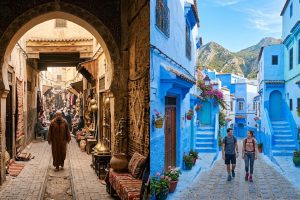
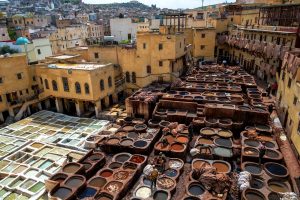
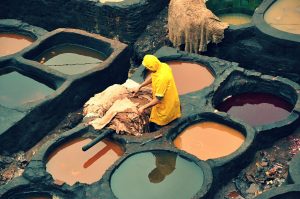
There is a moment on the road from Fes to Chefchaouen where Morocco changes completely. Behind you: the golden dust, the medina labyrinth, the thousand-year-old leather tanneries of Fes el-Bali. Ahead: the Rif Mountains, rising green and dramatic from the plain, hiding inside them a small city painted entirely blue. The transition takes about three and a half hours by car. It is one of the most satisfying journeys in North Africa.
The Fes to Chefchaouen route is one of the most popular connections in northern Morocco — and also one of the most misunderstood. Travelers frequently underestimate the journey time, confuse bus schedules, or miss the extraordinary things worth stopping for along the way. After 15+ years of guiding private tours through northern Morocco, we have learned exactly what makes this journey work beautifully and what makes it frustrating.
This guide covers everything: distances, transport options with real prices, the best stops along the route, what to expect when you arrive in Chefchaouen, and how to combine this journey with a broader northern Morocco itinerary.
⚡ Fes to Chefchaouen — Key Facts
- Distance: 199 km (124 miles) by road
- Driving time: 3 hours 15–30 minutes (direct, no stops)
- CTM bus time: 4 hours 40 minutes
- Bus price (CTM): $12–17 USD (one way)
- Private car transfer: $80–150 USD (whole car, not per person)
- Shared taxi (grand taxi): ~$15–20 USD per person
- No direct train: There is no train service between Fes and Chefchaouen
- Best departure time: Morning (7–9am) to arrive with full afternoon in Chefchaouen
- Day trip possible? Yes — but staying overnight is strongly recommended
Fes to Chefchaouen Distance & Route Overview
The road distance between Fes and Chefchaouen is 199 kilometres (124 miles). The route heads northwest from Fes, passing through Ouazzane before climbing into the Rif Mountains to reach Chefchaouen. There is no motorway for the full distance — the road alternates between comfortable dual carriageway and winding mountain roads through the Rif, which is both the main reason the journey takes longer than the distance suggests and the main reason the scenery is extraordinary.
The route passes through some genuinely spectacular Moroccan landscape — the flat, fertile agricultural plains north of Fes give way to the olive-covered foothills, which then rise steeply into the cedar and pine forests of the Rif. The final approach to Chefchaouen, winding up through the mountain with the city’s characteristic blue buildings visible against the green hillside, is one of the most striking arrivals of any journey in Morocco.
🗺️ The Route at a Glance
Fes → (N4 highway northwest) → Meknès direction junction → Ouazzane (possible coffee stop, 1h 45min from Fes) → Rif Mountain climb begins → Chefchaouen
Total drive: approximately 3 hours 15–30 minutes without stops. With a stop in Ouazzane or for photos at a mountain viewpoint: 4–4.5 hours.
How to Get from Fes to Chefchaouen: All Transport Options Compared
Option 1: CTM Bus (Budget-Friendly)
The CTM bus is the most popular option for budget travelers and backpackers. CTM (Compagnie de Transports au Maroc) is Morocco’s main national bus company — reliable, air-conditioned, and safe. The Fes to Chefchaouen service runs multiple times per day with buses departing approximately every 4 hours throughout the day.
- Price: 120–150 MAD ($12–17 USD) per person, one way
- Journey time: 4 hours 40 minutes
- Departures: From Fes CTM station, first departure around 7:00–8:00am, last around 4:30pm
- Luggage: 7kg hand luggage included; additional luggage in the hold costs a small extra fee (~5 MAD per bag)
- Comfort: Air-conditioned, reclining seats, one comfort stop en route
- Booking: Buy tickets at the CTM station in advance — do not leave this until the day of travel during peak season, as buses fill up and can be booked out for several days ahead
⚠️ Critical Warning About CTM Tickets
Travelers frequently arrive at the Fes CTM station to find buses fully booked for days ahead — particularly during spring and summer. Always buy your Fes to Chefchaouen bus tickets the moment you arrive in Fes, not the day you plan to leave. This single piece of advice prevents the most common travel disaster on this route. CTM tickets can also be booked online at ctm.ma.
Option 2: Private Car Transfer (Most Comfortable)
A private car or minivan transfer from Fes to Chefchaouen is the most comfortable and flexible option, and the one we always recommend to our tour guests. The driver picks you up directly from your riad or hotel in Fes, handles your luggage, and drops you at your accommodation in Chefchaouen — no station navigation, no schedule stress.
- Price: 800–1,500 MAD ($80–150 USD) for the whole car (not per person — split between your group)
- Journey time: 3 hours 15 minutes to 3 hours 30 minutes
- Flexibility: Stop anywhere you want along the route — viewpoints, villages, photo stops
- Group value: For 2–4 people, the per-person cost is similar to or only slightly more than the bus
- Booking: Book through your riad, a reputable tour operator, or directly with us at Days Morocco Tours
The private transfer also allows you to stop at Volubilis (the spectacular Roman ruins near Meknes, just slightly off the main route) or the sacred town of Moulay Idriss en route — turning the Fes to Chefchaouen journey into a genuinely memorable day of exploration rather than simply a transfer. See our guide to the Archaeological Site of Volubilis for why this detour is worth every minute.
Option 3: Shared Grand Taxi
The grand taxi (large shared taxi) is the most Moroccan way to travel between cities. Grand taxis are typically old Mercedes sedans that carry 6 passengers — 2 in the front, 4 in the back. They depart when full rather than on a fixed schedule.
- Price: ~150–200 MAD ($15–20 USD) per person
- Journey time: 3.5–4 hours (faster than bus, similar stops)
- Experience: Authentic, local, sociable — you will likely be the only tourist in the taxi
- Comfort: Basic — not ideal for tall passengers or those with large bags
- How to find one: Head to the grand taxi rank near the Fes bus station and ask for Chefchaouen — drivers will find you
- Tip: You can pay for 2 seats to have more space, or for all 6 seats to have the taxi entirely to yourself
Option 4: Private Guided Tour (Best Overall Experience)
For travelers who want to combine the Fes to Chefchaouen journey with a broader northern Morocco tour — taking in Meknes, Volubilis, the Rif Mountains, and possibly continuing to Tangier — a private guided tour is the most rewarding option. Our 7-day odyssey from Fes includes this journey as part of a carefully structured northern Morocco itinerary that also covers the Sahara desert, Meknes, and the imperial cities. The 11-day grand tour from Tangier covers this route in reverse, giving you Chefchaouen before Fes.
| Option | Price (per person) | Time | Best For |
|---|---|---|---|
| CTM Bus | $12–17 | 4h 40min | Budget solo travelers, backpackers |
| Grand Taxi (shared) | $15–20 | 3h 30min | Adventurous travelers, authentic experience |
| Private Car Transfer | $25–50 (split in group) | 3h 15min | Couples, families, comfort seekers |
| Private Guided Tour | Varies by itinerary | Full day+ | Travelers wanting full northern Morocco experience |
The Best Road Trip Route: Fes to Chefchaouen with Stops
If you have a private car — either hired or as part of a tour — the Fes to Chefchaouen drive is one of the finest road trips in northern Morocco. Here is the route we recommend with all the best stops:
Stop 1: Meknes — 1 Hour from Fes
Meknes is one of Morocco’s four imperial cities and one of its most underrated. While Marrakech and Fes attract enormous tourist attention, Meknes — just 60 kilometres from Fes — sees far fewer visitors despite its extraordinary walls, the massive Bab Mansour gate (one of the most impressive gateways in the Islamic world), and its elegant medina. A quick morning stop of 1–1.5 hours in Meknes before continuing to Chefchaouen gives you a genuine taste of imperial Morocco without the crowds. Read our full Meknes travel guide for what to see on a short visit.
Stop 2: Volubilis — 1.5 Hours from Fes
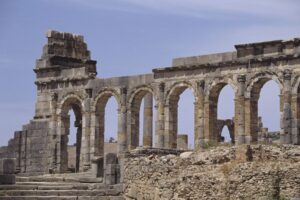
Just 33 kilometres north of Meknes lie the best-preserved Roman ruins in Morocco — and among the finest in all of North Africa. Volubilis was a thriving Roman provincial capital from the 1st to 3rd centuries AD, and the site preserves extraordinary mosaics, triumphal arches, and street layouts that have survived remarkably intact. A UNESCO World Heritage Site, Volubilis takes around 1.5–2 hours to explore properly. The combination of Meknes and Volubilis as a morning stop before the Fes to Chefchaouen drive is one of our most recommended additions to this journey. See our detailed guide to the Archaeological Site of Volubilis.
Stop 3: Ouazzane — 2 Hours from Fes
Ouazzane is a small, largely tourist-free Moroccan town perched on a hillside between the plains and the Rif Mountains. It is a perfect mid-journey coffee or lunch stop — authentic, unhurried, with a small but charming medina and excellent views of the surrounding countryside beginning to rise toward the Rif. Most travelers pass straight through Ouazzane without stopping, which is exactly why stopping there feels rewarding. Try a bowl of harira soup and a msemen flatbread at a local cafe — this is Moroccan road-trip food at its finest.
The Rif Mountain Approach — Final 45 Minutes
The final stretch of the drive from Ouazzane to Chefchaouen is where the scenery becomes genuinely dramatic. The road climbs steeply into the Rif Mountains through cedar and pine forest, with the valley below spreading in shades of green and ochre. Several natural viewpoints along this stretch offer spectacular panoramas — ask your driver to stop at the best one on the approach. The moment Chefchaouen first appears below, nestled in its mountain valley with its characteristic blue buildings visible even from distance, is one of those Morocco moments that travelers describe years later.
Is Fes to Chefchaouen Possible as a Day Trip?
Technically yes — but we do not recommend it, and here is why.
The journey each way takes approximately 4–5 hours on public transport, or 3.5 hours by car. A day trip means roughly 7–9 hours of travel time for a destination that genuinely deserves at least two full days of exploration. Chefchaouen’s blue medina is best experienced slowly — at dawn before the day-trippers arrive, in the golden afternoon light, and in the quiet evenings when the city truly belongs to itself again. Visitors who rush through on a day trip almost universally wish they had stayed.
If your schedule absolutely forces a day trip, depart Fes no later than 7am and take a private car rather than the bus to maximize time in Chefchaouen. Target a return departure no earlier than 6pm. But if there is any flexibility in your itinerary — stay overnight. One or two nights in Chefchaouen is one of the most memorable stays in all of Morocco.
💡 Our Guide’s Honest Recommendation
After 15 years of running this route, our advice is consistent: take two nights minimum in Chefchaouen. The first evening you will walk the blue medina in wonder. The second morning, you will wake up early and experience the city before the day visitors arrive — and that version of Chefchaouen, quiet and glowing in the morning mountain light, is something genuinely different from anything else in Morocco.
What to Do in Chefchaouen After Arriving from Fes
You have made the journey. You are standing at the entrance to the Blue City of Morocco. Here is how to spend your time:
Walk the Blue Medina — Immediately
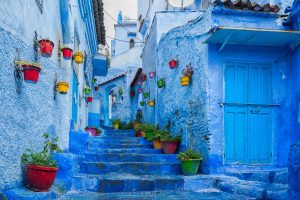
Do not check in to your riad first. Leave your bags at reception and walk directly into the medina. Chefchaouen’s old city is compact — roughly 500 metres across — and entirely navigable on foot. Every alleyway is a photograph. The blue ranges from cobalt to turquoise to powder blue to indigo depending on the time of day and the angle of the light. Uta el-Hammam square at the centre of the medina is the social heart of the city — sit with a mint tea at one of the cafe tables and let Chefchaouen settle around you after the journey from Fes.
Climb to the Spanish Mosque at Sunset
A 20-minute walk up the hillside above Chefchaouen leads to the ruins of an old Spanish mosque. The view from here at sunset — the entire blue city below, the Rif Mountains turning pink and gold, the valley stretching away to the west — is one of the finest panoramas in northern Morocco. Leave your riad around 6pm and walk up via the Ain Tissimane fountain path. Every guide in Chefchaouen knows this route.
Visit the Kasbah Museum
In the centre of Uta el-Hammam square stands a well-preserved 15th-century kasbah — one of the finest small museums in northern Morocco. The kasbah was built by Ali ibn Rashid, the Andalusian founder of Chefchaouen, in 1471, and its collection covers the city’s history, the Andalusian influence on Moroccan culture, and traditional Rif Mountain craftsmanship. Entry costs around 10 MAD — one of the best-value cultural experiences in Morocco.
Explore the Ras el-Maa Waterfall
At the eastern edge of the medina, a small river cascades over rocks beside women doing their laundry in the traditional manner — a scene that has changed little in centuries. The Ras el-Maa spring and waterfall area is a 10-minute walk from the main square and is one of those genuinely authentic Chefchaouen moments that no photograph fully captures. Bring your camera anyway.
Shop for Rif Mountain Crafts
Chefchaouen is famous for its distinctive handwoven textiles — blankets, djellabas, and woven bags in colours inspired by the mountains. The souks are less intense than Marrakech and Fes — vendors are unhurried, prices are negotiable but not aggressive, and the quality of local craftsmanship is excellent. The distinctive striped blankets of the Rif Mountain tradition make particularly beautiful souvenirs. Read our guide to how to bargain like a local in Morocco before you shop.
Best Time to Make the Fes to Chefchaouen Journey
The Fes to Chefchaouen route is beautiful year-round, but the seasons affect the experience significantly:
- Spring (March–May): The Rif Mountains are intensely green, wildflowers cover the hillsides, and the drive itself is at its most spectacular. Chefchaouen is alive but not yet at peak tourist numbers. The finest time for this journey.
- Summer (June–August): Hot in Fes (35–40°C) but pleasantly warm in Chefchaouen (26–28°C) thanks to the mountain altitude. Very popular — book accommodation months ahead. The blue city is busiest in July–August but the evening atmosphere is lively.
- Autumn (September–November): Excellent. Temperatures drop to comfortable levels. The light is beautiful. Crowds thin significantly after August. October is arguably the second-best month after April for this route.
- Winter (December–February): The Rif Mountains can be cold — Chefchaouen at altitude reaches near-freezing nights in January. The blue city in winter mist is hauntingly beautiful. Far fewer tourists. Some mountain roads may require caution in heavy rain.
Chefchaouen to Fes: The Return Journey
The return from Chefchaouen to Fes follows the same route in reverse. All the same transport options apply. The CTM bus from Chefchaouen to Fes departs multiple times daily from around 10:15am, with the last service around 6:45pm. Journey time is approximately 4 hours 30 minutes.
If continuing your Morocco journey from Chefchaouen rather than returning to Fes, the most popular onward routes are:
- Chefchaouen to Tangier: 2 hours by car — from where you can cross to Spain by ferry or fly home
- Chefchaouen to Tetouan: 1 hour — for the Spanish-influenced white city with a beautiful UNESCO medina. Read our Tetouan city guide for what to see.
- Chefchaouen to Tangier to Marrakech: The classic northern Morocco circuit, covered in full in our 11-day grand tour from Tangier
Combining Fes to Chefchaouen with a Northern Morocco Tour
The Fes–Chefchaouen journey works best as part of a broader northern Morocco itinerary rather than in isolation. The classic northern Morocco circuit combines:
- Fes (2–3 nights) — medina, tanneries, Al Qarawiyyin, Fes el-Jdid
- Meknes + Volubilis (day trip or stop en route)
- Chefchaouen (2 nights minimum) — blue medina, Spanish mosque, Rif Mountains
- Tetouan (optional half day)
- Tangier (1–2 nights) — two-ocean views, Cap Spartel, the famous caves
This full circuit takes 7–10 days and represents some of the most rewarding travel available in Morocco. See our 11-day grand tour from Tangier and 7-day odyssey from Fes for complete itineraries built around this route. For those combining north and south, our 10-day Morocco trip takes in imperial cities, desert, and the north in one seamless journey.
🔵 Ready to Travel from Fes to Chefchaouen?
We offer private transfers and fully guided tours on this route — door-to-door from your Fes riad to your Chefchaouen accommodation, with optional stops at Meknes, Volubilis, and Ouazzane along the way. Private, comfortable, and personalized to your schedule.
Practical Tips: Fes to Chefchaouen
Money
Withdraw Moroccan Dirhams (MAD) before leaving Fes — ATMs in Chefchaouen exist but are limited. See our guide to Moroccan currency for practical money advice. Bus tickets and grand taxis are always paid in cash. Private transfers can often be arranged in euros or dollars as well as dirhams.
Safety
The Fes to Chefchaouen route is completely safe. The Rif Mountains have a completely undeserved reputation among some travelers — the reality is a peaceful, hospitable mountain region. Chefchaouen itself is one of the safest cities in Morocco for tourists. Read our full Morocco safety guide for general travel security advice.
Accommodation in Chefchaouen
Book your Chefchaouen riad or guesthouse well in advance, particularly for spring and summer travel. The most atmospheric places to stay are inside the medina itself — riads and guesthouses built directly into the blue alleyways give you the experience of waking up inside the blue city. See our guide to accommodation and where to stay in Morocco for tips on choosing the right type of lodging.
What to Wear
Chefchaouen is a conservative Muslim city despite its popularity with tourists. Dress modestly — shoulders and knees covered when walking through the medina and residential areas. The famous photographed spots are visited constantly and locals are accustomed to tourists, but respectful dress is appreciated and appropriate. See our complete guide to what to wear in Morocco for full guidance.
Frequently Asked Questions: Fes to Chefchaouen
How far is it from Fes to Chefchaouen?
The road distance from Fes to Chefchaouen is 199 kilometres (124 miles). The journey takes approximately 3 hours 15–30 minutes by private car, or 4 hours 40 minutes by CTM bus. There is no direct train service between Fes and Chefchaouen.
How do I get from Fes to Chefchaouen by bus?
Take the CTM bus from the Fes CTM station. Buses depart approximately every 4 hours throughout the day, with the first service around 7–8am and the last around 4:30pm. Tickets cost 120–150 MAD ($12–17 USD) per person. The journey takes 4 hours 40 minutes. Book tickets as soon as you arrive in Fes — do not wait until the day of travel as buses frequently sell out, especially in spring and summer.
Can I do a day trip from Fes to Chefchaouen?
It is physically possible but strongly not recommended. The journey takes 4–5 hours each way by public transport, leaving only a few rushed hours in Chefchaouen. The blue city deserves a minimum of one overnight stay — ideally two nights. If a day trip is truly unavoidable, take a private car (3.5 hours) departing by 7am and return by 6pm.
How much does a private taxi from Fes to Chefchaouen cost?
A private car or taxi from Fes to Chefchaouen costs approximately 800–1,500 MAD ($80–150 USD) for the whole car — not per person. For a group of 2–4 people, this works out to a similar or only slightly higher per-person cost than the bus, with the significant advantages of door-to-door service, flexibility to stop along the route, and faster journey time.
Is there a train from Fes to Chefchaouen?
No. There is no direct or indirect train service between Fes and Chefchaouen. The only rail options in this region serve the Casablanca–Rabat–Meknes–Fes–Tangier corridor. To reach Chefchaouen from Fes, you must travel by bus, taxi, private car, or as part of a guided tour.
What is the best time to travel from Fes to Chefchaouen?
Depart early morning — 7–9am — to arrive in Chefchaouen with a full afternoon and evening to explore. This is especially important if you are taking the bus, as morning departures give you maximum time in the blue city. Spring (March–May) and autumn (September–November) offer the most beautiful road conditions and the most comfortable temperatures at both ends of the journey.
What should I not miss in Chefchaouen?
The blue medina itself is the main attraction — walk every alleyway, get lost on purpose, and find the quiet residential streets away from the main tourist flow. Beyond the medina: the climb to the Spanish Mosque for sunset views, the Ras el-Maa waterfall, the Kasbah Museum on Uta el-Hammam square, and the Rif Mountain hiking trails above the city. Shopping for authentic Rif Mountain textiles in the souks is also excellent.