Let’s start with the truth that most travel websites bury in careful euphemisms: June is hot in Morocco. Not uncomfortable-warm. In Marrakech and the southern interior, June afternoons can hit 38–40°C (100–104°F). The Sahara is firmly off the table for comfortable daytime activities. Sensible planning is not optional — it is essential.
And yet. June is also the month of the Gnaoua World Music Festival in Essaouira — one of the greatest music events on the African continent. The Atlantic coast is at its first-summer best. The Atlas Mountains are cool, accessible, and extraordinary. The northern cities of Tangier, Chefchaouen, and Tetouan are mild, beautiful, and refreshingly uncrowded. Long evenings — with 14 hours of daylight — give the country a pace and energy that is entirely its own.
The secret to a great June trip is not whether to come, but how and where. We have guided thousands of travelers through Morocco in June across our 15+ years as a Berber family tour operator. This is everything we know.
⚡ Morocco in June — Quick Facts
- Marrakech daytime: 32–38°C (90–100°F) — hot, plan around midday
- Sahara desert: 40–45°C (104–113°F) — avoid unless doing overnight only
- Atlas Mountains: 18–25°C (64–77°F) — ideal for hiking and day trips
- Atlantic coast (Essaouira, Agadir): 22–26°C (72–79°F) — perfect summer weather
- North (Tangier, Chefchaouen): 25–28°C (77–82°F) — warm and very manageable
- Rainfall: Virtually zero across all regions — Morocco’s dry season starts in June
- Star event: Gnaoua World Music Festival, Essaouira
- Sunshine: 10–11 hours per day — longest days of the year
- Prices: Just below July–August peak — good value window still open
Morocco Weather in June: The Honest City-by-City Breakdown
June in Morocco is a tale of two countries. The inland south bakes under genuine summer heat. The coast and north remain pleasantly warm. Understanding this divide is the entire key to planning a successful June trip.
| City / Region | Day Temp | Night Temp | Rain Days | Verdict |
|---|---|---|---|---|
| Marrakech | 35°C (95°F) | 20°C (68°F) | ~1 day | ✅ Possible — early mornings & evenings only |
| Fes | 32°C (90°F) | 17°C (63°F) | ~2 days | ✅ Sacred Music Festival — go for the evenings |
| Casablanca | 26°C (79°F) | 18°C (64°F) | ~2 days | ✅ Comfortable — Atlantic breeze helps |
| Chefchaouen | 27°C (81°F) | 14°C (57°F) | ~3 days | ✅ Excellent — cooler than southern cities |
| Tangier | 26°C (79°F) | 17°C (63°F) | ~2 days | ✅ Very comfortable — Mediterranean influence |
| Essaouira | 24°C (75°F) | 17°C (63°F) | ~1 day | ⭐ Best coastal pick — Gnaoua festival |
| Agadir | 26°C (79°F) | 18°C (64°F) | ~1 day | ⭐ Excellent beach weather — sea warm enough |
| Merzouga (Sahara) | 42°C (108°F) | 22°C (72°F) | ~0 days | ⚠️ Avoid daytime — overnight only if at all |
| Atlas Mountains | 22°C (72°F) | 10°C (50°F) | ~3 days | ⭐ Ideal for hiking — best June escape from heat |
🌊 Our Local Rule for June: Follow the Atlantic
After years of guiding in June, our advice is simple: build your itinerary along the Atlantic coast and north, and save any inland city visits for early morning and evening. The coast in June is genuinely wonderful — cool breezes, warm sea, long evenings. Marrakech and Fes are still very much worth visiting, but only travelers who plan their day around the heat truly enjoy them in June.
The Gnaoua World Music Festival: June’s Crown Jewel
Every June, the windswept coastal city of Essaouira hosts what many consider the finest music festival in Africa. The Gnaoua World Music Festival — known locally as the Gnaoua and World Music Festival — draws 500,000 visitors over four extraordinary days, transforming Essaouira’s blue-and-white medina and Atlantic beach into an open-air concert hall unlike anything else on earth.
The festival’s roots go deep. Gnaoua music is one of the oldest musical traditions in North Africa — a hypnotic, trance-inducing form born from the experience of sub-Saharan African slaves brought to Morocco centuries ago. It is spiritual music, ritual music, healing music, played on the guembri (a three-stringed bass lute), krakeb (iron castanets), and accompanied by deep call-and-response vocals. Hearing it performed by a master in a packed medina courtyard at midnight is an experience that genuinely changes people.
What makes the festival extraordinary is that it pairs these Gnaoua masters with international artists across jazz, blues, rock, electronic, and world music. The combinations — a Moroccan Gnaoua master with a New Orleans jazz band, a Brazilian capoeira group with a Sufi ensemble — produce performances that are wild, beautiful, and completely unpredictable.
Practically: book your Essaouira accommodation 3–4 months in advance if you plan to attend. The city fills completely. The festival itself is largely free — most concerts on the main stages are open to the public at no cost. See our guide to the Essaouira day excursion for how to combine this city with Marrakech on a shorter trip.
📅 June Festivals & Events in Morocco
- Early June: 🎵 Gnaoua World Music Festival — Essaouira. Four days, 500,000 visitors, free main stages
- Mid-June: Festival of World Sacred Music — Fes (if not held in May, it often extends into June)
- Throughout June: Marrakech Popular Arts Festival — traditional Moroccan music, acrobatics, and storytelling in Jemaa el-Fna square
- Late June: Summer Solstice celebrations — various traditional Amazigh observances across Berber communities
- June 1: International Children’s Day — festive atmosphere in public parks and family spaces across all cities
Best Things to Do in Morocco in June
1. Attend the Gnaoua World Music Festival in Essaouira
If you are visiting Morocco in June and the Gnaoua Festival dates align with your trip, rearrange your entire itinerary around it. Essaouira in June — with its Atlantic breeze keeping temperatures at a perfect 24°C while the rest of Morocco bakes — combined with one of the world’s great music events, is a genuinely once-in-a-lifetime experience. Plan a minimum of two nights in Essaouira during the festival. The city is compact, walkable, and utterly magical when it fills with music at every corner.
2. Escape the Heat in the Atlas Mountains
The single best decision a June traveler can make is to build the Atlas Mountains into their itinerary. At altitude, temperatures drop dramatically — the Imlil valley area averages just 22°C in June, compared to 35°C in Marrakech just 90 kilometres away. The High Atlas in June is still green from spring rains, the rivers are clear and cold, and the hiking trails are in perfect condition.
The Marrakech to Atlas Mountains day trip is one of the most popular ways to escape Marrakech’s midday heat in June. Combine it with a visit to the stunning Ourika Valley or the ancient kasbah of Ouarzazate for a fuller mountain experience. For dedicated hikers, the Toubkal circuit is in peak condition in June — tackle it early in the month before temperatures rise further at altitude.
3. Discover Morocco’s North: Tangier, Chefchaouen & Tetouan
June is arguably the best month to discover Morocco’s underrated north. Tangier — the city that bridges Africa and Europe, where the Atlantic meets the Mediterranean — enjoys a comfortable 26°C in June, cooled by sea breezes from two oceans. The medina is vibrant, the seafood is extraordinary, and the city’s cosmopolitan, literary atmosphere (Paul Bowles, William Burroughs, and the entire Beat generation famously lived here) gives it an edge unlike any other Moroccan city.
Chefchaouen, the Blue City, is at 27°C in June — warm enough to be thoroughly enjoyable, cool enough to walk extensively without suffering. The Rif Mountains around it are still partially green. The famous blue alleyways feel vivid and alive in the long June light. June is genuinely one of the best months to visit Chefchaouen before the July–August peak crowds arrive.
Tetouan — one of Morocco’s most overlooked cities, with a UNESCO-listed medina and a Spanish colonial character entirely its own — is delightful in June and hardly touched by mass tourism. Read our full guide to Tetouan for what makes it worth a stop.
4. Embrace the Atlantic Coast: Agadir & the Beach Towns
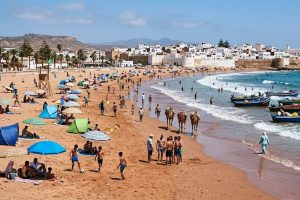
June is the opening of beach season on Morocco’s Atlantic coast. Agadir — with its wide crescent bay, warm sand, and reliable sunshine — hits its sweet spot in June: sea temperatures of around 20°C, air temperatures of 26°C, and the summer crowds not yet at their August peak. The beach culture around Agadir is genuinely excellent, with everything from surf schools to horseback riding at sunset.
For surfers, Taghazout just north of Agadir offers some of its best conditions in June for intermediate and advanced riders. The famous breaks — Anchor Point, Killer Point, Hash Point — are active and the surf camp scene is at full energy. See our guide to surfing in Taghazout for everything you need to know before paddling out.
Further up the coast, Essaouira is reliably cooler than anywhere inland — the city’s famous wind, the alizée, keeps temperatures around 24°C even in summer. It is the premier destination in Morocco for kitesurfing and windsurfing, and the historic medina is one of the most beautiful in the country. Our surfing in Essaouira guide covers the water sports scene in detail.
5. Explore Marrakech the Right Way: The Dawn-to-Dusk Rhythm
Marrakech in June is absolutely doable — if you adopt the city’s own rhythm. Locals have managed this heat for centuries. Their secret: the day has two active periods and one rest period. Early morning (6–10am) and evening (6–10pm) are for movement, exploration, and the streets. Midday to late afternoon is for shade, rest, a long lunch, and mint tea in a cool riad courtyard.
The Jemaa el-Fna square at 8am in June is extraordinary — market vendors setting up, the smell of fresh bread and orange juice, almost no tourists, and the square still cool from the night. At 9pm, the same square transforms again into a carnival of food stalls, musicians, storytellers, and snake charmers. These are the versions of Marrakech worth experiencing. The 2pm version in full sun is for the pool.
Key June Marrakech experiences: the Majorelle Garden at opening time (8am), the souks in the cool morning hours, the Bahia Palace before 10am, and the rooftop restaurants overlooking the medina for long, cool evening dinners. The hammam experience — a traditional Moroccan steam bath — is also particularly welcome in June heat, paradoxically cooling the body through the sweating process.
6. Visit Fes During the Festival of World Sacred Music
When the Festival of World Sacred Music extends into June (which it does in some years), Fes becomes one of the most culturally extraordinary places on earth to be. The ancient medina’s tilework, minarets, and medieval light — already stunning — become the backdrop for performances from Sufi masters, gospel choirs, Tibetan monks, West African griots, and hundreds of other sacred music traditions from around the world.
Even outside the festival, Fes in June rewards the traveler who plans wisely. Visit the Al Qarawiyyin Mosque — founded in 859 AD and recognized as the world’s oldest continuously operating university — in the cool morning. Explore the Chouara Tannery from a rooftop terrace. Spend evenings in the restaurants and music venues of the ville nouvelle. See our 7-day odyssey from Fes for the ideal northern Morocco itinerary.
The Sahara Desert in June: The Honest Advice
We believe in being direct with our guests, even when the answer is not what they want to hear. June is not a good month for a traditional Sahara desert experience. Daytime temperatures in Merzouga regularly exceed 42°C (108°F). A midday camel trek on the dunes in June heat is genuinely dangerous and deeply unpleasant rather than magical. The desert camps are hot even with shade. The experience that makes the Sahara extraordinary — the camel trek at golden hour, the cool night under stars, the sunrise — is compressed into a very narrow window.
If you absolutely must include the desert in a June itinerary: travel overnight only, arriving at camp in the evening, experiencing the night and sunrise, and departing before 10am. Never plan midday desert activities. Stay extremely well hydrated. Choose a camp with reliable shade and ideally air-conditioning in the tents for the hottest afternoon hours.
Our honest recommendation: if the desert is your priority, shift your trip to October, November, April, or early May. See our full range of tours from Marrakech that include desert itineraries across all seasons.
⚠️ June Heat Safety — Non-Negotiable Rules
1. Drink at least 3 litres of water per day — more if hiking or in the desert.
2. Never plan strenuous activity between 11am and 4pm in inland cities or the desert.
3. Wear a hat outdoors at all times — the June sun causes rapid sunburn and heat exhaustion.
4. Use SPF 50 sunscreen, reapplied every 2 hours in strong sun.
5. If you feel dizzy, nauseous, or stop sweating in heat — seek shade and cool water immediately. These are early signs of heat stroke.
Where to Go in Morocco in June: Our Recommended Strategy
Best destinations in June (comfortable & rewarding):
- Essaouira — perfect temperature, Gnaoua Festival, coastal beauty
- Agadir — beach season in full swing, warm but manageable
- Chefchaouen — cool, beautiful, best before July crowds
- Tangier — cosmopolitan, comfortable, two-ocean views
- Atlas Mountains — the ultimate June heat escape
- Fes — go for the festival and plan days around morning/evening exploration
Destinations requiring careful planning in June:
- Marrakech — doable with the dawn-to-dusk rhythm; avoid midday outdoors
- Ouarzazate — interesting but very hot; do mornings only
Avoid in June:
- Sahara desert (daytime activities) — genuinely dangerous heat
- Merzouga camel treks in midday — not safe in June temperatures
Best Morocco Tours for June
The ideal June itinerary prioritizes the north and coast, with imperial city visits timed for early mornings and evenings. Here are our recommendations:
- North Morocco circuit: 11-day grand tour from Tangier — Tangier, Chefchaouen, Fes, Meknes, and the north in ideal June conditions
- Classic imperial + coast: 7-day trip from Marrakech — customizable to emphasize coast and mountains over desert
- Fes-focused cultural trip: 7-day odyssey from Fes — perfect for the Sacred Music Festival period
- Coast and culture: 10-day Morocco trip — combines imperial cities, Atlas, and Atlantic coast
- Short Marrakech + mountains: 3-day expedition adapted for June — we can route via Atlas instead of desert
🎵 Planning a June Trip to Morocco?
June rewards travelers who plan wisely — the Gnaoua Festival, the Atlantic coast, the cool Atlas Mountains, the festival nights in Fes. We build private June itineraries that make the most of what this season genuinely offers, and we’re honest about what to skip. Let us plan yours.
What to Pack for Morocco in June
- Lightweight clothing: Linen and cotton only — breathable, light colours. Avoid synthetic fabrics entirely in this heat
- Sun hat: Wide brim, not a fashion cap — sun protection is genuine health protection in June
- SPF 50 sunscreen: Apply every morning, reapply every 2 hours outdoors. June sun is intense and unforgiving
- Sunglasses: Quality UV-blocking lenses — the Moroccan sun is strong enough to cause eye strain without protection
- Reusable water bottle: 1 litre minimum capacity. Fill it constantly. Dehydration is the #1 health issue for June visitors
- Light scarf: For sun protection on the neck and shoulders, and essential for mosque visits and conservative areas
- Evening layer: A light cardigan — evenings in Chefchaouen, the Atlas, and coastal towns can be surprisingly fresh
- Comfortable walking shoes: Closed-toe for long medina days, sandals for the beach and casual evenings
- Swimwear: Essential for coastal stays and for the riad pool that will become your afternoon sanctuary in Marrakech
🌿 Local Tip: Embrace the Moroccan Afternoon
Moroccans don’t fight the afternoon heat — they have perfected the art of escaping it. A long, unhurried lunch in a shaded riad courtyard, a pot of fresh mint tea, a short nap on a cool tiled floor — this is not laziness. It is centuries of accumulated wisdom about how to live well in a hot climate. June visitors who adopt this rhythm consistently have better trips than those who push through the midday sun and arrive exhausted at dinner.
Is June a Good Time to Visit Morocco? Our Honest Verdict
Yes — but with a specific type of traveler and itinerary in mind.
June is excellent for:
- Travelers whose priority is the Atlantic coast and beach culture
- Music lovers coming for the Gnaoua or Sacred Music festivals
- Hikers and nature lovers focused on the Atlas Mountains
- Anyone exploring northern Morocco — Tangier, Chefchaouen, Fes
- Budget-conscious travelers — prices are still below July–August peak
- Travelers who adapt easily to heat and know how to pace themselves
June is not ideal for:
- Travelers whose #1 priority is a Sahara desert camel trek experience
- Anyone sensitive to heat who cannot avoid midday outdoor activity
- Visitors who want to spend long, full days exploring Marrakech without a midday break
Our bottom line: June is a rewarding month in Morocco for those who plan around its character rather than against it. The coast is magnificent. The festivals are world-class. The northern cities are beautiful and cool. The evenings everywhere in Morocco in June — long, warm, fragrant with jasmine and grilling meat, filled with music — are among the finest of any travel experience anywhere in the Mediterranean world.
Practical Information: Morocco in June
Prices & Crowds
June sits just below the July–August peak in both price and crowd levels. Accommodation is cheaper than high summer. Marrakech is busy but not at its most overwhelming. The Atlantic coast and Gnaoua Festival destinations fill up fast — book 2–3 months ahead for Essaouira during the festival. For general June travel, 4–6 weeks advance booking is sufficient for most destinations.
Getting Around
All roads and routes are fully open in June. The heat makes long car journeys in the afternoon uncomfortable — plan drives for the morning or evening. Internal flights between Marrakech, Casablanca, Fes, Agadir, and Tangier are efficient and inexpensive — see our guide to flying Marrakech to Casablanca for tips. Train services on the Casablanca–Rabat–Fes–Tangier corridor are air-conditioned and comfortable.
Safety
Morocco is very safe in June. The main health risk is heat-related — follow the hydration and sun protection advice above seriously. Standard travel precautions apply in busy tourist areas — read our guide to common Morocco scams and our full Morocco safety guide. See our Morocco healthcare for tourists guide for what to do if you need medical assistance during your trip.
Frequently Asked Questions: Morocco in June
Is Morocco too hot in June?
It depends entirely on where you go. Marrakech and the inland south reach 35–40°C and require careful planning. The Atlantic coast (Essaouira, Agadir) stays at a very comfortable 22–26°C thanks to ocean breezes. The Atlas Mountains average 22°C. The northern cities of Tangier and Chefchaouen are warm at 26–27°C but entirely manageable. The answer is: not if you plan your itinerary around the coast and north.
What is the Gnaoua Festival in Morocco?
The Gnaoua World Music Festival is held each June in Essaouira. It is one of Africa’s largest and most celebrated music events, attracting around 500,000 visitors over four days. It celebrates Gnaoua — an ancient North African spiritual music tradition — by pairing Gnaoua masters with international artists across jazz, blues, world music, and electronic genres. Most concerts on the main stages are free to attend.
Can I visit the Sahara in June?
We strongly advise against daytime Sahara activities in June. Temperatures regularly exceed 42°C (108°F), making camel treks and dune activities genuinely dangerous. If you must include the desert, arrive in the evening, experience the night and sunrise, and leave before 10am. For the full Sahara experience, we recommend visiting between October and April instead.
What should I pack for Morocco in June?
Prioritize lightweight linen or cotton clothing in light colours, a wide-brim sun hat, SPF 50 sunscreen (non-negotiable), high-quality sunglasses, and a large reusable water bottle. Pack a light scarf for sun protection and modesty in conservative areas. A light cardigan for cool coastal evenings and the Atlas. Swimwear is essential for beach stays and riad pools.
Is June expensive in Morocco?
June sits just below the July–August high-season peak. Prices are higher than spring but not at their maximum. Essaouira during the Gnaoua Festival is an exception — accommodation prices spike significantly during those four days due to extreme demand. Book festival-period accommodation 3–4 months in advance.
Which city is best to visit in Morocco in June?
For comfort and beauty, Essaouira and Agadir on the Atlantic coast are the top choices. For cultural depth, Fes and Chefchaouen in the north offer rich experiences at manageable temperatures. Marrakech is worthwhile if you adopt the local morning/evening rhythm and rest during midday. The Atlas Mountains are the ideal June escape for any traveler who runs hot.
How far in advance should I book a June Morocco trip?
For Essaouira during the Gnaoua Festival: 3–4 months minimum. For Fes during the Sacred Music Festival: 2–3 months. For general June travel across Morocco: 4–6 weeks is usually sufficient for accommodation, and 6–8 weeks for private tour bookings to ensure availability and customization. Contact us early — June fills faster than most travelers expect.