The first time you walk into a Moroccan hammam, the steam is so thick you can barely see. The marble is warm beneath your feet. The air smells of olive oil, eucalyptus, and something ancient and mineral that you cannot quite name. And then someone starts scrubbing your skin with a rough glove, and you watch — slightly alarmed — as what appears to be an entire layer of you rolls off in grey ribbons onto the marble slab.
And then it is over. And you feel like a completely different person. Lighter. Cleaner than you have ever been in your life. Slightly dazed in the best possible way. Your skin glows. Your muscles ache pleasantly. You sleep that night better than you have in months.
This is the Moroccan hammam. Not a spa. Not a sauna. Something older, more functional, more communal, and ultimately more transformative than either. It is one of the greatest experiences Morocco offers — and one of the most misunderstood by first-time visitors who arrive without knowing what to expect.
This guide covers everything: the history, the full step-by-step process, the products, the etiquette, the prices, the different types of hammam, and the specific hammams worth seeking out in Morocco’s major cities. After reading this, you will walk into your first hammam confident and curious rather than confused and anxious.
⚡ Moroccan Hammam — Quick Facts
- What it is: A traditional communal steam bathhouse — part cleansing ritual, part social institution
- How long: 45 minutes to 2 hours depending on services chosen
- Cost (public hammam): 10–50 MAD ($1–$5) for entry + scrub
- Cost (riad/spa hammam): 200–600 MAD ($20–$60) for full treatment
- Gender separated: Always — separate sections or timed slots for men and women
- Key products: Savon beldi (black soap), kessa (exfoliating glove), ghassoul (clay), argan oil
- Best time to go: Morning or early afternoon — quieter than evenings
- Suitable for: All ages, all genders, all fitness levels
What Is a Moroccan Hammam? History & Cultural Significance
The word hammam comes from the Arabic root hammam, meaning “to heat.” It describes a tradition of communal steam bathing that has been part of North African and Islamic culture for over a thousand years — blending ancient Roman bathing practices with the Islamic religious emphasis on bodily purification before prayer.
In Morocco, the hammam is not a luxury. It is a weekly ritual, as routine as going to the barber. Every neighbourhood in every Moroccan city and town has at least one hammam, often located near the local mosque. Moroccan families go together — mothers and daughters, fathers and sons. Friends catch up on the week’s news while soaking in the steam rooms. For centuries, the hammam was where Moroccan women could gather freely, away from the more public spaces of the medina, to talk, laugh, share stories, and be completely at ease. Before a wedding, the bride’s female family and friends gather at the hammam for a ritual cleansing celebration. After the birth of a child, the new mother returns to the hammam as part of her recovery.
It is, in short, one of the most deeply woven threads in the fabric of Moroccan social and religious life. When you enter a Moroccan hammam as a visitor, you are not entering a tourist attraction. You are stepping into a living cultural institution that has functioned in essentially the same way for over a thousand years.
🏛️ A Brief History of the Hammam
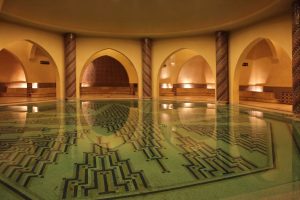
Morocco’s hammam tradition traces directly to the Roman thermae — public bathhouses that were the social centres of Roman provincial cities. When Arab and Islamic civilization spread across North Africa from the 7th century onward, the bathing tradition was absorbed and transformed. Islamic religious law (sharia) emphasizes ritual purity — taharah — before prayer, and the hammam became institutionalized as both a practical and spiritual space. The oldest continuously operating hammams in Morocco are found in Fes, some dating back to the 14th century during the Marinid dynasty. They look — and function — virtually identically to how they did then.
The Three Types of Moroccan Hammam
Not all hammams are the same — and knowing the difference before you go is one of the most useful pieces of information for a first-time visitor.
1. The Traditional Public Hammam (Hammam Chaabi)
This is the real thing. The neighbourhood hammam that local Moroccans have attended their entire lives. It is cheap, unpretentious, functional, and entirely authentic. Entry costs 10–30 MAD (around $1–$3). You bring your own soap and towel, or buy basic supplies at the door. The attendant performs your scrub if you want one — this costs an additional 20–50 MAD. The facilities are basic but clean. The steam rooms are genuinely hot. The experience is communal and can feel overwhelming on first visit, which is exactly why it is so extraordinary.
This is where you will sit next to local Moroccan families, hear the language around you, and understand — in a way that no medina walk or cooking class can replicate — what daily Moroccan life actually feels like from the inside. We strongly encourage every traveler in Morocco to visit at least one traditional public hammam. The initial unfamiliarity dissolves within minutes, and what remains is pure cultural immersion.
2. The Riad or Boutique Hammam
Many of Morocco’s riads and boutique hotels have private or semi-private hammam facilities. These offer a middle path between the raw authenticity of the public hammam and the full luxury of a spa hammam. Prices range from 100–300 MAD ($10–$30) for a basic treatment. The process is essentially the same as the traditional hammam — black soap, kessa scrub, rinse — but in a more private setting with better facilities and attentive service. For first-time visitors who are nervous about the communal aspect of a public hammam, starting here before graduating to a public hammam is a completely reasonable approach.
3. The Luxury Spa Hammam
Morocco’s finest spa hammams are world-class wellness experiences. The same ancient ritual — steam, black soap, kessa scrub — is elevated with premium argan oil treatments, ghassoul clay masks, full-body massages, mint tea service, and beautiful tiled surroundings. Prices range from 300–800 MAD ($30–$80) for a full treatment. These hammams are primarily for tourists and affluent local residents rather than the general population, but the quality of the experience justifies the cost for travelers looking for a restorative afternoon. The hammams within five-star riads and hotels in Marrakech are exceptional.
| Type | Price | Privacy | Authenticity | Best For |
|---|---|---|---|---|
| Public (Chaabi) | $1–$5 | Communal | ⭐⭐⭐⭐⭐ | Cultural immersion, budget travelers |
| Riad / Boutique | $10–$30 | Semi-private | ⭐⭐⭐⭐ | First-timers, couples |
| Luxury Spa | $30–$80 | Private | ⭐⭐⭐ | Luxury travelers, special occasions |
The Complete Hammam Process: Step by Step
Here is exactly what happens during a traditional Moroccan hammam experience — from the moment you arrive to the moment you leave feeling like a new person. Knowing this in advance removes all anxiety and lets you simply enjoy the process.
Step 1: Arrival & Changing Room
You arrive at the hammam and pay the entry fee at the door. The attendant will give you a locker or basket for your belongings, a towel if you have not brought your own, flip-flops for the wet floors, and sometimes a small plastic bucket. Undress down to your swimwear or underwear. Women typically wear bikini bottoms or underwear; some Moroccan women go topless in the traditional hammam — this is culturally normal and not sexual in any context. Men always wear shorts or underwear — going fully unclothed is not permitted for men. Put on your robe and flip-flops and meet your attendant.
⚠️ One Critical Tip Before You Go In
Do not shave the day before or the day of your hammam visit. The black soap and the kessa scrub on freshly shaved skin can sting significantly. Wait at least 24 hours after shaving before a hammam session. This applies to legs, face, and any other shaved area.
Step 2: The Warm Room — Opening the Pores
The traditional Moroccan hammam has three rooms at progressively higher temperatures: warm, hot, and very hot. You begin in the warm room — typically around 40–45°C — and spend 10–15 minutes allowing your body to adjust to the heat, your pores to open, and your muscles to begin relaxing. This is not a time to rush. Breathe slowly. Drink in the steam. Pour warm water over yourself from the bucket provided. Let the hammam do what it has been doing for a thousand years: prepare your body for what comes next.
Step 3: Savon Beldi — The Black Soap
Your attendant brings a bowl of savon beldi — Moroccan black soap. This is one of the most extraordinary skincare products in the world, and it looks like nothing so much as dark molasses: a thick, gel-like paste made from crushed black olives, virgin olive oil, and sometimes argan oil. It has been used in Moroccan hammams for centuries and its formulation has not changed.
The attendant — or you, if you prefer — applies the savon beldi generously across your entire body: legs, back, arms, chest, face. You stand, sit, and turn as directed. Once applied, you are left alone for 5–10 minutes to let the soap penetrate. The olive oil softens and loosens dead skin cells from below. The minerals in the soap begin drawing out impurities. Nothing dramatic happens visually — the magic of savon beldi is entirely beneath the surface, preparing your skin for the most thorough exfoliation of its life.
🫒 Savon Beldi: Morocco’s Ancient Skin Secret
Savon beldi (literally “traditional soap” in Moroccan Arabic) is made from crushed black olive paste and virgin olive oil. It contains no synthetic chemicals, no preservatives, and no artificial fragrance. Its natural composition includes vitamin E, oleic acid, and antioxidants that nourish and repair skin at a cellular level. It is antibacterial, anti-inflammatory, and suitable for all skin types including sensitive skin. Moroccan women have used it on their faces, bodies, and hair for generations. It is arguably the most effective natural cleanser in the world — and one of the finest souvenirs to bring home from Morocco. Buy it at a cooperative or pharmacy rather than a tourist souk for guaranteed quality.
Step 4: The Kessa Scrub — The Main Event
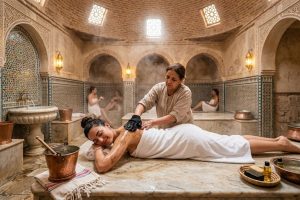
This is the moment that defines the Moroccan hammam experience. Your attendant puts on the kessa — a coarse, textured exfoliating mitt made from viscose fibres — and begins scrubbing your body in long, firm strokes across the marble slab.
What happens next is simultaneously alarming and deeply satisfying: visible rolls of dead skin begin coming off your body. Grey-brown ribbons of accumulated dead cells that your daily shower has never touched — loosened by the black soap and the steam — are removed in a way that feels unlike any other cleansing experience. The attendant works methodically across your entire body: arms, legs, back, stomach, feet. They will ask you to turn over. They will scrub areas you cannot reach yourself. It is not a gentle process. If it is too vigorous, the word to know is bshwiya — “softly” in Moroccan Arabic.
The entire scrub takes 15–20 minutes. By the end, your skin is pink, slightly tingling, and completely renewed. The visual evidence of what has been removed is remarkable — even people with excellent skincare routines are consistently astonished by how much dead skin the kessa removes.
Step 5: Ghassoul Clay Mask (Optional but Recommended)
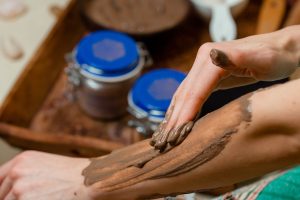
Ghassoul is a rare clay mineral found exclusively in the Atlas Mountains of Morocco — a reddish-brown earth with extraordinary absorptive properties. Mixed with rose water into a smooth paste and applied to the skin and hair, it draws out toxins, tightens pores, and leaves skin with a particular luminous quality that is hard to describe and impossible to mistake. A ghassoul mask treatment is typically offered as an add-on at riad and spa hammams. It costs 50–100 MAD extra and is absolutely worth it — particularly for the hair, which emerges from a ghassoul treatment with a soft shine that no commercial conditioner replicates.
Step 6: The Rinse
After the scrub — and any optional treatments — warm water is poured over your entire body to remove all traces of soap, dead skin, and clay. This rinse is thorough and methodical. Some hammams then offer a cool water rinse or plunge pool to close the pores and re-energize the body. This contrast of hot and cold is a cornerstone of the original Roman bathing tradition and feels genuinely electrifying after the heat of the steam rooms.
Step 7: Argan Oil Massage (Optional)
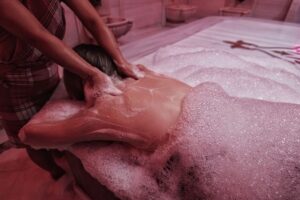
At spa and riad hammams, the process often concludes with a full-body massage using Moroccan argan oil — liquid gold pressed from the kernels of the argan tree, found almost exclusively in Morocco’s Souss Valley. Argan oil is extraordinarily rich in vitamin E, essential fatty acids, and antioxidants. Applied to freshly exfoliated, open-pored skin immediately after the hammam, its absorption and effect is unlike any other post-massage moisturizer. If a hammam massage with argan oil is available where you visit, always choose it. The combination of the kessa scrub’s mechanical exfoliation and the argan oil’s deep hydration produces skin results that last for days.
Step 8: The Cool Room — Mint Tea & Recovery
The final stage of the traditional hammam is a return to the cool room — the bayt al-baroud — where you wrap yourself in a towel, drink a glass of mint tea, and allow your body to return to its normal temperature. This stage is as important as any other. The heat has opened your cardiovascular system significantly; cooling down gradually is both physiologically important and deeply pleasurable. Many traditional hammams serve mint tea, dates, and sometimes small pastries in the cool room. Sit. Rest. Drink slowly. You have just experienced one of the oldest healing rituals in the world.
The Hammam Lexicon: Words You Need to Know
| Word | Pronunciation | Meaning |
|---|---|---|
| Hammam | hah-MAHM | The bathhouse itself — from Arabic “to heat” |
| Savon beldi | sah-VON bel-DEE | Traditional black olive soap — the hammam’s most essential product |
| Kessa | KESS-ah | The exfoliating scrubbing glove — the tool of the main treatment |
| Ghassoul | gha-SOOL | Atlas Mountain clay mask — used on skin and hair after the scrub |
| Tayeb | tah-YEB | “Good / okay” — to signal you are comfortable with the process |
| Bshwiya | bsh-WEE-yah | “Softly / gently” — use this if the scrub is too vigorous |
| Keyyis | keh-YEES | “Scrub me” — what you say to ask the attendant to begin |
Hammam Etiquette: The Rules That Matter
The hammam is a cultural space with its own code of conduct. Knowing these rules before you arrive ensures respect for other users and a more comfortable experience for you.
- No photographs inside: This is the most important rule and the most frequently violated by tourists. The hammam is an intimate space — photographing inside without permission is deeply disrespectful and in many hammams will result in being asked to leave
- Keep your voice low: The hammam is not silent, but it has a particular atmosphere of calm. Loud voices, laughter, and phone calls are considered rude
- Men and women are always separate: Never attempt to enter a section designated for the opposite gender. Traditional hammams either have completely separate entrances or designated time slots for each gender
- Men must always wear bottoms: Men going fully unclothed is not permitted in any Moroccan hammam
- Rinse your bench or mat after use: Basic hygiene courtesy — rinse whatever surface you used before moving on
- Do not splash others: Using large amounts of water carelessly or splashing other bathers is considered very rude
- Tip your attendant: 20–50 MAD ($2–$5) for a scrub is appropriate and genuinely appreciated. In a luxury spa hammam, 10–15% of the total service cost is standard
- Face the wall when adjusting clothing: When removing or adjusting underwear in the steam rooms, face toward the wall — basic modesty consideration
💡 Our Berber Family Tip on Etiquette
In our experience, Moroccans are extraordinarily welcoming to visitors at the hammam — particularly women visiting the women’s section. If you go with an open, respectful attitude and a willingness to be a little out of your comfort zone, you will almost certainly be helped, guided, and made to feel welcome. Moroccan women at the hammam are very accustomed to foreign visitors and will often guide first-timers through the process with warmth and humour. The hammam is one of the few spaces in Morocco where cultural barriers between visitors and locals dissolve almost completely.
What to Bring to the Hammam
- Flip-flops / plastic sandals: Non-negotiable — the floors are wet and warm. Many hammams provide them but bringing your own is more comfortable
- Swimwear or dark underwear: You will be in them for the duration — wear something you do not mind getting wet and soap-stained. Pale underwear tends to pick up colour from the black soap
- Two towels: One for the steam rooms and one for drying after. Some hammams provide them (especially riad and spa hammams) but traditional public hammams often do not
- Savon beldi: At a public hammam, bring your own — available from any pharmacy or souk stall for 10–30 MAD. Spa hammams provide it as part of the treatment
- Kessa glove: Optional if you want to do your own scrubbing in a public hammam. Available at the door of most hammams for 10–20 MAD
- Water or mint tea: You will sweat significantly. Rehydrate before, during (in the cool room), and after the session
- Change of clothes: Bring fresh, comfortable clothes to change into after — the ones you arrived in will feel heavy and wrong compared to how clean and light your skin feels
- Small amount of cash: For entry fee, tip, and any products you decide to buy at the door
Health Benefits of the Moroccan Hammam
The hammam is not just culturally significant — it is genuinely beneficial for physical health, and the science behind the traditional process is compelling:
- Deep skin exfoliation: The kessa removes dead skin cells that daily cleansing leaves behind, improving skin texture, tone, and the absorption of moisturizers applied afterward
- Improved circulation: The progressive heat exposure stimulates blood flow to the skin’s surface and throughout the body — similar in effect to cardiovascular exercise
- Muscle relaxation: The heat penetrates muscle tissue and reduces tension, lactic acid accumulation, and joint stiffness — particularly beneficial after long days of walking Moroccan medinas
- Detoxification: Sweating in high heat flushes toxins through the skin’s pores — the largest organ of detoxification in the human body
- Stress reduction: The combination of heat, steam, physical contact, and enforced stillness produces measurable reductions in cortisol levels. Most visitors fall asleep easily after a hammam session
- Skin conditions: Savon beldi’s antibacterial properties and the deep cleansing process have been used for generations to manage acne, eczema, and psoriasis
- Respiratory benefit: The steam is often infused with eucalyptus oil, which has natural decongestant properties — beneficial for anyone with sinus issues or mild respiratory congestion
⚠️ Who Should Approach the Hammam with Caution
The hammam is safe for the vast majority of people. However, the following groups should consult a doctor before visiting or choose only the cooler, warm rooms: people with uncontrolled high blood pressure, serious heart conditions, or severe hypertension; those in the late stages of pregnancy; anyone with open wounds, active skin infections, or contagious skin conditions; people with fever or acute illness. The heat is significant — listen to your body and exit to the cool room immediately if you feel dizzy, nauseous, or faint.
Where to Find the Best Hammams in Morocco
Best Hammams in Marrakech
Marrakech has the widest range of hammam options in Morocco — from centuries-old neighbourhood hammams to world-class spa facilities.
- Hammam el-Bacha: One of the most beautiful traditional hammams in Marrakech, dating from the early 20th century. Stunning original tilework, a massive heating system, and a genuinely local clientele. Located in the northern medina. Entry around 50 MAD with scrub service available
- Hammam Dar el-Bacha: Near the famous El Bacha Palace — a neighbourhood hammam that has served local families for generations. Basic, authentic, and very cheap at 10–20 MAD entry
- Riad hammams: Most mid-range and upmarket riads in Marrakech offer private hammam facilities for guests. If staying in a riad, ask your host about booking a private session — this is often the most comfortable first hammam experience for visitors
- Spa hammams (La Sultana, Les Bains de Marrakech): For a luxury experience with full spa services, argan oil massage, and beautiful surroundings — 400–800 MAD for the full treatment
Best Hammams in Fes
Fes is home to some of the oldest hammams in Morocco — some operating continuously since the Marinid period in the 14th century. The neighbourhood hammams of Fes el-Bali are among the most atmospheric in the entire country.
- Hammam Seffarine: Located near the famous Seffarine square of metalworkers, this is one of the oldest functioning hammams in Fes. The building itself is extraordinary — domed ceilings with star-shaped skylights that create shafts of steam-filtered light. Entirely authentic and very local
- Hammam Moulay Idriss: Near the sacred shrine of Moulay Idriss II in the heart of the medina. Visited for centuries by pilgrims and residents alike. A genuinely moving cultural experience
- Palais Amani: For a luxury spa hammam experience in Fes — stunning traditional architecture combined with full spa services and the full hammam ritual
Hammams in Chefchaouen, Essaouira & Other Cities
Every major Moroccan city and town has at least one neighbourhood hammam. In Chefchaouen, the local hammam near the central medina is authentic and inexpensive. In Essaouira, several riads offer excellent boutique hammam experiences. In the Sahara desert camps around Merzouga, some luxury camps have private hammam facilities — an extraordinary experience after a day in the desert dunes.
Combining the Hammam with Your Morocco Tour
The hammam works best at a specific point in your Morocco itinerary — after a long day of medina walking, ideally in the late afternoon before dinner. It functions both as cultural experience and as physical recovery, leaving your body genuinely rested and your skin transformed.
We build hammam visits into many of our guided tours as a dedicated experience rather than an optional afterthought. On our 6-day desert adventure from Marrakech, the hammam in Marrakech on the final evening serves as the perfect bookend to a week of desert dust and mountain wind. On our 7-day odyssey from Fes, a Fes hammam visit is one of the most requested cultural additions by our guests.
If you would like us to arrange a hammam visit — choosing the right type for your preferences, handling the booking, and briefing you in advance on exactly what to expect — simply mention it when you contact us to plan your tour. It is the kind of experience that is far better with guidance than without.
🛁 Ready to Experience a Real Moroccan Hammam?
We can arrange a private or traditional hammam experience as part of any Morocco tour — choosing the right hammam for your comfort level, handling the booking, and preparing you for exactly what to expect. It is one of the most memorable things you will do in Morocco.
Frequently Asked Questions: Moroccan Hammam
What is a Moroccan hammam?
A Moroccan hammam is a traditional communal steam bathhouse that has been central to Moroccan culture for over a thousand years. It is not simply a spa — it is a weekly ritual for most Moroccan families, functioning as both a cleansing space and a social institution. The experience involves steam rooms, Moroccan black soap (savon beldi), and a thorough full-body exfoliation using a kessa glove, leaving skin cleaner and softer than almost any other cleansing method.
What should I wear to a Moroccan hammam?
Women typically wear bikini bottoms or underwear — some Moroccan women are topless in the traditional hammam, which is culturally normal. Men must always wear shorts or underwear. Bring dark-coloured underwear as black soap can temporarily stain pale fabrics. Flip-flops are essential as the floors are wet. Bring two towels — one for the steam rooms and one for drying after.
How much does a Moroccan hammam cost?
A traditional public hammam costs 10–30 MAD ($1–$3) for entry, plus 20–50 MAD ($2–$5) for a scrub by the attendant. Riad and boutique hammams charge 100–300 MAD ($10–$30) for a full treatment. Luxury spa hammams cost 300–800 MAD ($30–$80) for a complete experience including massage. All represent exceptional value compared to spa prices anywhere in Europe or North America.
Is a Moroccan hammam safe and hygienic?
Yes — reputable hammams clean their surfaces and tools regularly. Traditional hammams use very hot water and the black soap itself has antibacterial properties. For additional peace of mind, bring your own kessa glove rather than using a shared one. Avoid visiting if you have open wounds or an active skin infection. The overall hygiene standard of established hammams in Morocco’s major cities is consistently good.
Do men and women use the hammam together?
No — Moroccan hammams are always gender-segregated. Larger hammams have completely separate sections for men and women with separate entrances. Smaller neighbourhood hammams often have a single space with designated hours — mornings typically for women, evenings for men, or vice versa. Always check the timetable before visiting a small hammam.
Can I visit a hammam as a solo traveler or tourist?
Absolutely. Tourists are welcomed at virtually all Moroccan hammams — the experience is genuinely open to everyone regardless of nationality, religion, or background. As a solo visitor, the attendant will guide you through the entire process. Knowing the key words (bshwiya for “softer,” tayeb for “okay”) and following the etiquette rules above will make the experience completely comfortable from the first visit.
What is the difference between a hammam and a Turkish bath?
They share Roman origins but have developed distinct traditions. Turkish baths (hamam) typically involve marble slabs, hot rooms, and cold plunge pools. The Moroccan hammam is distinguished by savon beldi (black olive soap) and the kessa glove — a more vigorous exfoliation process that removes far more dead skin than the Turkish method. Moroccan hammams also tend to be more communal and socially embedded in daily life than their Turkish counterparts, which have become more tourist-oriented in Istanbul and other major cities.