When you announce you are going to Morocco alone as a woman, you will almost certainly hear two things: someone who had a terrible time and tells you not to go, and someone who had an extraordinary trip and cannot understand why you are hesitating. Both of these people are telling the truth. The difference between their experiences was almost entirely preparation.
Morocco is one of the most visited destinations in Africa — 4.3 million tourists arrived in Q1 2026 alone, and millions of those are women traveling alone. The vast majority return home with experiences they describe as transformative, empowering, and deeply memorable. The challenge of solo female travel in Morocco is real but manageable, and understanding it clearly — not exaggerating it into fear, not dismissing it into naivety — is the single most important thing you can do before your trip.
This is the guide we would give to a woman we care about. The honest truth about what you will experience, what you will not experience, the strategies that work, the cities that are easiest for solo women, and how to arrive prepared rather than surprised.
⚡ Solo Female Morocco — The Honest Numbers
- Is it safe? Yes — violent crime against female tourists is genuinely rare
- The real challenge: Persistent verbal attention in busy medinas — not dangerous, but real and draining without strategy
- Morocco 2026 tourism: 4.3M visitors Q1 2026 — one of Africa’s most visited destinations
- Easiest city for solo women: Chefchaouen — consistently rated Morocco’s most relaxed destination
- Most intense city: Marrakech medina — extraordinary but requires more awareness
- Most empowering experience: Sahara desert overnight — universally described as transformative by solo female travelers
- Emergency number: 19 (police) | Tourist police: present at all major medinas
The Honest Safety Assessment: What’s Real and What’s Exaggerated
Let us separate three things that often get confused in the conversation about solo female travel in Morocco:
What is genuinely rare: Physical violence, robbery with violence, sexual assault, and serious crime against female tourists. Morocco’s violent crime rate against visitors is low. This is not a dangerous country in the sense of physical threat. Women who have traveled here consistently and independently over decades confirm this, and the statistics bear it out.
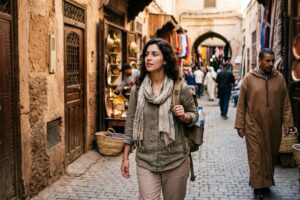
What is real and worth understanding: Persistent verbal attention — comments, approaches, catcalling, and unsolicited conversation — in busy tourist areas, particularly the Jemaa el-Fna area in Marrakech and the major souk routes of Fes. This is the most commonly reported experience by solo female travelers. It is genuinely annoying and can be exhausting over multiple days if you are not prepared for it. It is not physical danger. But it is a real feature of the experience in certain areas and dismissing it entirely does not help anyone prepare well.
What is overwhelmingly more common: Kindness. Genuine Moroccan hospitality toward foreign women — from riad hosts, from women encountered in the hammam, from families who invite you for tea, from shopkeepers who offer help with no expectation attached. Most women who travel Morocco alone describe their interactions with Moroccan people as one of the highlights of their trip. The warm encounters vastly outnumber the difficult ones, and this matters for calibrating your expectations honestly.
📊 Putting the Risk in Context
Morocco ranks 78th out of 163 countries on the 2024 Global Peace Index — above several popular solo female travel destinations including Brazil, South Africa, and parts of Southeast Asia. Women travelers who have visited both Morocco and popular European destinations frequently report comparable or lower levels of street harassment in Morocco than in parts of Italy, Spain, and Turkey. The difference is cultural context and preparation: travelers who arrive understanding Morocco’s social dynamics consistently have far more positive experiences than those who arrive without that awareness.
The 5 Strategies That Actually Work
These are practical, field-tested strategies from women who have traveled Morocco extensively — not generic advice, but things that genuinely change the experience:
1. Walk with Purpose — Always
Body language is the single most effective tool for reducing unwanted approaches in Morocco. Confident, purposeful walking — head up, steady pace, direction committed — dramatically reduces the frequency of approaches. Touts and persistent vendors target people who look hesitant, lost, or indecisive. Even when you have absolutely no idea where you are, keep walking until you can check your phone away from the main street, then recalibrate and continue with purpose. This works. Women who have spent weeks in Morocco independently confirm it is the most useful single habit to develop from day one.
2. “La Shukran” — One Time, Firmly, and Walk
“La shukran” (no thank you) said once, firmly, without smiling, and without breaking stride is the most powerful phrase in a solo female traveler’s Morocco vocabulary. The critical detail: once only. Any response beyond the first — even a second “no,” even a polite explanation — is interpreted as willingness to negotiate. Say it once, keep walking, do not look back. This is not rudeness. It is the clearest possible signal in the cultural context, and experienced Morocco travelers use it dozens of times per day without drama or conflict.
3. Sunglasses Are Not Optional
Eye contact in Morocco’s busy medinas can invite approaches. Sunglasses allow you to navigate, appreciate your surroundings, and observe without making eye contact with everyone who looks your way. Women who wear sunglasses throughout busy medina days consistently report fewer unwanted interactions than those who do not. A practical and inexpensive piece of kit that makes a measurable difference.
4. The Ring Strategy
Wearing a ring on your wedding finger and, if directly asked about a companion, mentioning a husband who is “at the riad” or “joining later” deflects the majority of persistent attention quickly. This is widely used by solo female travelers in Morocco and across North Africa and the Middle East as a practical self-protection strategy. Whether you consider it deception or pragmatism is a personal call — the effect on your experience is real and consistent.
5. Use Your Riad as Your Information Hub
The single best resource for a solo female traveler in Morocco is not a guidebook or a travel app — it is the staff at your riad. Riad owners and their teams know which streets are safe at which times, which restaurants to avoid, which tour operators are legitimate, how to arrange safe transport, and which routes are quietest for walking. Ask them everything. They are genuinely invested in your positive experience — their reviews depend on it — and they will consistently give you better, more current information than any published source.
What to Wear: Region by Region
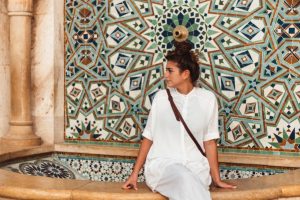
Clothing does not make you responsible for unwanted attention. But in Morocco’s specific social context, it does affect how much of it you receive — and this is worth knowing practically even if it is not philosophically satisfying.
| Location | Recommended | Why |
|---|---|---|
| Marrakech / Fes medinas | Loose long-sleeved top, maxi trousers or skirt, scarf accessible | Measurably reduces verbal attention; more comfortable in heat than shorts in actual practice |
| Gueliz (Marrakech new town) | Standard European summer dress — shorts and short sleeves acceptable | Modern mixed neighbourhood, significantly more relaxed atmosphere |
| Essaouira / Coastal cities | Relaxed — light summer clothing fine, modest for medina walks | Atlantic coast culture is significantly more relaxed than interior cities |
| Chefchaouen | Modest but relaxed — light trousers and covered shoulders | Small, calm city with mixed local/international atmosphere |
| Atlas Mountains / Rural villages | Long sleeves, long trousers or skirt — more conservative than cities | More traditional communities where modesty is deeply important and respected |
| Beach / Pool (Agadir, resorts) | Standard swimwear — bikini absolutely fine at resort beaches | Tourist resort areas operate to international beach standards |
The one item worth more than any other in your wardrobe for solo female travel in Morocco: a large, lightweight cotton scarf. It covers shoulders in a medina, wraps over your head in a mountain village, keeps you warm on a desert night, and converts to a beach wrap at the coast. Pack two. See our complete guide to what to wear in Morocco as a woman traveller and our full Morocco packing list.
City by City: Where Solo Women Feel Best
Chefchaouen — The Most Relaxed City in Morocco
Unanimously described by solo female travelers as the single most comfortable city in Morocco. The blue-painted mountain town has a calm, artistic atmosphere, a strong international traveler community in its hostels and cafés, virtually no aggressive vendor culture, and a genuine sense of safety that women describe as qualitatively different from anywhere else in the country. The medina is small enough to feel manageable within hours of arrival. The hiking trails in the surrounding Rif Mountains are excellent for independent exploration. Many solo women describe Chefchaouen as the place where they finally relaxed fully. See our guide to the Blue City of Morocco.
Essaouira — The Atlantic Refuge
Consistently the second most comfortable city for solo female travelers — a slower, windswept, bohemian Atlantic coastal town where the international traveler community creates a naturally mixed and open social environment. The medina is manageable and the overall atmosphere significantly more relaxed than Marrakech or Fes. Long beach walks, port sardine lunches, rooftop sunset tea: Essaouira is Morocco at its most accessible for independent female travelers. The Gnaoua music scene creates a unique cultural atmosphere. See our guide to Essaouira.
Rabat — Morocco’s Safest City
Morocco’s capital is consistently rated the country’s safest and most organized city. Modern, walkable, with a strong educated urban population and significantly less tourist-trade aggression than Marrakech or Fes. The Kasbah des Oudayas, the Hassan Tower, and the Chellah ruins are all excellent and easily navigated independently. For first-time Morocco solo female travelers who want a gentle entry point, Rabat is often a better first city than Marrakech. See our guide to Rabat, Morocco’s enchanting capital.
Fes — Deep Cultural Immersion
Fes is the most culturally extraordinary city in Morocco — and also the most navigationally complex. The medina is the world’s largest car-free urban area with 9,000 alleys, many of which are dead ends. Getting lost in Fes is a near-certainty on the first day. Many solo women report feeling more on edge in Fes than in Marrakech simply because the navigation challenge adds anxiety. The strategy that consistently works: a licensed guide for the first day — not optional, genuinely transformative. With orientation established, independent exploration on subsequent days becomes deeply satisfying. The “fake guide” problem in Fes (men who approach offering to show you the way and lead you toward commission-earning shops) is the specific challenge to be aware of: say “la shukran” firmly and use your downloaded offline map. See our complete guide to Fes, Morocco’s spiritual capital.
Marrakech — The Most Intense, Also the Most Rewarding
Marrakech is the city where most solo female travelers have both their most difficult and their most extraordinary Morocco moments — sometimes on the same day. The Jemaa el-Fna area is the most intense, the Kasbah neighbourhood and residential medina significantly calmer. The practical approach: stay in a well-reviewed riad inside the medina (so you return somewhere safe and comfortable), explore the souks in the morning before heat and crowds build, and know the “la shukran” strategy so well it feels automatic. The rewards are extraordinary — the square at sunset, the Majorelle Garden at dawn, the souks in full mid-morning colour. See our complete guide to Marrakech.
The Sahara Desert — The Most Empowering Experience
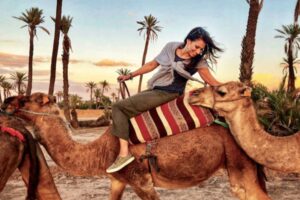
This surprises many solo female travelers: the Sahara desert overnight experience — which sounds logistically complex and physically remote — is consistently described as one of the most empowering solo female experiences in Morocco. When booked through a licensed tour operator, the desert camp is safe, well-staffed, and welcoming. The camel trek, the desert night, the sunrise: these are experiences that solo women describe as genuinely transformative in terms of confidence and self-discovery. Book through our desert tours from Marrakech for a fully supported, safe, and extraordinary solo desert experience. See our Merzouga and Sahara guide.
The Solo Female Traveler’s Secret: Moroccan Women’s Spaces
One of the most underused strategies for solo female travelers in Morocco is actively seeking out the spaces where Moroccan women gather. These environments offer something genuinely rare: connection with Moroccan women on equal terms, in spaces where the social dynamic shifts entirely from the street experience.
- The women’s section of a traditional hammam — a two-hour session alongside local Moroccan women going about their weekly ritual. The warmth, humour, and genuine hospitality of Moroccan women toward foreign female visitors in this space is extraordinary. See our complete Moroccan hammam guide
- Women’s argan cooperatives — near Essaouira and the Souss Valley, cooperatives of Berber women produce and sell argan oil and cosmetics directly. Visiting one is both a shopping experience and a genuine cultural encounter
- Cooking classes in a riad — a private or small-group cooking class is often shared with Moroccan women teachers whose warmth and pride in their cuisine creates immediate connection. See our Morocco cooking class guide
- Women’s tea in Berber villages — in the Atlas Mountains especially, Berber women are known for extraordinary hospitality toward foreign female visitors. With a guide who speaks Tachelhit, a village tea encounter becomes one of the trip’s most memorable moments
Practical Safety: Transport, Accommodation & Emergencies
Transport
- Always agree on taxi prices before getting in — insist on the meter for petit taxis (or agree a firm price). The scam of demanding much higher payment on arrival is the most common transport issue for solo female travelers
- Ask your riad to arrange taxis — particularly for airport and late-night transfers. A riad-arranged taxi has an established relationship and accountability that a street taxi does not
- Never accept lifts from strangers — Grand taxis are legitimate shared transport. Private car offers from non-official drivers are not
- CTM buses are safe and reliable — book reserved seats and travel in first class for overnight journeys. See our Morocco train guide for rail alternatives
Accommodation
- Stay in well-reviewed riads — not the cheapest unreviewed option. Riad staff are your most important safety resource. Their service, local knowledge, and accountability make them far superior to anonymous budget hotels for solo female travelers
- Book your first two nights in advance — arriving in any new Moroccan city without booked accommodation adds unnecessary stress and decision-making pressure when you are tired
- Hostels are a viable option — Morocco has a growing hostel culture in Marrakech, Fes, and Chefchaouen with strong solo female traveler communities. Many solo women find the social dimension of hostels valuable in Morocco specifically
Emergency Contacts
🆘 Save These Before You Arrive
- Police: 19
- Gendarmerie (rural): 177
- Ambulance: 15
- SOS Helpline (toll-free): 0800 00 08 85
- US Embassy Rabat: +212 537 637 200
- UK Embassy Rabat: +212 537 633 333
- Australian Embassy Rabat: +212 537 670 200
Register your trip before travel: US citizens use the STEP program (step.state.gov). UK citizens register at gov.uk/foreign-travel-advice/morocco. Both provide safety alerts and emergency assistance.
Solo Female Morocco Itinerary: 10 Days
Built specifically around the cities and experiences that solo women consistently rate most positively:
- Days 1–2: Chefchaouen — begin here. The Blue City settles you into Morocco gently, builds your confidence, and delivers extraordinary photographs. Hike to the Spanish Mosque viewpoint on day 2
- Days 3–4: Fes — hire a licensed guide for day 1 of the medina, explore independently on day 2. Tanneries, Al Qarawiyyin, the artisan souks. One of the most culturally profound Morocco experiences
- Days 5–6: Marrakech — arrive with your Morocco confidence already built from Chefchaouen and Fes. Majorelle Garden at 8am, souks, Jemaa el-Fna at sunset, hammam afternoon. The city feels very different when you are not experiencing it as your first Morocco destination
- Day 7: Atlas Mountains day trip — Imlil and a guided valley walk. See our Atlas Mountains day trip guide
- Days 8–10: Sahara desert — join our desert tour from Marrakech for a fully supported 3-day desert experience. The Sahara section of a Morocco solo female trip is consistently the highlight
🌸 Planning Your Solo Morocco Trip as a Woman?
We are a Berber family with 15 years of experience welcoming solo female travelers. We offer private solo tours and small group desert tours where solo women connect with each other — both designed with solo female comfort, flexibility, and genuine safety in mind. Tell us your dates and we plan the perfect Morocco experience for you.
Frequently Asked Questions: Solo Female Travel Morocco
Is Morocco safe for solo female travelers in 2026?
Yes — Morocco is safe for solo female travelers. Violent crime against female tourists is genuinely rare. The most commonly reported challenge is persistent verbal attention in busy medinas (particularly Marrakech’s Jemaa el-Fna area) — annoying and sometimes exhausting, but not physically dangerous. The vast majority of women who visit Morocco alone describe the experience as extraordinarily rewarding, deeply cultural, and often transformative in terms of personal confidence.
What is the best city in Morocco for solo female travelers?
Chefchaouen is consistently rated Morocco’s most comfortable city for solo women — calm, small, photogenic, and genuinely welcoming. Essaouira is the second most relaxed option. Rabat is the safest and most organised. Fes offers the deepest cultural experience with a guide. Marrakech is the most intense but rewards those who arrive prepared. The Sahara desert experience, booked with a licensed operator, is consistently rated the most empowering solo female experience in Morocco.
How do I handle verbal harassment in Morocco?
The strategies that work: walk with purpose always, say “la shukran” once firmly without smiling and keep walking, wear sunglasses to avoid eye contact, wear modest clothing in medinas, and use your riad staff’s advice for which routes and areas are calmest at which times. The critical detail: respond once only. Any second response — even a second “no” — is interpreted as willingness to engage. One clear “la shukran,” continued walking, no eye contact. This works consistently.
Do I need to wear a headscarf in Morocco?
No — Morocco does not require foreign women to wear a headscarf. A large cotton scarf is worth carrying for its practical versatility (modesty in conservative areas, warmth at night, hammam use, desert dust protection, sun protection) but it is not mandatory in any city or area tourists visit. The modest clothing recommendation for medinas refers to covered shoulders and knees — not headscarf.
Is it safe to travel to the Sahara desert alone as a woman?
Yes — when booked through a licensed tour operator. The desert camp experience is safe, well-staffed, and consistently described by solo female travelers as one of the most empowering experiences of their Morocco trip. Book with a licensed operator rather than an unlicensed fixer. Our desert tours from Marrakech welcome solo female travelers and frequently combine them with other solo travelers for the group dynamic many women find valuable.
Should I get travel insurance for solo female travel in Morocco?
Absolutely — travel insurance is non-negotiable for solo travel anywhere, and Morocco’s remote areas (Sahara desert, High Atlas mountains) make medical evacuation coverage specifically important. Ensure your policy covers: medical evacuation, emergency repatriation, and trip cancellation. See our Morocco travel insurance guide.
Written by the Days Morocco Tours team — a Berber family from Morocco who has welcomed solo female travelers from every country for over 15 years. We offer private and group tours designed with solo female travelers’ comfort and safety as the primary consideration. Read our story here.