This is the most common question in Morocco travel planning. Marrakech vs Fes? Both cities are ancient imperial capitals with UNESCO-listed medinas. Both have extraordinary food, souks, riads, and the particular atmosphere of a Moroccan city that has been alive and complex for over a thousand years. Both are genuinely transformative places to spend several days. And yet they feel almost nothing alike.
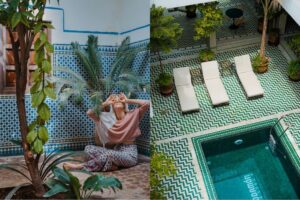
Marrakech is the extrovert — rose-coloured, theatrical, frenetic, and utterly seductive. The city puts on a performance every single day and it does not apologize for it. The energy of Jemaa el-Fna at sunset, the glamour of the great riads, the accessibility of the Atlas Mountains and the Sahara desert as day-trip and extension options: Marrakech is Morocco at maximum engagement, optimised for visitors without sacrificing its own character.
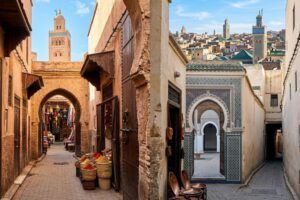
Fes is the introvert — scholarly, spiritual, quietly extraordinary, and deliberately resistant to the idea of performing for anyone. It is the world’s oldest continuously inhabited medieval city, its 9,000 alleys unchanged in structure since the 12th century, its artisan guilds still producing leather and copper and silk using the same processes they developed under the Marinid dynasty. Fes rewards patience and depth in a way that Marrakech does not quite demand — and what it gives back to travelers who bring that patience is something more lasting than the memories Marrakech produces.
This guide gives you the complete honest comparison across every dimension that matters — and a clear recommendation depending on what kind of traveler you are.
⚡ The Quick Answer
- Choose Marrakech if: First Morocco trip, limited time, want maximum variety, love luxury and nightlife, coming from a budget airline hub
- Choose Fes if: Deeper cultural experience, love history and craftsmanship, want “real Morocco” with less tourist polish, have 3+ days
- Best answer: Visit both — they are 330 km apart, connected by train, and together give you a Morocco experience that neither city alone provides
- Suggested order: Marrakech first (easier entry), Fes second (deeper reward)
- Cost difference: Fes is 20–30% cheaper than Marrakech for equivalent quality
The Cities at a Glance: Marrakech vs Fes
| Category | Marrakech | Fes |
|---|---|---|
| Founded | 1062 AD (Almoravid dynasty) | 789 AD (Idrisid dynasty) |
| Vibe | Theatrical, cosmopolitan, intense | Scholarly, spiritual, medieval |
| Medina navigability | Moderate — central square as anchor | Complex — 9,000 alleys, GPS unreliable |
| Tourist infrastructure | Excellent — most developed in Morocco | Good but less polished |
| Signature landmark | Jemaa el-Fna square | Chouara Tannery |
| Nightlife | Excellent — rooftop bars, clubs | Quiet — few tourist bars |
| Day trips | Atlas Mountains, Sahara, Essaouira | Meknes, Volubilis, Chefchaouen |
| Cost level | Higher — 20–30% premium | Lower — better value |
| Airport connections | Excellent — major European hub | Good — regional European flights |
| Best for | First-timers, luxury, short trips | Culture-seekers, depth, returning visitors |
Marrakech: Everything You Need to Know
The Character of the City
Marrakech has been welcoming foreign visitors for longer than almost any other city in Morocco — Winston Churchill painted here in the 1930s, the Rolling Stones stayed in the 1960s, and the city has never stopped being both magnetically Moroccan and surprisingly accessible to the international visitor. This is both its genius and its compromise. Marrakech has adapted to tourism without surrendering its soul entirely — the Jemaa el-Fna remains genuinely extraordinary and not performative, the residential medina lanes behind the souk quarter are authentically lived-in, and the riad culture has produced some of the finest boutique accommodation in the world. But the tourist premium is real, the souvenir economy is pervasive, and the “real Morocco” that some travelers seek requires more deliberate effort to find here than in Fes.
The physical character of Marrakech is immediately distinctive: the rose-pink ochre of the buildings, the flat rooftops stretching to the Atlas Mountains horizon, the minaret of the Koutoubia Mosque as the city’s compass needle. Motorbikes share the medina’s main lanes with pedestrians, donkeys, and tourists. The energy is constant, kinetic, and after three days, can be exhausting.
Marrakech’s Greatest Experiences
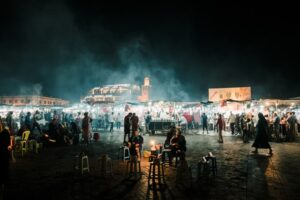
- Jemaa el-Fna at sunset — the most extraordinary public square in the world at the hour it comes alive. From a rooftop café above the square, with mint tea. See our guide to Jemaa el-Fna
- Majorelle Garden at opening time — 8am before the crowds, the cobalt blue buildings and tropical planting in morning silence. See our Majorelle Garden guide
- Bahia Palace — the finest accessible example of Moroccan palace architecture. Painted cedar ceilings, carved stucco, private courtyard gardens. See our Bahia Palace guide
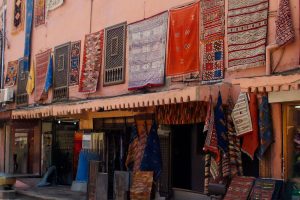
- The souks in full morning colour — the spice souk, the leather souk, the lantern quarter, the carpet souk. Best from 9–11am before the heat and crowds peak. See our guide to markets in Marrakech
- A private hammam in a riad — the steam, black soap, kessa scrub, and argan oil massage in a private suite. The most luxurious recovery experience in Morocco. See our Moroccan hammam guide
- Hot air balloon at dawn over the Palmeraie — the Atlas Mountains in the distance, the city below, the palm grove spreading beneath you. See our hot air balloon guide
Marrakech Day Trips: The Gateway Advantage
Marrakech’s greatest practical advantage over Fes is its day trip and extension options. From Marrakech:
- Atlas Mountains (Imlil) — 90 minutes. See our Atlas Mountains day trip guide
- Essaouira — 3 hours by CTM bus. Atlantic coast, ramparts, seafood
- Ait Benhaddou — 3 hours by car. UNESCO kasbah, Game of Thrones location
- Ouzoud Waterfalls — 2.5 hours. Morocco’s most spectacular waterfall
- The Sahara desert — 5–7 hour drive. The full southern circuit is accessible from Marrakech in a 3–5 day extension
Marrakech: The Honest Downsides
Tourist pressure is the consistent complaint. The Jemaa el-Fna area and the main souk routes have aggressive tout culture that requires awareness and assertiveness. Prices for accommodation and food are 20–30% higher than equivalent quality in Fes. The most famous experiences (Majorelle Garden, Bahia Palace) are crowded during peak season. And the city, once you understand it, can feel less “authentically Moroccan” and more “tourism-adapted Morocco” compared to Fes — which is not entirely unfair, though it undersells Marrakech’s genuine character.
Fes: Everything You Need to Know
The Character of the City
Fes does not try to be anything for anyone. It simply is what it has been for 1,200 years — the spiritual, intellectual, and artisanal heart of Morocco — and it extends this reality to visitors on its own terms. The Fes el-Bali medina is the world’s largest car-free urban area: no motorbikes, no cars, no golf carts. Donkeys and mules carry everything. The lanes narrow to barely shoulder-width in places. The craft guilds — leather workers, brass beaters, silk weavers, potters — operate in the same districts they have occupied for centuries, producing goods that Moroccan families actually buy rather than tourist souvenirs manufactured for export.
Where Marrakech feels like Morocco at maximum visual engagement, Fes feels like Morocco at maximum historical depth. Travelers who spend three days here consistently describe the experience as one of the most intellectually and culturally rewarding of their travel lives — more complex than Marrakech, more demanding of patience, and more lasting in what it leaves behind.
Fes’s Greatest Experiences
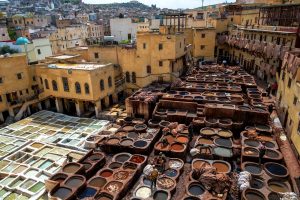
- The Chouara Tannery at dawn — the most iconic image in Morocco: circular stone vats of natural dye visible from surrounding rooftop terraces. The process unchanged since the 11th century. Best in morning light. See our full Fes guide
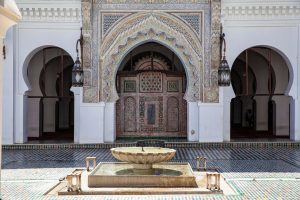
- The Al Qarawiyyin Mosque — founded in 859 AD as the world’s oldest continuously operating university. Non-Muslims cannot enter but the carved wooden doors and the sound of students reciting within create an experience of extraordinary cultural depth. See our Al Qarawiyyin guide
- Bou Inania Madrasa — the finest accessible example of Marinid architecture in Morocco: intricate carved cedar screens, geometric zellige tilework, and a carved stucco interior of bewildering complexity, all centred around a white marble courtyard
- Seffarine Square — the metalworkers’ quarter where brass and copper craftsmen beat trays, pots, and architectural elements with medieval tools against a soundtrack of constant ringing metal. An extraordinary living demonstration of a craft tradition unchanged for centuries
- Getting lost in the medina — genuinely lost, in the good way. With offline maps downloaded and a general directional sense, wandering the Fes medina’s 9,000 lanes reveals hidden courtyards, ancient fountains, neighbourhood mosques, and the daily life of a medieval city still entirely in use
- The Borj Nord panoramic view at sunset — the 16th-century fortress above the medina offers the finest panoramic view in Morocco: a sea of green-tiled rooftops and minarets stretching to the horizon, best at golden hour
Fes Day Trips: The Northern Morocco Gateway
Fes’s day trip options are different in character from Marrakech’s — less dramatic in landscape terms but extraordinarily rich in history:
- Meknes — 45 minutes by train. Morocco’s most underrated imperial city, huge Bab Mansour gate, royal stables, Moulay Ismail mausoleum. Often has the medina almost to yourself
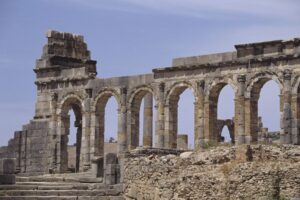
- Volubilis — 1 hour by car. The best-preserved Roman ruins in North Africa — mosaics, triumphal arch, Capitol — from the 3rd century AD. UNESCO World Heritage site. See our Volubilis guide
- Chefchaouen — 4 hours by CTM bus. The Blue City as a 2-night extension from Fes is one of the classic northern Morocco experiences
- Sahara desert — approximately 7 hours by car. Fes is geographically closer to the Merzouga dunes than Marrakech and the Sahara circuit can be driven from Fes via the Middle Atlas cedar forests, a spectacular approach through a completely different landscape
Fes: The Honest Downsides
The medina navigation is genuinely challenging. Getting lost in Fes is not charming on day one when you are tired and hungry — it is stressful without a guide or a well-downloaded offline map. The “fake guide” problem — men who approach offering to show you the way and steer you toward commission-earning shops — is specifically concentrated in Fes rather than Marrakech. Nightlife is minimal by Moroccan city standards. Accommodation variety is significantly less than Marrakech. And the city demands more patience than Marrakech’s more immediately legible layout and entertainment infrastructure.
Medinas Face to Face: The Defining Comparison
Both cities have UNESCO-listed medinas. This is where the experience diverges most dramatically and where your personal travel style matters most.
🌹 Marrakech Medina
- Jemaa el-Fna as natural anchor — you always know where you are in relation to it
- Main souk lanes are relatively wide and well-lit
- Motorbikes add noise and navigation challenge but also create clear routes
- GPS works reliably on main routes
- Many restaurants, cafés and amenities throughout
- More tourist-adapted — English widely spoken
- Higher density of touts on main routes
- Most visitors navigate independently within one day
🏛️ Fes El-Bali Medina
- World’s largest car-free urban area — no motorbikes, only mules
- 9,000+ alleys — GPS regularly fails in narrow lanes
- No central square to anchor navigation
- Lanes as narrow as 60cm in places
- More authentic daily life — fewer tourists per square metre
- Artisan production still for local market, not just tourists
- Guide strongly recommended for first visit
- Takes 2–3 days to begin navigating with confidence
Food: Where to Eat and What
Both cities have excellent food — but they excel in different ways and at different price points.
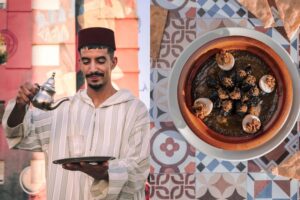
Marrakech has Morocco’s most developed restaurant scene: riad courtyard dining, rooftop restaurants with Atlas Mountain views, international cuisine in Gueliz (French, Italian, Japanese), a vibrant street food scene on Jemaa el-Fna. The tanjia — slow-cooked meat in a clay urn left at the hammam oven for 8 hours — is Marrakech’s exclusive signature dish. See our guide to the best restaurants in Marrakech.
Fes is the culinary capital of Morocco by local consensus. The pastilla — that extraordinary sweet-savoury pastry of pigeon, almonds, and cinnamon dusted with icing sugar — is a Fes invention and is better here than anywhere else. Family-run eateries in the medina serve home-cooking-standard food that makes most Marrakech restaurant food feel slightly theatrical by comparison. Prices are 30–40% lower for equivalent quality. The food in Fes rewards the traveler who asks their riad host where to eat rather than relying on tourist-zone restaurants.
Accommodation: Riads in Both Cities
Both cities are famous for their riads — traditional courtyard houses converted to guesthouses — and staying in one is one of the essential Morocco experiences regardless of which city you choose. The differences:
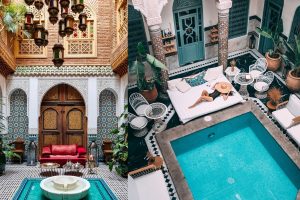
Marrakech riads range from budget-friendly to world-class luxury with over 1,000 to choose from. The variety and quality are extraordinary. The finest riads in Morocco are in Marrakech — La Mamounia, El Fenn, Riad Yasmine — and command premium global rates. Budget riads start around 300–400 MAD per night. See our Morocco accommodation guide.
Fes riads are fewer in number but often feel more authentically historical — less renovated for Instagram-tourism and more genuinely occupying the centuries-old buildings they were converted from. Many are still family-owned and run with a warmth that larger Marrakech operations sometimes lose at scale. Prices are 20–30% lower for comparable quality.
Cost Comparison: Real 2026 Numbers
| Category | Marrakech | Fes | Difference |
|---|---|---|---|
| Mid-range riad | 600–1,200 MAD/night | 400–900 MAD/night | Fes 25% cheaper |
| Restaurant meal (mid-range) | 150–280 MAD/person | 100–200 MAD/person | Fes 30% cheaper |
| Licensed guide (full day) | 400–600 MAD | 350–500 MAD | Similar |
| Petit taxi (short ride) | 15–30 MAD | 12–25 MAD | Fes slightly cheaper |
| Daily budget (comfortable) | 800–1,400 MAD/day | 600–1,000 MAD/day | Fes 25–30% cheaper |
For the complete Morocco budget breakdown, see our Morocco trip cost guide.
Who Should Visit Marrakech
- First-time Morocco visitors — Marrakech’s infrastructure reduces the learning curve. You ease into Morocco rather than being thrown into it. The tourist framework is more forgiving of navigation errors and unexpected situations
- Short trip travelers (2–4 days) — Marrakech delivers its greatest experiences in 2–3 days. Fes requires more time to unfold properly
- Luxury seekers — Marrakech has the finest hotels, spas, and fine dining in Morocco. La Mamounia, Royal Mansour, and dozens of exceptional luxury riads set a global standard
- Night life and social scene — Marrakech has a genuine rooftop bar and club culture that Fes largely lacks
- Families with children — Marrakech’s wider streets, more varied entertainment options, and stronger tourism infrastructure make it more family-manageable. See our guide to things to do in Marrakech with family
- Travelers using it as a gateway — for the Sahara desert, Atlas Mountains, Essaouira, and the south, Marrakech is the unrivalled hub
Who Should Visit Fes
- History and culture-focused travelers — Fes is the deepest cultural experience available in Morocco. The medina’s 1,200-year continuity and the living craft traditions create something that no amount of tourist infrastructure in Marrakech can replicate
- Return visitors to Morocco — many travelers who have done Marrakech choose Fes for their second visit and consistently describe it as the more profound experience
- Budget travelers — equivalent quality at 20–30% lower cost across accommodation, food, and activities makes Fes Morocco’s best-value major city
- Travelers who dislike aggressive tourist culture — the vendor culture in Fes is focused on navigation-related touts rather than persistent souvenir pressure. After one day’s orientation, the medina feels significantly calmer than Marrakech’s tourist core
- Food enthusiasts — Fes is the culinary capital of Morocco. The pastilla, the harira, the mechoui, the couscous at family restaurants: Fes food at its best is the finest in the country
- Travelers heading north to Chefchaouen — Fes is the natural gateway to the northern Morocco circuit (Meknes, Volubilis, Chefchaouen, Tangier)
The Best Answer: Visit Both
The honest recommendation is not to choose — it is to visit both. Marrakech and Fes are 330 km apart and connected by a comfortable 3h40m train journey. They are different enough that visiting both genuinely doubles the Morocco experience — not in the sense of covering more ground, but in the sense of understanding something more complete and more true about what this country is and has been.
The most logical structure: fly into Marrakech (better flight connections, easier entry point), spend 3–4 days including an Atlas Mountains day trip, take the train to Fes, spend 3 days in the medina and on a Meknes-Volubilis day trip, then return to Casablanca by train for your flight home. This is the backbone of our 7-day Morocco itinerary and the circuit we recommend to almost every first-time Morocco visitor.
If you truly can only choose one: Marrakech for your first Morocco trip, Fes for your second. First-timers consistently get more from Marrakech because the infrastructure matches the inexperience. Return visitors consistently describe Fes as the more lasting experience. This is not a contradiction — it is simply the right city at the right time in your Morocco journey.
To build the perfect itinerary combining both cities, contact us and we will plan the route around your specific interests, pace, and budget. Our private tours connect both cities with all the stops in between — Sahara, Atlas, Ait Benhaddou — in exactly the right sequence. See all our Morocco private tours.
🏙️ Ready to Visit Marrakech, Fes — or Both?
We are a Berber family who has guided travelers through both cities for 15 years. We know the riads, the restaurants, the licensed guides, and the right sequence for every type of traveler. Tell us your dates and interests and we plan the perfect Morocco city route for you.
Frequently Asked Questions: Marrakech vs Fes
Is Marrakech or Fes better for a first-time visitor?
Marrakech is the better first Morocco destination for most visitors. Its tourist infrastructure is more developed, the medina is easier to navigate with Jemaa el-Fna as a central anchor, English is more widely spoken, and the range of activities and dining options is broader. The learning curve is gentler, allowing first-time visitors to ease into Morocco without the navigational complexity of Fes. If you can only visit one city on a first trip, Marrakech. If you are returning, Fes.
Is Fes cheaper than Marrakech?
Yes — significantly. Fes is approximately 20–30% cheaper than Marrakech across accommodation, restaurants, and activities for equivalent quality. A mid-range riad in Fes costs 400–900 MAD per night versus 600–1,200 MAD in Marrakech. Restaurant meals at comparable quality are 30–40% lower. For budget-conscious travelers seeking cultural depth, Fes offers far better value per dirham spent.
Which city has a better medina — Marrakech or Fes?
They are extraordinary in completely different ways. Marrakech’s medina is more navigable, more tourist-adapted, and more immediately legible — Jemaa el-Fna anchors everything. Fes el-Bali is the world’s largest car-free urban area, more authentically medieval, more complex (9,000 alleys), and ultimately more profound as a cultural experience — but requires more time and ideally a guide for the first day. Fes wins on historical depth and authenticity. Marrakech wins on accessibility and immediate reward.
How far is Marrakech from Fes?
Approximately 330 km by the direct northern route through Casablanca. By train: 3 hours 40 minutes via Casablanca (with a change). By direct road: approximately 5–6 hours. The most efficient route for a combined visit: train Marrakech–Casablanca–Fes, or the scenic desert circuit driving Marrakech → Ait Benhaddou → Dades → Merzouga → Middle Atlas → Fes (5–7 days). See our complete 7-day Morocco itinerary.
Do I need a guide in Fes but not in Marrakech?
A guide significantly enriches the experience in both cities. In Marrakech, guides are helpful but not essential — the medina is manageable independently after a day of orientation. In Fes, a licensed guide for at least the first day is genuinely strongly recommended — the medina’s 9,000 alleys regularly confuse GPS, the tannery viewing terraces require guide access, and the fake guide problem (men steering tourists toward commission shops) is specifically concentrated in Fes. One good guided day in Fes provides the orientation that makes independent exploration on subsequent days deeply rewarding.
What is the signature food of each city?
Marrakech’s exclusive dish is tanjia — meat slow-cooked in a clay urn at the hammam oven for 8 hours. It exists only in Marrakech and is genuinely extraordinary when prepared traditionally. Fes is associated with pastilla — the sweet-savoury pigeon, almond, and cinnamon pastry dusted with icing sugar. Fes also has the finest couscous and harira in Morocco by local consensus, and its family-run restaurant cooking is generally considered the country’s finest culinary tradition. See our guide to the best restaurants in Marrakech and our complete Moroccan food guide.
Which city is better for shopping?
Both are excellent but for different purchases. Marrakech is better for home décor, modern Berber design, fashion-forward carpet and textile choices, and the widest range of souvenir options. Fes is better for traditional craftsmanship — the leather from the Chouara tannery district, the famous blue-and-white Fes ceramics, intricate metalwork, and hand-woven silk textiles. Prices for equivalent craft quality are generally lower in Fes. See our guide to bargaining in Morocco.
Written by the Days Morocco Tours team — a Berber family who has guided travelers through both Marrakech and Fes for over 15 years and knows both cities with the depth that only years of daily presence provides. Read our story here.