
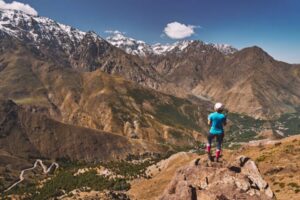
Sixty-three kilometres south of Marrakech — ninety minutes by car — a completely different Morocco begins. The city’s heat, noise, and medina energy fall away as the road climbs into the High Atlas. Walnut trees line the river. Pink-red adobe villages appear on hillsides that look impossible to build on. Mules carry firewood. Children wave from stone bridges. And then Imlil appears — a mountain village at 1,740 metres, surrounded by peaks that rise to over 4,000 metres, with the summit of Mount Toubkal (the highest peak in North Africa at 4,167 metres) visible on clear days above the southern ridgeline.
Most Morocco travelers never make it to Imlil. They arrive in Marrakech, walk the souks, visit the Majorelle Garden, eat tagine twice, and fly home. The ones who make it to Imlil come back with the photographs that actually stop the scroll — snow-capped peaks at dawn, stone villages carved into canyon walls, walnut orchards turning gold in October, and the particular quality of light that exists only at altitude in the Atlas. They also come back having experienced a Morocco that has nothing to do with tourist infrastructure, souvenir hawking, or medina performance: genuine Berber mountain life, extraordinary landscape, and the particular satisfaction of having walked somewhere that required actual effort to reach.
This is the complete guide to Imlil — trekking routes, costs, timing, how to get there, where to stay, and everything that makes the difference between a good visit and an unforgettable one.
⛰️ Imlil Morocco — Essential Facts
- Altitude: 1,740 metres (5,709 feet) above sea level
- Distance from Marrakech: 63 km — approximately 90 minutes by car
- Mount Toubkal: 4,167 metres — highest peak in North Africa, 2-day trek from Imlil
- National Park: Toubkal National Park — established 1942, Morocco’s first national park
- Best season: April–June and September–November for trekking; July–August for Toubkal summit
- Cash only: No ATMs in Imlil — withdraw in Marrakech before leaving
- Local language: Tachelhit (Berber dialect) — French and basic English in guesthouses
- Guide cost: 350–500 MAD per day for licensed mountain guide ($35–50)
What Makes Imlil Different from Every Other Morocco Destination
Imlil is not a tourist attraction. It is a functioning Berber mountain village that happens to be the gateway to North Africa’s highest trekking destination. The distinction matters enormously to the experience. There are no souvenir stalls with fake fossils, no touts offering to show you the way, no restaurants serving tourist-adapted tagines with less spice than a Moroccan family would recognise. What there is: small family-run guesthouses, a handful of cafés serving honest mountain food, a mule track that serves as the main high street, and the extraordinary landscape of the High Atlas beginning immediately in every direction.
The day-trippers from Marrakech arrive around 10am and leave by 4pm. Once they are gone, Imlil becomes itself again — quiet, atmospheric, genuine. Staying at least one night is the most important decision you can make about your Imlil visit. The mountains at dawn and dusk, when the light does things to the rock and the snow that midday photography cannot replicate, are available only to those who spend the night.
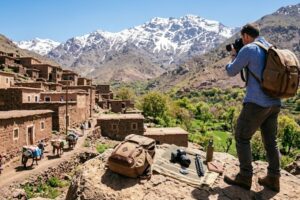
Trekking from Imlil: All Routes by Level
Easy: Valley Walks & Village Circuits (2–5 hours)
Not every visitor to Imlil needs to be a trekker. The valley walks from the village — north toward the Mizane River, east toward the village of Aroumd, or south along the mule trails into the lower Atlas — are accessible to anyone with reasonable fitness and appropriate footwear. No guide is required for these routes, though one will dramatically enrich the experience by providing the names of every plant, the history of every village, and an introduction to families along the route.
The Aroumd Loop: The most popular half-day walk — 3–4 hours round trip. Climb the mule track from Imlil to the ancient terraced village of Aroumd perched above the valley, then return via the riverbed. Views of Toubkal and the surrounding massif are spectacular from the upper village. Distance: approximately 8 km. Elevation gain: 300 metres.
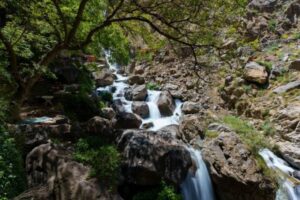
The Waterfall Walk: A 30-minute walk from Imlil village leads to a series of small waterfalls in the Atlas cedar and walnut forest. Genuinely beautiful and entirely achievable for any fitness level. Perfect for families with children or visitors who want the mountain atmosphere without serious exertion.
Multi-village circuit: A guide-led full-day walk connecting Imlil to the villages of Armed, Tiziane, and Sidi Chamharouch (a sacred shrine visited by Moroccan pilgrims) — approximately 6–7 hours with a reasonable pace. One of the finest cultural walking days available in the High Atlas.
Moderate: Toubkal Base Camp (Day Trek or Overnight)
The route from Imlil to the Toubkal Refuge at 3,207 metres is the most popular serious trek in Morocco. It is achievable for fit, non-technical hikers in a single long day (7–9 hours return) or more comfortably as an overnight, staying at the CAF (Club Alpin Français) refuge and returning the next morning.
The path climbs through the Mizane Valley past Sidi Chamharouch — a natural rock formation at 2,310 metres where a small shrine and café mark the traditional stopping point — then ascends more steeply through rocky scree to the refuge. The views from the refuge across the Atlas massif are extraordinary. Many visitors stop here rather than continuing to the summit, and the refuge experience itself — simple mountain food, sleeping in dormitory bunks with fellow trekkers from across the world, watching the stars from the terrace at 3,200 metres — is genuinely memorable.
Distance: 12 km one way | Elevation gain: 1,467 metres | Fitness required: Good — this is a serious mountain walk
| Route | Duration | Distance | Elevation Gain | Level |
|---|---|---|---|---|
| Aroumd Loop | 3–4h | 8 km | 300 m | Easy |
| Waterfall Walk | 1h | 3 km | 80 m | Very easy |
| Toubkal Refuge | 7–9h return | 24 km | 1,467 m | Moderate–Hard |
| Toubkal Summit | 2 days | 30 km | 2,427 m | Hard |
| M’Goun Circuit | 4–7 days | 60–100 km | Varies | Hard — Expert |
Hard: Mount Toubkal Summit (2-Day Trek)
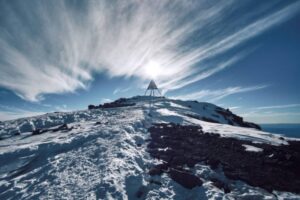
Standing at 4,167 metres, Mount Toubkal is the highest peak in North Africa and the highest mountain in the Arab world. It does not require technical climbing in summer conditions — no ropes, no ice axes, no specialist equipment — but it demands good fitness, proper preparation, and genuine respect for altitude. The standard route involves:
Day 1: Imlil → Sidi Chamharouch (2,310m, 3–4 hours) → Toubkal Refuge (3,207m, 2–3 hours more). Total: 5–7 hours. Overnight at the refuge.
Day 2: Refuge → Summit (4,167m, 3–4 hours, pre-dawn departure recommended for clear summit views and to beat afternoon cloud) → Return to Imlil (3–4 hours). Total: 6–8 hours.
Important practical notes: Three police checkpoints on the route require your passport — keep it accessible in a zippered pocket. The summit section involves steep rocky scree. In winter (December–March), crampons and ice axes are required and a qualified mountain guide is essential. In summer, fit hikers can complete this without technical equipment but a licensed guide remains strongly recommended for navigation in poor visibility and emergency response. Altitude sickness is possible above 3,000 metres — ascend slowly, stay hydrated, and descend immediately if serious symptoms develop.
⚠️ Altitude Sickness: Know the Signs
Acute Mountain Sickness (AMS) can affect anyone above 2,500 metres regardless of fitness. Warning signs: persistent headache, nausea, dizziness, loss of appetite, difficulty sleeping. The treatment is simple: descend. Do not attempt to push through altitude sickness symptoms at altitude. The Toubkal Refuge medical post at 3,207 metres has basic medical facilities. Morocco has mountain rescue services — the Gendarmerie Royale can be contacted in emergencies — but evacuation from altitude takes time. Prevention: ascend slowly, drink 3–4 litres of water per day, avoid alcohol the night before summit day, and consider one acclimatisation night in Imlil before tackling Toubkal.
When to Visit Imlil
Imlil is open year-round, but the experience differs dramatically by season:
- Spring (March–May): The finest season. Wildflowers across the lower slopes, walnut trees in blossom, clear skies, comfortable temperatures at altitude (5–15°C in the day). Snow still on the high peaks above 3,500m, which makes summit photography extraordinary. The Toubkal Refuge path may have snow sections in March–April — crampons useful but not always required
- Summer (June–August): Best weather for summit attempts — clear conditions and dry paths. Hot in the lower valley (25–30°C) but perfectly comfortable at altitude. This is the peak trekking season — the refuge fills and advance booking is essential. Early morning summit departures recommended to beat afternoon cloud
- Autumn (September–November): Arguably the most beautiful season in the valley — walnut trees turning gold in October, the harvest underway, excellent light, fewer visitors than summer. The Toubkal summit remains accessible in good conditions until late November. Our personal favourite time to guide here
- Winter (December–February): A completely different experience — snow-covered, cold (temperatures below freezing above 2,000m at night), extraordinarily beautiful. Toubkal summit requires full winter mountaineering equipment. Not suitable for casual visitors. For experienced winter trekkers with proper equipment and a qualified guide, an extraordinary adventure
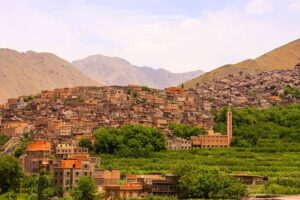
How to Get to Imlil from Marrakech
By Grand Taxi (Recommended for Independent Travelers)
The most convenient independent option. Grand taxis from Marrakech depart from a dedicated stand near the Jemaa el-Fna bus stop. The journey to Imlil costs approximately 250–350 MAD to hire the entire taxi (for up to 6 people, or negotiate for fewer), or 40–60 MAD per person in a shared taxi. Journey time: approximately 75–90 minutes depending on traffic. The road is fully paved all the way to Imlil village. Confirm the taxi is going to Imlil specifically — some drivers offer Asni (the nearest large town, 17 km before Imlil) as an alternative. Insist on Imlil.
By Private Transfer (Recommended for Groups)
Our most popular option for organized visits. A private vehicle from your Marrakech accommodation directly to Imlil, timed to your schedule, with a driver who waits or returns to collect you. We arrange this as part of all our Atlas Mountains day trips from Marrakech and as a standalone transfer. Cost for a private vehicle: approximately 400–600 MAD each way.
What NOT to Do: Public Bus
Buses run from Marrakech to Asni (the larger town before Imlil) but do not continue to Imlil village. You would then need a local taxi for the final 17 km — functional but slow and requires coordination. Grand taxi or private transfer is a significantly better use of time.
Where to Stay in Imlil
Accommodation in Imlil consists almost entirely of family-run guesthouses and small lodges. There are no international hotel chains, no luxury resorts, and no city-standard facilities — and this is entirely the point. The atmosphere of staying in a Berber family guesthouse in the Atlas Mountains, with mountain views from every terrace, home-cooked Atlas meals, and the sound of the river replacing traffic: this is the experience Imlil offers that no hotel in Marrakech can replicate.
- Kasbah du Toubkal: The benchmark property — a restored kasbah perched above the village with sweeping valley views, hammam, guided walk programmes, and full board. The responsible tourism certification and community investment model make it a genuinely ethical choice. Book 4–6 weeks ahead for peak periods. Cost: 600–900 MAD per person per night
- Riad Imlil: A beautiful traditional riad in the village with mountain-view terrace and excellent home cooking. Mid-range: 300–500 MAD per night
- Berber Family Lodge: Founded by a local Berber guide, this is the most authentic guesthouse experience in the area — simple, warm, run with genuine hospitality. Budget-friendly: 150–250 MAD per night
- Toubkal CAF Refuge: At 3,207 metres — basic dormitory accommodation for serious trekkers en route to the summit. Must be booked in advance especially July–August. Contact via caf-maroc.ma
Essential reminder: Imlil has no ATM. Withdraw sufficient cash in Marrakech before leaving. Budget 1,500 MAD minimum per day for accommodation, meals, guide fees, and incidentals for a 2-night trek visit.
The Berber Culture of Imlil: What Most Guides Miss
Imlil sits at the heart of the Souss-Massa-Drâa Berber heartland — the indigenous Amazigh people who have inhabited the High Atlas for millennia before the Arab arrival and who maintain their own language (Tachelhit), their own architectural traditions (the pink-red adobe construction using Atlas clay), their own agricultural calendar (organised around the almond blossom in February, the walnut harvest in October, and the pastoral cycles of their herds), and their own social structures.
The mule is still the primary vehicle in the upper Atlas — not as a tourist attraction, but because many villages above 2,000 metres have no road access and have never needed one. Women weave on outdoor looms using the same patterns their grandmothers used. The communal bread oven (ferran) in the village centre serves every family’s daily bread. Friday prayers fill the small mosque. Harvest season brings the whole community to the terraced fields.
For a traveler who has spent time in Morocco’s medinas — which are extraordinary but also well-adapted to tourism — Imlil provides something genuinely different: a community that is not performing for visitors, simply living. A guide who speaks Tachelhit and knows these families by name opens this world in a way that independent walking simply cannot. Our guides from the High Atlas region make this the centrepiece of every Imlil visit. Contact us to arrange a guided visit to Imlil as part of your Morocco tour.
Combining Imlil with Your Morocco Itinerary
Imlil works perfectly as either a day trip or a 2-night addition to any Morocco itinerary. The most natural integrations:
- As a Marrakech day trip: Depart Marrakech at 7am, arrive Imlil by 9am, 4–5 hour valley walk with a local guide, lunch in a guesthouse, return to Marrakech by 6pm. The Marrakech to Atlas Mountains day trip is our most popular single-day experience
- As a 2-night trek: Day 1 Marrakech → Imlil (arrive afternoon, acclimatise, evening in the guesthouse). Day 2: full Toubkal Refuge trek. Day 3: return to Marrakech and continue your itinerary south toward the Sahara. Perfect before our 6-day desert adventure from Marrakech
- As a standalone mountain break: 3–4 nights in Imlil for serious trekkers — Aroumd loop on day 1, refuge on day 2, summit on day 3, rest and culture day 4. The most complete Atlas Mountains experience available from Marrakech
See our complete 7-day Morocco itinerary for how to integrate Imlil into a broader Morocco route, and our Morocco packing list for exactly what to bring for mountain trekking.
🏔️ Ready to Explore the Atlas Mountains?
We are a Berber family from the Atlas region — our guides grew up in these mountains, speak the local language, and know every trail, family, and viewpoint. Day trips from Marrakech, multi-day treks, and Toubkal summit expeditions arranged for all fitness levels. Tell us what you want to do and we plan the route.
Frequently Asked Questions: Imlil Morocco
How do I get from Marrakech to Imlil?
The easiest options are grand taxi (shared or private, 250–350 MAD for the whole taxi, 75–90 minutes) or a private transfer arranged through your tour operator or riad. Grand taxis depart from near Jemaa el-Fna square. There is no direct bus to Imlil village — buses serve Asni, 17 km before Imlil, requiring an onward local taxi. For day trip visitors, a private vehicle with driver is significantly more convenient.
Is Imlil suitable for non-hikers?
Absolutely. The village itself, the 30-minute waterfall walk, and the Aroumd loop are all accessible for anyone with reasonable mobility. The experience of Berber mountain village life, the food, the guesthouse atmosphere, and the views from the valley are entirely separate from trekking to altitude. Many visitors come to Imlil for a day or overnight stay with minimal walking and find it deeply rewarding.
Do I need a guide for the Toubkal trek?
For valley walks around Imlil: not required. For the route to the Toubkal Refuge and summit: strongly recommended and officially encouraged by Moroccan park authorities. The ridge becomes dangerous in poor visibility, altitude sickness requires knowing when to descend, and mountain rescue in the Atlas is not the organised system Europeans or Americans may be used to. Licensed guides in Imlil charge 350–500 MAD per day — an entirely worthwhile investment for safety and for the cultural and navigational knowledge they provide.
What is Mount Toubkal?
Mount Toubkal (Jebel Toubkal) is at 4,167 metres the highest mountain in North Africa and the highest peak in the Arab world. It sits within Toubkal National Park — Morocco’s first national park, established in 1942. It does not require technical mountaineering in summer but demands good fitness, proper equipment, and altitude awareness. The standard 2-day route from Imlil is the most popular high-altitude trek in Morocco.
What should I pack for Imlil and the Atlas Mountains?
Essential: hiking boots with ankle support (non-negotiable for anything beyond the village), warm layers (temperatures drop quickly at altitude even in summer), waterproof jacket, sun protection, at least 2 litres of water, cash (no ATMs in Imlil), passport (required at three checkpoints on the Toubkal route). For a complete equipment list, see our Morocco packing list.
Can I visit Imlil as a day trip from Marrakech?
Yes — and it is one of the finest day trips from Marrakech available. Depart at 7–8am, arrive by 9–9:30am, complete a 4–5 hour valley walk with a local guide, have lunch in a guesthouse, and return to Marrakech by 6pm. See our Marrakech to Atlas Mountains day trip guide for the full day itinerary and booking details.
Written by the Days Morocco Tours team — a Berber family with deep roots in the High Atlas who has been guiding travelers through Imlil, the Toubkal trek, and the Atlas mountain villages for over 15 years. Read our story here.