Morocco is one of the most diverse countries on earth to pack for. In a single 7-day trip, you might walk the medieval stone lanes of Fes in the morning, cross a 2,260-metre mountain pass in the afternoon, spend a night in a Sahara desert camp under stars so thick they look like spilled salt, and end your week sipping coffee at a windswept Atlantic seafront café in Essaouira. Each of those environments requires something slightly different from your bag.
Most Morocco packing lists get one thing wrong: they treat Morocco as a single climate. It is not. The desert in summer can hit 48°C. The Atlas Mountains in winter can drop below freezing. Chefchaouen in March requires a proper jacket. Agadir in July requires almost nothing but light cotton and sunscreen. Packing well for Morocco means packing for the specific places you are going and the specific season you are visiting — not for “Morocco” in the abstract.
This guide gives you exactly that. We have broken it down by environment, by season, and by travel type — with a master checklist at the end you can screenshot and use. Nothing on this list is filler. Everything has been earned through watching real travelers on real Morocco trips.
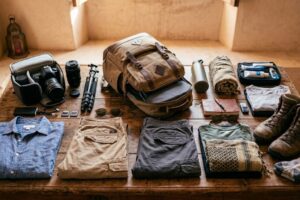
⚡ Morocco Packing — The 5 Rules Before You Start
- Layers beat single heavy items — Morocco’s temperature swings are extreme. A light fleece + light jacket beats one thick coat in almost every situation
- Modesty over fashion — Covered shoulders and knees everywhere outside resort beaches. You will feel more comfortable and encounter less hassle
- Cobblestones are brutal — Every medina in Morocco destroys inappropriate footwear. Do not bring new shoes. Break them in first
- Your bag will gain weight — Morocco’s souks are extraordinary. Leave space for what you will buy. Moroccan rugs, ceramics, argan oil, and leather goods happen to everyone
- Backpack beats rolling suitcase in medinas — The narrow cobblestone lanes of Fes, Marrakech, and Chefchaouen were not built for wheeled luggage. If in doubt, go carry-on and backpack
What to Pack for Morocco: Season by Season
Before anything else — check which season you are traveling. The same Morocco packing list for a May trip is completely wrong for an August trip in the same cities.
Spring (March–May) — The Best Season to Pack For
Spring is Morocco’s finest season — warm days, spectacular light, wildflowers in the Atlas, roses blooming in the Dades Valley. It is also the most pleasant to pack for because the temperatures are moderate enough that you do not need extremes in either direction.
Temperatures to expect: Marrakech 22–28°C day / 12–16°C night. Atlas Mountains 12–18°C day / 4–8°C night. Sahara 28–34°C day / 12–16°C night. Chefchaouen 18–22°C day / 8–12°C night.
- Lightweight layers — cotton or linen tops, a light cardigan, one mid-layer fleece
- Long trousers or loose trousers — for all medina walking and mountain days
- One pair of long maxi skirt or dress (women) — comfortable, modest, and photogenic
- A light waterproof jacket — spring rain can arrive quickly in northern Morocco
- Warm socks for mountain and desert nights — temperatures fall fast after sunset
- SPF 50 sunscreen — spring sun in Morocco is more intense than most Europeans expect
Summer (June–August) — The Challenge Season
Morocco in summer requires the most careful packing. Interior cities like Marrakech and Fes can exceed 40°C — sometimes 45°C. The Sahara can reach 50°C. Coastal cities are far more comfortable thanks to Atlantic breezes. If you are visiting the coast (Essaouira, Agadir, Taghazout), summer is wonderful. If you are visiting the desert in July, plan accordingly.
Temperatures to expect: Marrakech 38–42°C day / 22–25°C night. Sahara 44–50°C day / 20–25°C night. Essaouira 24–28°C day / 16–20°C night. Atlas 25–32°C day / 14–18°C night.
- Light linen or cotton clothing exclusively — synthetic fabrics are miserable in this heat
- A wide-brim hat — non-negotiable in the desert and open landscapes
- SPF 50+ sunscreen — buy a large bottle before arriving, not in Morocco where quality varies
- Cooling face mist — sounds indulgent, genuinely essential in 45°C Sahara midday
- One light fleece — still needed for desert nights and air-conditioned transport
- Reusable water bottle, minimum 1.5 litres — you will drink 3–4 litres per day in summer
- Electrolyte tablets or powder — heat exhaustion is a real risk in summer; replace what you sweat out
⚠️ Summer Desert Warning
If you are joining a Sahara desert tour between June and August, add these to your list regardless of anything else: electrolyte sachets, SPF 50 lip balm (the desert sun cracks lips within hours), a large lightweight scarf to wrap around your face and neck, and closed shoes with thick soles — desert sand at midday can exceed 70°C on the surface and will burn through thin sandal soles instantly.
Autumn (September–November) — The Other Best Season
September and October mirror spring in the best possible way: comfortable temperatures, clear skies, and the summer crowds gone. November begins to cool noticeably, especially in the mountains and north.
Temperatures to expect: Marrakech 28–34°C (Sept) → 20–26°C (Nov). Atlas 18–24°C → 10–16°C. Sahara 30–36°C → 22–28°C. Chefchaouen 20–24°C → 12–16°C.
- Pack identically to spring with one addition: a warmer mid-layer from October onward
- Rain jacket from October — autumn rain arrives more unpredictably than spring
- One proper warm fleece for November mountain and desert visits
Winter (December–February) — The Surprise Season
Morocco in winter is far colder than most visitors from warm countries expect — and warmer than visitors from northern Europe expect. The coastal cities (Agadir, Essaouira, Casablanca) remain mild and pleasant at 16–22°C. Marrakech is cool but sunny at 18–22°C. The Atlas Mountains and Fes can be genuinely cold, with snow in the High Atlas and frost in Fes at night.
- A proper warm jacket or coat — not just a fleece — for Fes, Chefchaouen, and any mountain time
- Thermal underlayer for Atlas Mountain excursions
- Warm socks and waterproof shoes for Fes and Chefchaouen (both can be wet and muddy)
- Layers that can come off — Marrakech days are warm even in December
- Sunscreen still needed — winter sun at altitude and in the desert is deceptive
Clothing: The Master List by Environment
For the Medinas (Marrakech, Fes, Chefchaouen, Rabat)
Morocco’s ancient medinas require clothing that covers shoulders and knees as a basic minimum. This applies in all seasons and for all genders, though it is more important for women in terms of the harassment differential. Beyond modesty, the medina environment means: long days on uneven stone surfaces, dust and crowds, narrow alleys that trap heat in summer and funnel cold winds in winter.
| Item | Women | Men | Why |
|---|---|---|---|
| Tops | Long-sleeved loose tops or linen shirts | T-shirts or shirts — short sleeves fine | Shoulder coverage for women reduces street attention significantly |
| Bottoms | Maxi skirts, loose linen trousers, light jumpsuits | Lightweight chinos or linen trousers | Knee coverage is the minimum courtesy in medina environments |
| Layers | Light cardigan or thin fleece — medinas trap cold air in winter and cool down quickly at sunset in all seasons | Always needed | |
| Scarf | One large, lightweight cotton or linen scarf — the single most versatile item you can bring to Morocco | Modesty cover, sun protection, hammam use, cold nights, dust shield, tourist-friendly all-purpose | |
For the Sahara Desert
Desert packing is where most travelers get it wrong in both directions — either overpacking for cold they imagine but do not experience, or underpacking for heat and sun they did not anticipate. The golden rule: desert days are extreme heat, desert nights are genuine cold. Never forget either.
- Loose linen or cotton long-sleeved shirt — paradoxically, covering your skin protects you from the sun better than exposed skin with sunscreen. Berber desert guides have worn this for centuries for this exact reason
- Light cotton trousers — not shorts. Sand is everywhere. Long trousers protect your legs from sunburn, camel saddle chafing, and the cold once the sun drops
- A proper warm layer — fleece or light down jacket. Desert nights in the Sahara drop to 10–15°C even in summer, and below 0°C in December–January
- Closed shoes with thick soles — sandals are romantic in camel trek photos but genuinely uncomfortable. Sand fills them instantly. Closed trail shoes or hiking shoes are far better
- Extra thick socks — specifically for the desert. Your feet need cushioning on camel saddle stirrups and protection from the sand getting inside shoes
- Large cotton scarf or turban — wrap around head and face during camel treks to protect from sun, wind, and blowing sand. This is not optional in the desert
- Small backpack just for the overnight — your main luggage stays at the guesthouse in Merzouga. Bring only what you need for the desert camp overnight
For everything you need to know about the desert experience itself, read our complete guide to Merzouga and the Sahara desert.
🐪 Our Berber Desert Packing Secret
The single most underrated item for Sahara desert nights is a warm hat. When the sun disappears and the temperature drops 25°C in 90 minutes, the heat escapes through your head fastest. A simple wool beanie weighs almost nothing and will be the most important thing in your bag between 10pm and sunrise. Pack one regardless of the season you are visiting.
For the Atlas Mountains
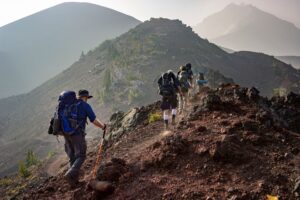
Whether you are doing a day trip to the Ourika Valley or trekking in the High Atlas, the mountains require proper footwear above everything else. The terrain is rocky, often wet, and steep. The temperature swing between noon at lower altitude and early morning at higher altitude can be 20°C.
- Hiking boots or trail shoes with ankle support — this is the most important item for any Atlas Mountain activity. Lightweight trail runners work for day hikes. Proper boots are needed for anything involving the Toubkal summit area
- Moisture-wicking base layer — works in both directions: keeps you cool when hiking uphill, keeps you warm when you stop and the sweat evaporates
- Mid-layer fleece — always. Atlas Mountain temperatures at any altitude are unpredictable
- Waterproof outer layer — essential from October to May. Atlas rain arrives fast and the wind makes it feel much colder than the temperature suggests
- Walking poles — optional but highly recommended for anyone doing a full day in the High Atlas. The descents on loose scree are significantly easier with poles
- Sunscreen and lip balm — UV intensity increases dramatically at altitude. Many people burn badly in the Atlas thinking the relatively cool air means lower sun exposure. It does not
Footwear: The One Decision That Makes or Breaks Your Morocco Trip
We see this every single trip: someone arrives with the wrong shoes and spends their first full medina day miserable, blistered, or both. Morocco’s medina cobblestones are uneven, worn smooth by centuries of foot traffic, and brutal on thin-soled shoes, sandals with no support, and any shoes not yet broken in. The Sahara sand works into sandals instantly. The Atlas trails require ankle support. Get the shoes right and everything else becomes easier.
- Comfortable walking shoes / broken-in sneakers — your primary footwear for cities. Must be broken in before the trip. Blisters in Marrakech medina are a common and entirely preventable disaster
- Sandals with straps — for evenings, riad time, beach, and coastal cities. Not for long medina walks, not for the desert, not for mountains
- Flip-flops — specifically for hammam visits (see our Moroccan hammam guide for why this matters) and riad indoor use. Not for outdoor use beyond poolside
- Hiking boots or trail shoes — if any Atlas Mountain or trekking activity is in your itinerary. Non-negotiable
- Slip-on shoes — optional but very useful for mosque visits (where shoes are removed at the entrance) and frequent shoe-removal situations
Documents & Money: What You Actually Need
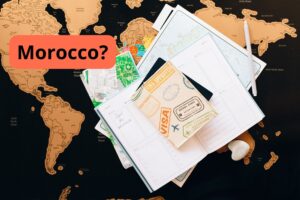
- Passport — valid for at least 6 months beyond your travel dates. Many countries’ citizens can enter Morocco visa-free for 90 days. Check our Morocco visa guide for your specific nationality
- Travel insurance documents — printed and digital copy. See our guide to travel insurance for Morocco for what to look for in a policy
- Emergency contacts printed — do not rely entirely on your phone in Morocco. Power outages, dead batteries, and remote areas without signal are all real
- Cash in Moroccan Dirhams (MAD) — withdraw on arrival at airport ATMs (usually the best rates). Many souks, local restaurants, and smaller guesthouses are cash-only. Read our guide on how much cash to bring to Morocco
- Debit/credit card — useful as backup and for larger payments, but do not rely on it exclusively. See our Morocco payment methods guide for where cards are and are not accepted
- International driving license — only if you plan to rent a car. See our hire a car in Morocco guide
Tech & Electronics
🔌 Morocco Power Essentials
- Plug adapter: Type C and Type E — Morocco uses European round-pin plugs. UK, US, and Australian plugs will not work without an adapter. Buy one before you travel — airport shops in Morocco sell them but at tourist prices
- Voltage: 220V — US devices designed for 110V need a voltage converter, not just a plug adapter. Check your device label before assuming it will work
- Power bank — essential. Desert camp electricity is generator-powered and often only available for a few hours. Mountain guesthouses frequently have limited outlets. Your phone is your map, camera, and communication — keep it charged
- SIM card or eSIM — Maroc Telecom and Orange both have strong coverage across Morocco. Buy a local SIM at the airport for affordable data. See our guide to getting internet in Morocco for the best current options
- Camera or phone with good camera — Morocco is relentlessly photogenic. If you ever regret under-photographing a trip, Morocco will be it. Read our Morocco drone laws guide if you plan to fly a drone
- Offline maps downloaded — Maps.me or Google Maps offline for your route. In the Sahara, the Atlas Mountains, and many rural areas, mobile data disappears entirely
- Headphones — for long transfers between cities. The Marrakech to Fes drive via the desert circuit is beautiful but takes multiple days in a vehicle
Health & Toiletries: The Morocco-Specific List
Morocco is a well-developed country with pharmacies in every city and town. You do not need to bring industrial quantities of everything. You do need to bring a few things that are harder to find or more expensive locally.
- Sunscreen SPF 50+ — bring from home. Quality sunscreen in Morocco is expensive and limited in selection in smaller towns
- Diarrhoea medication — traveler’s stomach affects some visitors, particularly in the first few days. Imodium or equivalent. This is not about Morocco being unhygienic — it is simply a different bacterial environment to what your gut knows
- Antihistamine — Morocco’s spring is intensely floral. The Dades Valley rose season, the Atlas Mountain wildflowers, and the general dust can affect anyone with sensitivities
- Personal medications with documentation — bring sufficient supply plus 25% extra for delays. Some medications require documentation at customs; check with your doctor if you carry prescription medications. See our Morocco healthcare for tourists guide
- Rehydration sachets — critical in summer heat, useful in all seasons when stomach issues arise
- Plasters / blister pads — for inevitable medina walking blisters, especially on days 1–2 before your feet adjust
- Hand sanitiser and tissues — public toilets in smaller towns and markets are not always stocked with soap or paper. Non-negotiable practical item
- Lip balm with SPF — the desert and mountain air is intensely dry. Lips crack within a day without protection
- Insect repellent — for evenings in the desert, garden riads, and mountain villages in spring. Not required everywhere but useful in rural contexts

The One Thing Everyone Forgets (And Regrets)
After 15 years of guiding, there is one item that comes up in conversations the morning after the desert camp night with consistent regularity. Not sunscreen. Not the plug adapter. Not walking shoes.
It is a small padlock.
Desert camp luggage is stored in communal areas. Train compartments in overnight trains between cities are shared. Budget riads sometimes use simple key-and-handle wardrobe locks. A small TSA padlock weighs almost nothing and travels in your toiletry bag. It has never been needed on any of our private tours — but on the occasions people have been on shared transport or mixed desert camps, it has been the difference between a relaxed night’s sleep and an anxious one.
Pack it. You probably will not use it. You will never regret having it.
What NOT to Pack for Morocco
Just as important as what to bring — what to leave at home:
- Heavy jewellery — Morocco’s souks are busy and petty theft is real. Leave anything of sentimental or high monetary value at home. Read our guide to scams in Morocco for what to be aware of
- A big rolling suitcase as your only bag — the worst possible choice for medina navigation. If you must bring one, check it at your riad and use a daypack for city exploration
- Revealing clothing as your primary wardrobe — short shorts, strapless tops, and miniskirts will cause consistent unwanted attention in medinas and conservative areas. Reserve them for pool and beach situations. You will have a better trip in modest clothing — not because Morocco requires it legally, but because it makes every interaction smoother
- Expensive electronics beyond what you will actually use — do not bring the camera with three lenses if you will use your phone. Do not bring the laptop if you are not working. Every expensive item is something to worry about
- Alcohol — Morocco is a Muslim country with alcohol sold in licensed establishments in cities. Importing alcohol in your luggage is technically legal but unnecessary — you can buy what you need in the country if you drink. See our guide to Moroccan wine
- A drone without permits — drone laws in Morocco are strict. See our drone regulations guide for the current legal requirements
The Master Morocco Packing Checklist
📋 Screenshot This Before You Pack
CLOTHING
- ☐ 4–5 lightweight tops (long-sleeved or with cardigan for women)
- ☐ 2–3 pairs of loose trousers or maxi skirts/dresses
- ☐ 1 pair of shorts or lighter bottoms (for beach/pool only)
- ☐ 1 light fleece or mid-layer
- ☐ 1 waterproof jacket (essential Oct–May, useful all year)
- ☐ 1 warm jacket (essential Nov–Mar, desert nights all year)
- ☐ 1 large cotton scarf (the most versatile item in your bag)
- ☐ Enough underwear and socks for the trip (laundry available in riads)
- ☐ Swimwear (for riad pools, hammam, beach)
- ☐ Warm hat (desert and mountain nights)
FOOTWEAR
- ☐ Broken-in comfortable walking shoes
- ☐ Sandals (evening and coastal use)
- ☐ Flip-flops (hammam and indoor riad use)
- ☐ Hiking boots or trail shoes (if any Atlas Mountain activity planned)
DOCUMENTS
- ☐ Passport (6+ months validity)
- ☐ Travel insurance documents (printed + digital)
- ☐ Visa documentation if required for your nationality
- ☐ Cash in MAD (withdraw on arrival at airport ATM)
- ☐ Debit / credit card as backup
TECH
- ☐ Type C/E plug adapter (European round-pin)
- ☐ Power bank (fully charged)
- ☐ Phone with offline maps downloaded
- ☐ Camera (optional if phone camera is sufficient)
- ☐ Local SIM card (buy at arrival airport) or eSIM pre-loaded
HEALTH
- ☐ Sunscreen SPF 50+ (bring from home)
- ☐ Lip balm with SPF
- ☐ Diarrhoea medication
- ☐ Antihistamine
- ☐ Rehydration sachets
- ☐ Plasters / blister pads
- ☐ Hand sanitiser and tissues
- ☐ Insect repellent (for rural and desert use)
- ☐ Personal medications with documentation
ACCESSORIES
- ☐ Daypack or small backpack
- ☐ Reusable water bottle (1.5–2 litres)
- ☐ Small padlock
- ☐ Electrolyte tablets (especially for summer travel)
- ☐ Headtorch / small torch (desert camp nights)
- ☐ Empty bag or foldable tote (for souk purchases)
- ☐ Travel journal (Morocco demands to be written about)
Combining Your Packing with Your Morocco Itinerary
The best Morocco packing list is specific to your route. A trip focused entirely on Marrakech and Fes needs almost nothing from the desert section above. A desert and mountain trip needs everything from both. A 7-day Morocco itinerary covering the classic Marrakech-to-Sahara-to-Fes circuit needs the full list.
If you are unsure what your route will involve, start with your itinerary and work backward through this list. We are happy to advise on packing specifics for any of our Morocco private tours — a quick email with your dates and route gets you a personalised packing recommendation. Contact us here.
🎒 Ready to Pack — But Not Sure Where to Go?
We are a Berber family based in Morocco with 15 years of guiding experience across every environment on this packing list — medinas, desert, mountains, and coast. We build private tours around your specific travel style, group, and budget. Tell us your dates and we’ll plan everything else.
Frequently Asked Questions: Morocco Packing List
What should I absolutely not forget when packing for Morocco?
The five items most commonly forgotten and most missed: a Type C/E plug adapter (your electronics will not charge without one), SPF 50 sunscreen (expensive and limited in smaller towns), a large cotton scarf (the most versatile item in Morocco — modesty, sun, cold, hammam, and sand protection all in one), a power bank (desert camps have limited electricity), and a padlock (for shared luggage storage situations). Everything else can be bought in Morocco if you forget it.
Can I wear shorts in Morocco?
Shorts are fine at beaches, riad pools, and international resort areas. In medinas, traditional markets, and smaller towns, shorts on women attract more attention and shorts on men are culturally unusual. Not illegal in either case — but long, loose trousers make every medina interaction more comfortable and are much cooler in hot weather than they appear. Linen trousers in 38°C Marrakech are genuinely more comfortable than shorts because they protect from the sun and allow airflow.
How much luggage space should I leave for souvenirs?
More than you think. Morocco’s souks are exceptional — leather goods, hand-woven rugs, ceramics, argan oil, preserved lemons, spices, lanterns, and handmade jewellery. Every experienced Morocco traveler arrives with extra space and still ends up buying a second bag. Leave at least 30% of your bag empty when you depart home. Pack a foldable tote bag in your luggage specifically for souk purchases.
Do I need travel insurance for Morocco?
Yes — and it matters more than in many destinations. Morocco’s remote areas (Sahara desert, High Atlas mountain villages) have limited medical infrastructure. Medical evacuation from a desert camp or mountain trek is expensive and complicated without proper insurance. Read our complete travel insurance for Morocco guide for what your policy must cover.
Is there anything I should not bring into Morocco?
Narcotics and drugs are strictly illegal and customs enforcement is thorough. Drones require prior permits — see our drone laws guide. Pornographic material is illegal. Large amounts of foreign currency (over $10,000 equivalent) must be declared. All other standard international travel restrictions apply. Morocco’s customs is generally straightforward for legitimate tourist equipment.
Should I pack a first aid kit for Morocco?
A basic travel first aid kit is useful: plasters, antiseptic wipes, diarrhoea medication, pain relief, antihistamine, and rehydration sachets. For the Sahara desert and High Atlas mountain trekking, also include blister pads, a small bandage, and any personal prescription medications. Morocco has good pharmacies in all cities and towns — you do not need to pack a comprehensive kit, just the basics your body specifically needs for the activities you plan. See our Morocco healthcare guide for pharmacies and emergency care information.
What is the best bag type for Morocco?
For medina exploration specifically: a daypack or small crossbody bag beats everything. Rolling suitcases are genuinely difficult on Morocco’s cobblestone medina streets — the noise, the uneven surfaces, and the narrow lanes make them frustrating. If you are doing a guided tour with a vehicle, a regular suitcase is fine as it stays in the car while you explore on foot. If you are traveling independently, a 40–50 litre backpack is the most practical option for the entire trip.
Written by the Days Morocco Tours team — a Berber family based in Morocco who has guided thousands of travelers through every environment on this packing list over 15+ years. We lead private tours from Marrakech across Morocco year-round. Read our story here.