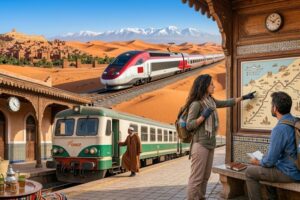
Morocco has something that no other African country has: a high-speed rail network. The Al Boraq — launched in 2018 as Africa’s first high-speed train — connects Tangier to Casablanca at up to 320 km/h, reducing a journey that once took 4.5 hours to just over 2 hours. Beyond the Al Boraq, the ONCF network (Office National des Chemins de Fer) connects Morocco’s major cities with comfortable, reliable, and genuinely affordable train services that are consistently preferable to long-distance taxis for anyone who values comfort and predictability.
Understanding Morocco’s train network — which routes it covers, which it does not, how to book, and what the trains are actually like — is one of the most practically useful things any Morocco traveler can know. This is the complete Morocco Train Guide.
🚄 Morocco Rail — Essential Facts (2026)
- Operator: ONCF (Office National des Chemins de Fer du Maroc)
- Book online: oncf-voyages.ma
- Al Boraq high-speed: Tangier → Kenitra → Casablanca | 2h10 | 150–220 MAD second class
- Main network hubs: Casablanca, Rabat, Fes, Meknes, Marrakech, Tangier
- NOT served by train: Chefchaouen, Essaouira, Merzouga (Sahara), Agadir, Ouarzazate
- Frequency: Hourly or more on main routes (Casa–Rabat every 30 minutes)
- Classes: First class and second class — both comfortable, first class has reserved individual seats
- Night trains: Marrakech to Tangier overnight couchette available
The Al Boraq: Africa’s Only High-Speed Train
The Al Boraq (named after the mythical creature that carried the Prophet Mohammed to heaven) is Morocco’s pride and genuine evidence of the country’s infrastructure ambitions. Operating at up to 320 km/h on the Tangier–Casablanca corridor, it is the fastest train in Africa and runs to a standard comparable with European high-speed rail.
The experience on board is comfortable and modern: air conditioning, reserved seating, good legroom, clean carriages. The journey from Tangier to Casablanca in just over 2 hours feels genuinely remarkable given the distance covered. Tickets cost approximately 150–220 MAD ($15–22) in second class — extraordinary value for a two-hour high-speed journey.
The Al Boraq stops at Kenitra, connecting to the broader ONCF network south toward Rabat and Casablanca and north toward Tangier. Future extensions to Marrakech and Agadir are planned as part of Morocco’s 2030 World Cup infrastructure programme — see our Morocco 2030 World Cup guide for details on the rail expansion.
Morocco’s Main Train Routes: Times & Prices
| Route | Duration | 2nd Class | 1st Class | Frequency |
|---|---|---|---|---|
| Tangier → Casablanca (Al Boraq) | 2h 10m | 150–220 MAD | 220–300 MAD | ~8x daily |
| Casablanca → Marrakech | 3h 00m | 100–160 MAD | 160–230 MAD | ~10x daily |
| Casablanca → Fes | 3h 40m | 130–180 MAD | 200–270 MAD | ~8x daily |
| Casablanca → Rabat | 1h 00m | 50–80 MAD | 80–120 MAD | Every 30 min |
| Fes → Meknes | 0h 45m | 25–40 MAD | 40–60 MAD | ~12x daily |
| Tangier → Marrakech (overnight) | ~10h | 180–250 MAD | Couchette available | 1–2x daily |
Prices are approximate 2026 standard-season rates. Book in advance for holiday periods. Check current timetables and exact prices at oncf-voyages.ma
What Morocco’s Trains Do NOT Cover
This is equally important to understand. Morocco’s rail network serves the main corridor cities — but significant tourist destinations are not on the network:
- Chefchaouen (Blue City) — nearest station is Tangier (2 hours by bus from Chefchaouen) or Fes (4 hours by bus)
- Essaouira — no train. CTM bus from Marrakech (3 hours, 80–100 MAD) is the standard option
- Merzouga / Sahara desert — no train anywhere near. Requires bus or private vehicle from Marrakech or Fes
- Agadir — not on the current network (future extension planned for 2030)
- Ouarzazate — no train. Bus or private vehicle from Marrakech
- Chefchaouen to Fes — CTM bus is the only comfortable direct option (4 hours, 75–100 MAD)
For routes not served by train, CTM buses are the best alternative. See our guide to getting around Morocco for the full transport comparison, and our Morocco road trip guide if you are considering driving your own route.

How to Book Morocco Train Tickets
Online (Recommended)
The ONCF website at oncf-voyages.ma allows ticket booking in advance. The site works in French and Arabic — use Google Translate if needed. Credit cards are accepted. Print or save your ticket to your phone. Booking online is strongly recommended for the Al Boraq, for holiday periods (Eid, school holidays), and for any journey where you need a guaranteed seat.
At the Station
Ticket windows are available at all major stations. For second-class travel on standard trains, you can usually buy at the station on the day. For first class and the Al Boraq, advance booking at the station (the day before at minimum) is recommended during busy periods.
On the Train
For standard trains, you can technically board without a ticket and pay on the train — but this risks not getting a seat on busier routes and costs slightly more. Not recommended for the Al Boraq, which requires a reserved seat ticket.
First Class vs Second Class: Worth the Upgrade?
Second class on Morocco’s trains is perfectly comfortable — upholstered seats, air conditioning, clean carriages. On busier trains (Casablanca–Rabat especially), it can get crowded during rush hours. For journeys under 2 hours, second class is entirely adequate.
First class offers individual reserved seats, more space, and a notably calmer carriage environment. For journeys over 2 hours — Casablanca to Marrakech (3 hours), Casablanca to Fes (3h40m) — the upgrade costs approximately 60–80 MAD extra and is worth it for the space and the guaranteed seat. For the Al Boraq specifically, first class significantly improves the experience on what is already a comfortable train.
The Best Morocco Train Journeys for Scenery
- Casablanca → Marrakech: The approach to Marrakech through the Haouz plain with the Atlas Mountains rising ahead is one of the great train arrival moments in Africa
- Casablanca → Fes: Passes through the fertile plains of the Gharb and Saïs, then descends into Fes through the city’s surrounding hills — a beautiful approach to one of the world’s great medieval cities
- Tangier → Kenitra (Al Boraq): The Rif Mountains visible from the train windows, then the Atlantic coast briefly visible as the train approaches Kenitra
Practical Tips for Taking the Train in Morocco
- Arrive 15 minutes before departure — Moroccan trains generally run on time but platform confirmation can be late at smaller stations
- Keep your ticket accessible — inspectors check tickets during the journey, not at barriers
- Buy snacks and water before boarding — station shops are fine but onboard service is limited on standard trains
- Luggage — no weight limits, but overhead racks have limited space on busy trains. Keep your main bag at your feet
- Phone charging — first-class carriages on modern trains have power sockets. Second class is inconsistent — bring a fully charged power bank
- Station locations — Marrakech station is conveniently located just outside the medina’s Gueliz border. Casablanca has multiple stations — check which one your train uses (Casa-Voyageurs for most intercity trains)
🚆 Planning Your Morocco Trip Route?
We combine the best of Morocco’s train network with private vehicles for the routes trains don’t reach — giving you the efficiency of rail between major cities and the freedom of a private vehicle for the desert, mountains, and coastal routes. Contact us to plan your ideal Morocco itinerary.
Frequently Asked Questions: Morocco Train Guide
Is the Al Boraq train worth taking?
Absolutely — it is one of the genuine travel highlights of Morocco. Africa’s only high-speed train running at 320 km/h from Tangier to Casablanca in just over 2 hours is a remarkable experience, and the ticket price (150–220 MAD second class) is extraordinary value. If your itinerary includes Tangier, take the Al Boraq at least one way.
Can I take the train from Marrakech to the Sahara desert?
No — the rail network does not serve Merzouga (Erg Chebbi), Zagora, or any Sahara destination. From Marrakech, reaching the Sahara requires a bus (CTM to Ouarzazate then onward connections) or a private vehicle. Most travelers join a desert tour from Marrakech for this section, which includes all transport.
How do I book Morocco train tickets online?
Book at oncf-voyages.ma — Morocco’s official national rail website. The site works in French and Arabic. Credit card payment is accepted. Print or save your ticket to your phone. Booking 1–2 days in advance is sufficient for most routes; book further ahead for holiday periods and the Al Boraq.
Is the Morocco train safe?
Yes — Morocco’s ONCF trains are genuinely safe and the incidents involving tourists on trains are extremely rare and generally limited to petty theft of unattended luggage in crowded carriages. Keep your bag visible and accessible, do not leave it on the overhead rack unattended on busy routes, and travel normally. First class is noticeably less crowded and correspondingly lower-risk for petty theft.
How does the Morocco train compare to the CTM bus?
For routes where both exist (Casablanca–Marrakech, Casablanca–Fes), the train is generally faster, more comfortable, and more reliable. The bus is 20–40% cheaper and reaches destinations the train does not (Chefchaouen, Essaouira, Ouarzazate). The practical rule: take the train between major hub cities, take CTM buses for routes not on the rail network.
Written by the Days Morocco Tours team — a Berber family who has navigated every corner of Morocco’s transport network for 15 years. Read our story here.