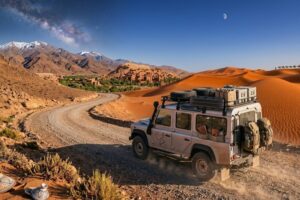
There is a specific moment on a Morocco road trip that happens to almost everyone, usually somewhere between the Tizi n’Tichka Pass and the first glimpse of pre-Saharan desert: you realise that no photograph you have seen of this country — and you have seen many — came close to preparing you for the actual scale and beauty of the landscape you are driving through. The mountains are bigger. The valleys are more alive. The kasbahs rising from the red earth are more cinematic. And the road stretching ahead, empty and sinuous, feels like the beginning of something genuinely extraordinary.
Morocco is one of the world’s great road trip countries. Within a single day’s drive from Marrakech you can cross North Africa’s highest paved road pass, descend through a UNESCO World Heritage kasbah village, wind through rose-filled valleys, and arrive at the edge of the Sahara desert. The country’s road network is modern and well-maintained. The landscapes are endlessly varied. And the freedom of having your own vehicle — to stop when something is beautiful, to take the smaller road, to spend an extra hour at the gorge without worrying about a bus schedule — transforms the Morocco experience entirely.
This guide covers everything: the best routes, driving rules, car rental, fuel costs, what to watch out for, and day-by-day itineraries from 5 to 14 days.
⚡ Morocco Road Trip — Essential Facts
- Driving side: Right (same as continental Europe and USA)
- License required: Valid national license + International Driving Permit (IDP) recommended
- Speed limits: 120 km/h motorways / 100 km/h national roads / 60 km/h towns
- Fuel price (2026): Approximately 14–15 MAD/litre (petrol) — around $1.40/litre
- Car rental cost: Economy from $35–45/day, 4×4/SUV from $55–80/day
- Currency for tolls: Cash MAD — have coins and small notes ready
- Best road trip season: March–May and September–November
- 4×4 required? Not for the main circuit. Recommended for off-piste desert tracks
Before You Drive: The Honest Road Reality
Morocco’s road infrastructure has improved enormously over the past two decades. The motorway network (autoroutes) is modern, dual-carriageway, and identical to European motorway standards. National roads (N-roads) are generally paved and well-maintained, though quality varies. Mountain roads are paved but demand concentration — tight switchbacks and steep gradients require confident driving. Desert pistes (off-road tracks) range from well-graded gravel to routes requiring genuine 4×4 capability.
The one honest caveat: Moroccan driving style takes adjustment. Urban traffic in Casablanca and Marrakech is busy and not always rule-based. Overtaking on mountain roads can be aggressive. Livestock on rural roads is a real hazard at dawn and dusk. None of this is a reason not to drive — hundreds of thousands of tourists self-drive Morocco every year without incident — but it requires awareness and patience rather than the expectation of quiet, rule-following roads throughout.
Our advice: avoid driving in city centres if possible. Hire a car, do the scenic routes, and use petit taxis or walking within medinas where cobblestone streets are impractical for vehicles anyway. See our existing guide to driving in Morocco for the full rules and regulations breakdown.
The 4 Greatest Morocco Road Trip Routes
Route 1: The Classic Sahara Circuit — Marrakech → Desert → Marrakech
Distance: ~1,200 km loop | Duration: 5–7 days | Best season: Oct–April
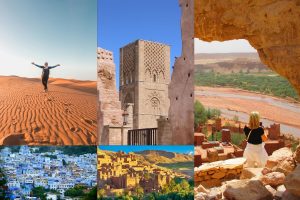
This is the Morocco road trip. The route that every road tripper eventually takes, and the one that stays with you longest. It crosses the highest paved pass in North Africa, passes through a UNESCO kasbah village used as a set for Gladiator and Game of Thrones, winds through the valley of roses, penetrates the slot canyon of the Todra Gorge, and ends at the towering dunes of Erg Chebbi. Then it comes back via the Road of a Thousand Kasbahs — arguably the most beautiful long stretch of road in Africa.
Day 1 — Marrakech to Ait Benhaddou (196 km, ~4–5 hours with pass stop)
Depart Marrakech early — by 7am to catch the Tichka Pass in morning light. Take the N9 south toward Asni. Within 90 minutes you begin climbing toward Tizi n’Tichka at 2,260 metres — North Africa’s highest paved road pass. The switchbacks are dramatic and the views across the Atlas Mountains are extraordinary. Stop at the summit (marked by souvenir stalls selling fossils and minerals).
The descent toward Ouarzazate reveals red-earth valleys utterly unlike anything on the Marrakech side. After 3.5 hours total, exit at Ait Benhaddou — the UNESCO World Heritage ksar rising above the Ounila River. Cross the riverbed on foot (or the footbridge), climb to the top granary for the finest view, and allow 1.5–2 hours. See our full guide to Ouarzazate and the south. Overnight in Ait Benhaddou or Ouarzazate.
Day 2 — Ait Benhaddou to Dades Valley (110 km, ~2–3 hours)
Take the N10 east through Ouarzazate — stop to visit Atlas Film Studios if the film industry interests you, then continue through the wide pre-Saharan valleys. The road passes through rose-growing country: the Valley of Roses around Kelaat M’Gouna blooms spectacularly in April–May. Arrive in the Dades Valley late morning. Spend the afternoon exploring the Dades Gorge — the signature Monkey Fingers rock formations turn copper in the afternoon light. Overnight in a gorge-view guesthouse.
Day 3 — Dades Valley to Merzouga (164 km, ~3–4 hours with Todra stop)
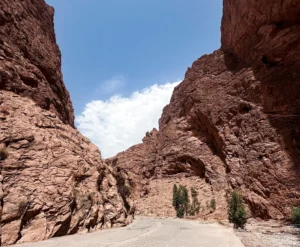
Drive 45 minutes east to the Todra Gorge — 300-metre walls of orange limestone squeezing to 10 metres apart at the narrowest point, with a cold river running between them. Walk in on foot. Allow 45–60 minutes. Then continue east through the Ziz Valley — a spectacular descent through a date palm oasis — before the pre-Saharan landscape opens into the great hammada (rocky desert) approaching Merzouga. Arrive at Erg Chebbi late afternoon for the sunset camel trek. See our full Merzouga and Sahara guide.
Day 4 — Sahara sunrise, then Skoura (280 km, ~4–5 hours)
Wake at 5:30am for the desert sunrise. Return to Merzouga by 9am. Drive west via the Road of a Thousand Kasbahs — the N10 route that passes through Tinerhir, Boumalne Dades, Kalaa M’Gouna, and Skoura. This is the most beautiful single road in Morocco: an almost continuous succession of ancient clay kasbahs rising from the valley floor, some crumbling, some inhabited, all extraordinary. Stop at the Skoura palm grove — a UNESCO-protected oasis with several magnificent kasbahs including the famous Amerhidil. Overnight in Skoura or Ouarzazate.
Day 5 — Return to Marrakech via Tichka (200 km, ~4 hours)
Drive the Tichka Pass again — this time from the desert side, which presents entirely different views. The ascent through the pre-Saharan foothills before the Atlas rise is spectacular in the morning light. Arrive Marrakech by midday with the afternoon free for the medina.
🗺️ The 6 Unmissable Road Stops on This Circuit
- Tizi n’Tichka summit (2,260m) — pull over, get out, look in every direction
- Ait Benhaddou kasbah — UNESCO site, cross the riverbed on foot
- Monkey Fingers, Dades Gorge — the most photographed rock formation in Morocco
- Todra Gorge entrance — walk in, feel the scale of the canyon walls
- Erg Chebbi dunes at sunset — the Sahara does not disappoint
- Skoura palm grove — walk into the date palm oasis at dawn
Route 2: The Atlantic Coast Cruise — Tangier to Agadir
Distance: ~950 km | Duration: 7–10 days | Best season: All year (coast avoids extreme heat)
Morocco’s Atlantic coast offers an entirely different road trip character: dramatic clifftops, white fishing villages, surf towns, and a sequence of cities each with their own distinct personality. Start in Tangier — where Africa meets Europe across the Strait of Gibraltar — and drive south along the Atlantic, stopping at Asilah (a whitewashed Andalusian port town with beautiful blue-doored medina), Rabat (Morocco’s elegant capital), Casablanca (Hassan II Mosque, Art Deco architecture), El Jadida (Portuguese cistern), Oualidia (Morocco’s oyster coast), Essaouira (wind, ramparts, Gnaoua music), and finally Agadir.
The motorway (A1) connects most of this route quickly. For the most beautiful coastal driving, take the smaller coastal roads between Oualidia and Essaouira — the R301 passes salt flats, empty Atlantic beaches, and viewpoints that will stop you cold.
Route 3: The Imperial Cities Loop — Casablanca → Rabat → Meknes → Fes → Marrakech
Distance: ~900 km loop | Duration: 7–10 days | Best season: Year-round
Morocco’s four imperial cities — Casablanca, Rabat, Meknes, and Fes — connected by well-maintained motorway. This is the cultural road trip: ancient medinas, Roman ruins (Volubilis, near Meknes), the world’s oldest university at Fes, and the journey south through the Middle Atlas cedar forests with their Barbary macaque colonies. See our guide to the spiritual city of Fes and Rabat, Morocco’s enchanting capital.
Route 4: The Northern Circuit — Tangier → Chefchaouen → Fes
Distance: ~350 km | Duration: 4–5 days | Best season: All year
Morocco’s north is its least-visited region and one of its most beautiful. Tangier’s literary history and Strait of Gibraltar views. The Rif Mountains approaching Chefchaouen — the road curves through cedar forest before the blue city appears in the hillside. Then south via the Middle Atlas to Fes. A compact route ideal for a long weekend or the opening section of a longer Morocco road trip. See our guide to the Blue City of Morocco.
Car Rental in Morocco: What You Need to Know
Which Type of Car to Rent
| Car Type | Daily Cost | Best For | Our Verdict |
|---|---|---|---|
| Economy hatchback | $35–45 | Cities, motorways, main circuit | Fine for the classic Sahara circuit — all roads are paved |
| Small SUV / crossover | $50–65 | Most routes including mountain roads | Best all-around choice — handles everything comfortably |
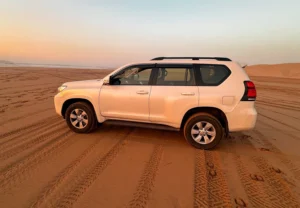
| 4×4 / full SUV | $65–80 | Desert pistes, Chigaga dunes, Atlas off-road | Required for serious off-road; unnecessary for standard routes |
Key tips: Book with a credit card that includes rental car collision coverage to avoid expensive supplemental insurance. Ensure full comprehensive coverage is included — not just third-party. Check the car thoroughly for pre-existing damage and photograph everything before driving away. Fuel is diesel for most Moroccan rental cars — double-check before filling. See our hire a car in Morocco guide for reputable agencies and what to check in the contract.
Road Trip Fuel Costs: Real Numbers
Fuel in Morocco costs approximately 14–15 MAD per litre ($1.40/litre) for petrol (essence) in 2026. Diesel is slightly cheaper. Key route fuel estimates:
- Marrakech to Ait Benhaddou: ~200 MAD ($20)
- Full Sahara circuit (Marrakech loop, ~1,200 km): 1,400–1,800 MAD ($140–180)
- Tangier to Agadir coast (~950 km): 1,100–1,500 MAD ($110–150)
Fuel stations are plentiful on motorways and national roads. In the desert and remote Atlas areas, stations can be sparse and may close early — fill up by noon in isolated zones. Stations in Morocco do not typically offer self-service; attendants pump fuel and a 2–5 MAD tip is appreciated.
The Morocco Road Trip Packing List
- Offline maps downloaded — Google Maps offline for your full route. Mobile data disappears in remote areas. Maps.me is a useful backup
- Cash in MAD — tolls are cash-only. Desert and mountain areas are cash-only for fuel, accommodation, and food. Read our cash guide for Morocco
- International Driving Permit (IDP) — technically required alongside your national license. Available from your national motoring association before travel
- Reusable water bottles and a large reserve supply — particularly for desert days. The space in a rental car makes this easier than on public transport
- Car charger / power inverter — keep phones charged on long drives
- Paper map backup — for the rare situations where electronic navigation fails in remote mountain terrain
For the complete packing guide for Morocco, including what to bring for the desert and mountains, see our Morocco packing list.
Prefer a Driver to a Rental Car?
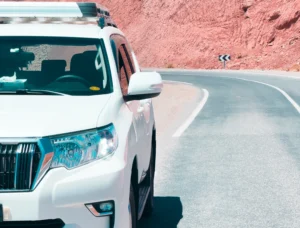
Many travelers who want the flexibility and scenery of a road trip without the stress of driving Morocco’s mountain roads choose a private vehicle with a local driver-guide. This gives you all the stop-when-you-want flexibility of a self-drive road trip combined with an expert who knows every lay-by, viewpoint, local restaurant, and shortcut on the route — and handles all the parking, fuel, and navigation. It is the format most of our Morocco private tours take. Contact us to build your ideal road trip with a driver.
🚗 Ready to Hit the Road in Morocco?
We build custom Morocco road trip itineraries — self-drive with detailed guides, or private tours with a knowledgeable local driver. Tell us your dates and we plan the perfect route.
Frequently Asked Questions: Morocco Road Trip
Do I need a 4×4 for a Morocco road trip?
Not for the classic Sahara circuit — all main routes including the Tichka Pass, Ait Benhaddou, Dades Valley, Todra Gorge, and Merzouga are fully paved. A standard economy car handles everything. A small SUV adds comfort on mountain roads. A full 4×4 is only necessary if you plan to leave the paved roads for desert pistes or off-road tracks.
Is driving in Morocco dangerous?
Statistically, Morocco’s roads have a higher accident rate than Western Europe. However, the vast majority of incidents involve local drivers in urban traffic — not tourists on scenic routes. The practical advice: avoid driving in city centres, drive slowly on mountain switchbacks, be cautious at dusk and dawn when livestock cross roads, and do not rush. Morocco’s most beautiful roads reward driving slowly anyway. See our driving in Morocco guide for full safety advice.
What is the best road trip route in Morocco?
The classic Sahara circuit from Marrakech — crossing Tichka Pass, Ait Benhaddou, Dades Valley, Todra Gorge, Merzouga dunes, and returning via the Road of a Thousand Kasbahs — is the definitive Morocco road trip. It covers the country’s greatest landscapes in a logical 5–7 day loop. The Atlantic coast cruise from Tangier to Agadir is the best alternative for those who prefer coastal scenery.
How much does fuel cost in Morocco?
Approximately 14–15 MAD per litre ($1.40/litre) for petrol in 2026. A full Sahara circuit of approximately 1,200 km costs around 1,400–1,800 MAD ($140–180) in fuel for a standard economy car.
Can I drive into the Sahara desert?
Yes — the road to Merzouga (Erg Chebbi dunes) is fully paved and accessible in any standard car. The desert camp itself requires a camel trek or 4×4 to reach, but your rental car stays safely in Merzouga village. For the more remote Erg Chigaga dunes, a 4×4 and usually a local guide are required.
Do I need an International Driving Permit for Morocco?
Technically yes — Morocco legally requires an IDP alongside your national driving license. In practice, many travelers drive without one without issues. Our recommendation is to get one before travel — it is inexpensive and available from your national motoring association (AA, AAA, ADAC etc.), and it gives you legal coverage in the event of any incident.
Written by the Days Morocco Tours team — a Berber family who has driven every route in this guide over 15 years of guiding Morocco’s most spectacular self-drive roads. Read our story here.