Renting a car in Morocco is, for many travellers, the single decision that determines whether a Morocco trip becomes an adventure of open roads and unplanned stops, or a frustrating cycle of bus schedules and shared taxi negotiations. Morocco’s road network is genuinely good — better than most first-time visitors expect — and the freedom of a rental car opens up the country’s most extraordinary landscapes on your own schedule: the Tizi n’Tichka pass at sunrise, an unplanned stop at a roadside argan oil cooperative, a detour to a Berber village that isn’t on any tour itinerary.
It is also a decision that comes with real considerations specific to Morocco: driving culture that differs meaningfully from North America or Northern Europe, insurance terms that vary significantly between rental companies, and certain roads and situations that genuinely warrant caution. This guide covers everything: the best rental companies, realistic prices, the documents you need, driving rules and road conditions, insurance, and the honest picture of when self-drive makes sense and when it doesn’t.
⚡ Car Rental in Morocco — Essential Facts for 2026
- Minimum age: 21 (often 23–25 for certain vehicle categories)
- License required: Valid driving license from your home country + International Driving Permit (IDP) recommended
- Driving side: Right-hand side of the road (same as USA, Canada, continental Europe)
- Average daily rate (economy car): $25–45/day
- Average daily rate (4×4): $50–90/day
- Fuel cost: ~14–15 MAD/litre ($1.40–1.50) — diesel slightly cheaper than petrol
- Major rental hubs: Marrakech Menara, Casablanca Mohammed V, Agadir, Fes, Tangier airports
- Speed limits: 120 km/h motorway, 100 km/h main roads, 60 km/h urban, 40 km/h near schools
- Best booking method: Compare via aggregator, book directly with the company afterward for best insurance terms
- Recommended insurance: Full coverage (CDW + theft protection) — Moroccan roads include real risks (animals, unmarked speed bumps, mountain conditions)
Do You Need a Car in Morocco?
Not necessarily — Morocco has an excellent train network connecting the northern imperial cities, and intercity buses and grand taxis cover virtually every other route. Many travellers do Morocco entirely without a rental car, relying on trains, grand taxis, and private guided tours for the southern desert circuit.
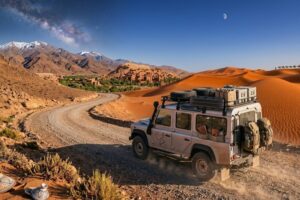
A rental car makes the most sense for travellers who want to explore at their own pace, who plan to visit smaller towns and viewpoints off the main tourist circuit, who are travelling in a group of 3–4 where the per-person cost becomes very competitive, or who simply enjoy driving as part of the travel experience. For the classic Marrakech–Sahara–Marrakech southern circuit specifically, many travellers — including experienced independent drivers — choose a private driver-guide instead, since the route includes mountain passes, unfamiliar road conditions, and a level of local knowledge (the best stops, the right timing for light at each viewpoint) that a guide provides and a rental car does not. Our group vs private tours guide and Morocco road trip guide cover this decision in depth.
Best Car Rental Companies in Morocco
Morocco’s car rental market includes major international brands and a large number of local Moroccan companies, both at airports and in city centres. Here is the honest picture of what each category offers:
International Rental Companies
Europcar, Hertz, Avis, and Sixt all operate in Morocco’s major airports and cities. These companies offer the most straightforward booking experience for international travellers, accept major credit cards for the security deposit, generally provide newer vehicle fleets, and have English-speaking staff at airport locations. Insurance terms are usually clearer and more comprehensive than local companies, though prices run 20–40% higher. For first-time visitors to Morocco who want the simplest, most predictable rental experience, an international brand booked through RentalCars.com or directly through the company website is the safest choice.
Reputable Local Moroccan Rental Companies
Morocco has dozens of local rental companies, particularly in Marrakech, Agadir, and Casablanca, offering significantly lower prices than international brands — often 30–50% less for equivalent vehicles. The quality varies considerably. The best local companies maintain well-serviced fleets, offer clear written contracts (insist on one in French or English, never verbal-only agreements), and have a genuine local reputation that can be verified through reviews. Avoid any company offering a price that seems significantly below the local market average — this is consistently the sign of inadequate insurance coverage, hidden fees revealed only at return, or a vehicle in poor mechanical condition.
How to Choose: Our Honest Recommendation
- First-time visitors, simpler logistics, peace of mind: Book an international brand through your home country in advance
- Better value, willing to do more research: A well-reviewed local Moroccan company, booked with a clear written contract
- Group of 4+, wanting maximum flexibility: A larger vehicle or 4×4 from either category — cost per person becomes very competitive
- The southern desert circuit specifically: Consider a private driver-guide instead — see our road trip guide for the comparison
Car Rental Prices in Morocco (2026)
Morocco’s car rental prices remain genuinely affordable by international standards, though prices spike significantly during peak season (Christmas/New Year, Easter, and the spring months of March–May).
💰 Average Daily Car Rental Rates in Morocco
- Economy (Dacia Logan, Renault Clio): $25–40/day
- Compact/mid-size (Volkswagen Golf, Renault Megane): $35–55/day
- SUV (Dacia Duster): $45–70/day
- 4×4 (Toyota Hilux, Dacia Duster 4×4): $55–90/day
- Automatic transmission surcharge: +$8–15/day (manual is standard and significantly cheaper)
- Full insurance / CDW (no excess): +$10–20/day
- Additional driver fee: $5–10/day or one-time fee
- One-way rental (different pickup/return city): $50–150 surcharge
- Peak season surcharge (March–May, Dec–Jan): +20–40% on base rates
For the full cost picture of a Morocco trip, see our complete Morocco trip cost guide.
What Documents Do You Need to Rent a Car in Morocco?
- Valid driving license from your home country, held for a minimum of 1–2 years (varies by company)
- International Driving Permit (IDP): Not always strictly required for short stays from many countries, but strongly recommended — particularly if your license is not in French or Arabic. An IDP costs little and removes any ambiguity at police checkpoints, which are common throughout Morocco. Obtain one through your national automobile association before departure.
- Passport: Required for identification and contract
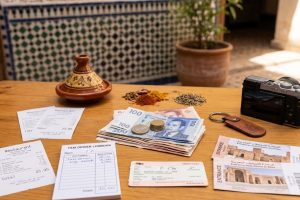
- Credit card in the main driver’s name for the security deposit (typically 3,000–8,000 MAD, held and released after return)
- Minimum age: Usually 21, sometimes 23 or 25 for SUVs and 4×4 vehicles — check with your specific company
Driving in Morocco: Rules, Conditions, and What to Expect
Morocco drives on the right, like the USA, Canada, and continental Europe. Road signage follows international standards and is generally clear on major routes. The motorway network (autoroute, marked “A” routes) connecting Casablanca, Rabat, Tangier, Fes, and Marrakech is excellent — modern, well-maintained, and tolled. Outside the motorway network, road quality varies: major national routes (marked “N”) are generally well-paved and well-maintained, while smaller regional and rural roads can be narrower, less consistently maintained, and occasionally affected by weather (flash flooding in valleys after rain, snow in the Atlas passes in winter).
Speed Limits and Police Checkpoints
Speed limits are 120 km/h on motorways, 100 km/h on main national roads, 60 km/h in urban areas, and 40 km/h near schools — these are strictly enforced with radar cameras and physical checkpoints. Police checkpoints are common on major routes, particularly near city limits and on the southern desert roads. They are routine and not cause for concern — slow down, have your documents ready, and be polite. Officers occasionally ask foreign drivers a few questions about their journey; this is standard practice, not an indication of a problem.
Mountain Driving
The Tizi n’Tichka pass (2,260m, between Marrakech and Ouarzazate) and the Tizi n’Test pass (2,092m, the alternative southern route) are both paved but genuinely mountainous — narrow in sections, with sharp switchbacks and limited visibility around bends. Both are entirely manageable for a confident driver in good conditions, but should be driven in daylight, at reduced speed, and with caution around slower trucks and local drivers who know the road and may overtake on blind corners. Winter snow occasionally closes the Tizi n’Test; the Tizi n’Tichka is the more reliable winter route as it carries the primary north-south traffic.
Driving in Medinas and City Centres
Medinas (the old walled cities) are pedestrian-only in their core — you cannot and should not attempt to drive into Marrakech’s, Fes’s, or Essaouira’s medina interior. Park outside the medina walls (most riads can arrange secure parking nearby or provide directions) and walk in. City centre driving in Casablanca, Rabat, and Marrakech’s Gueliz district follows standard urban rules but with notably assertive local driving styles — more horn use, closer following distances, and more fluid lane discipline than North American or Northern European drivers are used to. Defensive, patient driving is the right approach.
Night Driving
We generally advise against night driving on rural roads in Morocco. Unlit roads, unmarked speed bumps in small towns, livestock and pedestrians on rural roads, and the occasional unlit vehicle or cart make night driving meaningfully riskier than daytime driving. Plan your itinerary so that significant intercity legs are completed before dusk.
Roundabouts and Right of Way
Moroccan roundabouts generally give priority to traffic already in the roundabout (similar to UK/European convention), though local practice is not always perfectly consistent — approach cautiously and watch what other drivers actually do rather than relying purely on the rule. In smaller towns, give way to pedestrians proactively; pedestrian right-of-way is not always respected by other drivers and small children and animals on the road are common.

Car Rental Insurance in Morocco: What You Actually Need
Insurance is the area where most car rental problems in Morocco originate — either through inadequate coverage that leaves travellers liable for significant repair costs, or through aggressive upselling at the rental counter for coverage that should have been included from the start.
🛡️ Car Rental Insurance Checklist for Morocco
- CDW (Collision Damage Waiver): Should be included in your base rate — confirm before booking, not after
- Theft Protection (TP): Often separate from CDW — confirm it’s included, as vehicle theft, while uncommon, does happen
- Excess/deductible amount: Ask exactly what you are liable for in case of damage — this can range from 0 MAD (zero excess) to 8,000+ MAD depending on the policy
- Tyre and windscreen coverage: Often excluded by default — worth adding given Morocco’s road conditions, particularly for rural and mountain routes
- Personal accident insurance: Usually optional — check whether your travel insurance policy already covers this (most comprehensive policies do)
- Cross-border restrictions: Confirm whether your insurance is valid if your itinerary takes you near the Western Sahara region or border areas
Our strong recommendation: pay for full coverage with zero excess from the outset, even if it costs more upfront. The savings from a cheaper, less comprehensive policy are rarely worth the financial exposure if an incident occurs — particularly given Morocco’s variable rural road conditions, the presence of livestock on roads, and the unfamiliarity of driving conventions for most international visitors. Always photograph the vehicle thoroughly (every panel, all four tyres, the dashboard mileage and fuel level) before driving away, and again upon return, as a documented record in case of any dispute.
Fuel, Tolls, and Practical Driving Costs
Fuel in Morocco costs approximately 14–15 MAD per litre ($1.40–1.50) — diesel (gasoil) is slightly cheaper than petrol (essence) and most rental SUVs and 4×4 vehicles run on diesel. Fuel stations are plentiful on major routes; on remote desert and mountain roads, fill up whenever you pass a station rather than waiting until the tank is low. Morocco’s motorway network (autoroute) charges tolls — a Marrakech to Casablanca run on the motorway costs approximately 70–90 MAD in tolls, paid in cash at toll booths. Parking in city centres typically costs 5–10 MAD per hour with informal attendants (gardiens) who watch vehicles for a small tip (5–10 MAD) — this is a normal and accepted practice throughout Morocco.
The Best Road Trip Routes for a Rental Car in Morocco
Morocco rewards a rental car most on routes where flexibility and unplanned stops add real value. The Atlantic coast route from Casablanca through Essaouira to Agadir is excellent self-drive territory — well-paved roads, manageable distances, and a string of worthwhile coastal stops. The Imperial Cities circuit — Casablanca, Rabat, Meknes, Fes — connects efficiently by either train or rental car, with a car offering the advantage of stopping at Volubilis and smaller towns en route. The Chefchaouen to Tangier stretch through the Rif Mountains is a beautiful and manageable self-drive route.
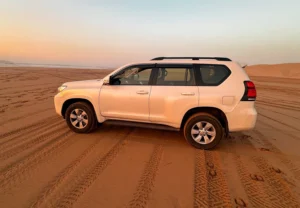
The classic southern desert circuit — Marrakech to Merzouga via Ait Benhaddou, the Dades Valley, and Todra Gorge — is drivable in a standard rental car (the road is fully paved) and is one of the most spectacular drives in the world, but it requires confidence with mountain driving, a full day’s commitment per leg, and the local knowledge to know where to stop for the best views and light. Many self-drive travellers on this specific route choose to combine a rental car for the northern cities with a private guide for the southern circuit. Our complete Morocco road trip guide covers every route in detail with mile-by-mile recommendations.
Common Car Rental Problems in Morocco — and How to Avoid Them
- Pre-existing damage not documented: Always photograph the vehicle thoroughly before driving away, with timestamps, and have the rental agent acknowledge any existing scratches or dents in writing on the contract.
- Unexpected charges at return: Get a clear, itemised written contract at pickup specifying exactly what is included (insurance level, mileage limits, additional driver, fuel policy) and confirm the total price in MAD before signing.
- “Full tank” disputes: Photograph the fuel gauge at pickup and return. Most rentals operate on a “full to full” basis — return with the same fuel level you received.
- Aggressive upselling at the counter: If you booked with insurance included online, you should not be pressured into additional coverage at pickup. Politely decline and reference your booking confirmation if this happens.
- Currency confusion: Confirm all prices in Moroccan Dirhams, never accept quotes only in euros or dollars without a clear MAD conversion.
Prefer a Driver Who Knows Every Road?
If the idea of mountain passes and unfamiliar roads doesn’t appeal, we offer private driver-guided tours across all of Morocco’s classic routes — the same freedom and flexibility as a rental car, with someone who knows every stop, every shortcut, and every viewpoint worth the detour.
We reply within 24 hours · No obligation
Frequently Asked Questions: Renting a Car in Morocco
How much does it cost to rent a car in Morocco?
An economy car costs $25–40/day, a mid-size car $35–55/day, and an SUV or 4×4 $45–90/day, with full insurance adding $10–20/day. Peak season (March–May, Christmas/New Year) adds a 20–40% surcharge. Booking 2–3 months in advance generally secures the best rates.
Do I need an International Driving Permit for Morocco?
It is not always strictly mandatory for short visits from many countries, but it is strongly recommended, particularly if your home license is not in French or Arabic. It removes any ambiguity at police checkpoints and is inexpensive to obtain through your national automobile association before departure.
Is it safe to drive in Morocco?
Yes, with appropriate caution. Major roads and motorways are well-maintained and safe. Mountain passes require confident, attentive driving in daylight. Night driving on rural roads carries higher risk due to unlit roads, animals, and unmarked hazards. Urban driving requires defensive habits given more assertive local driving styles. Our Morocco safety guide covers the broader picture.
Can I drive into the Sahara desert with a rental car?
The road to Merzouga (Erg Chebbi) is fully paved and accessible in a standard rental car — no 4×4 required. However, reaching Erg Chigaga near M’Hamid requires crossing 50 km of open desert piste, which absolutely requires a proper 4×4 with an experienced driver and is not advisable in a standard rental car under any circumstances. See our Merzouga vs M’Hamid guide for the full comparison.
What is the minimum age to rent a car in Morocco?
Most companies require drivers to be at least 21 years old and to have held a valid license for 1–2 years, with some companies requiring 23 or 25 for SUV and 4×4 categories. Young driver surcharges may apply for drivers under 25.
Should I rent a car or hire a private driver in Morocco?
For the northern imperial cities and coastal routes, a rental car offers excellent value and flexibility. For the southern desert circuit specifically — mountain passes, unfamiliar road conditions, and a route where local knowledge significantly enhances the experience — many travellers prefer a private driver-guide. Our group vs private tours guide covers the full comparison of costs and experience.