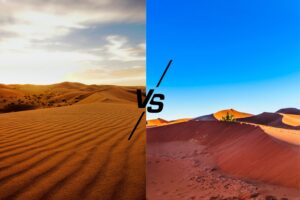
Merzouga vs MHamid, this is the question that every traveller who has done their research eventually arrives at. You have seen the photographs — the towering orange dunes, the camel silhouette at sunset, the vast silence of the Sahara — and you have discovered that Morocco has not one great desert destination but two. Merzouga, in the southeast, is the famous one: the dunes in every Instagram feed, the destination of every shared minibus tour, the backdrop of a hundred travel documentaries. M’Hamid el Ghizlane, in the south, is the other one: quieter, further, wilder, less visited, and — for a certain kind of traveller — far more rewarding.
Both are extraordinary. Both will change how you think about landscape and silence and your own smallness in the world. But they are genuinely different experiences, and the right choice depends entirely on what you are looking for, how much time you have, what you are willing to spend, and whether you want the iconic version or the authentic one.
This guide gives you the honest, unvarnished comparison — distances, dune sizes, camp quality, costs, accessibility, and the kind of traveller each desert suits best. By the end, you will know exactly which one is right for your trip.
⚡ Merzouga vs M’Hamid — At a Glance
| Merzouga (Erg Chebbi) | M’Hamid (Erg Chigaga) | |
|---|---|---|
| Distance from Marrakech | ~560 km / 7–8 hrs | ~540 km / 7–8 hrs |
| Dune height | Up to 150 m (Erg Chebbi) | Up to 300 m (Erg Chigaga) |
| Dune area | ~50 km² — compact, accessible | ~150 km² — vast, remote |
| 4×4 required? | No — paved road to village | Yes — 50 km desert piste to dunes |
| Tourist crowds | Moderate to high (peak season) | Low — genuinely remote |
| Camp quality range | Budget to ultra-luxury | Basic to mid-range (luxury growing) |
| Minimum tour length | 2 days / 1 night from Marrakech | 3 days / 2 nights minimum |
| Best for | First-timers, families, luxury | Adventurers, photographers, repeat visitors |
| Shared tour price (3d/2n) | $80–160 per person | $110–200 per person |
Merzouga and Erg Chebbi: The Iconic Moroccan Sahara
Merzouga is a small village in the Tafilalt region of southeastern Morocco, sitting directly at the base of Erg Chebbi — a sea of orange sand dunes that rise abruptly from the flat, black stone hammada as if placed there by a different geological logic entirely. There is nothing gradual about the Erg Chebbi approach: one moment you are driving through stony semi-desert scrubland, and then, around a bend in the road, the dunes appear — enormous, shockingly orange, and beautiful in a way that is almost confrontational.
The dunes of Erg Chebbi reach heights of up to 150 metres and cover an area of roughly 50 square kilometres. They are not Morocco’s largest dunes — that distinction belongs to Erg Chigaga near M’Hamid — but they are among the most visually dramatic in North Africa and uniquely accessible: the paved road runs directly to the village of Merzouga, meaning you can step off a tour vehicle and be riding a camel into the dunes within thirty minutes of arrival. This accessibility is Merzouga’s greatest practical advantage over M’Hamid, and it is the primary reason it has become Morocco’s most visited desert destination.
What Makes Merzouga Special
Beyond the famous dunes, Merzouga sits within a landscape of extraordinary variety. The Dayet Srji — a seasonal salt lake at the village’s edge — draws flamingos in winter and creates mirror-perfect reflections of the dune ridge that are among the most surreal photography opportunities in Morocco. The nearby Khamlia village is home to a community of Gnawa musicians — descendants of sub-Saharan slaves — whose hypnotic traditional music performances, offered informally in the village for visitors who seek them out, represent one of Morocco’s most genuine cultural encounters. The nomadic Berber and Tuareg families of the surrounding region can be visited with a knowledgeable guide, offering a window into a way of life that has remained fundamentally unchanged for centuries.
Merzouga is also the region’s activity hub. Beyond camel trekking, the dunes around Erg Chebbi offer sandboarding, quad biking, 4×4 desert driving, and overnight bivouac experiences at varying distances from the village. The Sahara desert facts guide explains what makes this specific desert ecosystem unique — the colour, the height, the formation, and why these particular dunes exist at all.
Camp Quality at Merzouga
Merzouga has by far the widest range of desert camp accommodation in Morocco — from basic communal Berber tents at $20 per person per night to extraordinary private luxury camps with en-suite bathrooms, proper beds, private terraces, and multi-course dinners served under lantern light. The camp market here is mature and competitive, which means prices are reasonable and quality at every level is higher than at more remote destinations. Our guide to the 10 best camps in the Sahara desert of Merzouga covers the full range with honest, current assessments.
The Honest Downside of Merzouga
Merzouga’s accessibility is also its limitation. In peak season — December through February and the spring school holiday periods — the base of the Erg Chebbi dunes can feel surprisingly busy. The camel trains heading to the major camps follow well-worn paths. The dunes near the most popular camps bear evidence of foot traffic. From a distance and at the right time of day (early morning, well away from the main camp cluster), the solitude is complete and overwhelming. But at the most visited spots during peak hours, Merzouga is unmistakably a popular tourist destination — which may or may not be relevant to your experience, depending on what you came for.
For travellers who prioritise genuine desert solitude and are willing to invest extra days and a slightly higher budget to get it, M’Hamid and Erg Chigaga deliver what Merzouga cannot always guarantee.

M’Hamid el Ghizlane and Erg Chigaga: The Wild Sahara
M’Hamid el Ghizlane — “the plain of gazelles” in Arabic — is the last town before the Algerian border, 90 kilometres south of Zagora on the southern edge of the Draa Valley. It is a small, traditional, genuinely remote desert town that feels as though it exists on the edge of the known world — because, in practical terms, it does. The paved road ends at M’Hamid. Beyond it, the Sahara begins.
The destination for travellers coming to M’Hamid is Erg Chigaga — a vast sea of dunes 50 kilometres into the desert from the town, accessible only by 4×4 across open desert piste. At up to 300 metres in height and covering approximately 150 square kilometres, Erg Chigaga is significantly larger than Erg Chebbi and genuinely more remote. There are no paved roads near it, no village at its base, and — except during the busiest periods of the year — very few other visitors.
Getting to Erg Chigaga requires a 4×4 vehicle and a knowledgeable driver who knows the piste — there are no signposts and the track changes with the wind and seasonal flooding. This is not a limitation but a feature: the 50-kilometre drive across the hammada and pre-dune sand fields to the Erg Chigaga massif is itself one of the most extraordinary desert experiences Morocco offers, passing through landscapes of stony desert, dried riverbeds, isolated nomad encampments, and increasingly towering dune formations that announce the Erg long before you arrive at it.
What Makes M’Hamid and Erg Chigaga Special
Erg Chigaga’s primary gift is scale and solitude. The dunes here are larger than anything at Merzouga — walking or riding to the summit of a major Chigaga dune is a genuine physical undertaking that rewards with a panoramic view of an ocean of sand extending in every direction to the horizon with no sign of human presence. The silence at the top of an Erg Chigaga dune at dawn is absolute in a way that is difficult to communicate to someone who has not experienced it.
The town of M’Hamid itself is worth time. The weekly Monday souk — a traditional market drawing nomadic Berber and Tuareg families from the surrounding desert — is one of the most authentic market experiences in southern Morocco, with none of the tourist-oriented commerce that characterises the souks of Marrakech and Fes. The town’s ancient kasbah quarter and the nearby Oued Draa — Morocco’s longest river, which flows only occasionally but whose palm-lined riverbed is one of the most beautiful valley landscapes in the south — add historical and natural depth to the destination. See our Zagora city guide for the wider regional context, as Zagora is the gateway city most visitors pass through on the way to M’Hamid.
For travellers interested in Morocco’s nomadic Berber and Tuareg cultures, M’Hamid is also the better base. The families who continue a semi-nomadic lifestyle in the desert between M’Hamid and the Algerian border are more accessible here — a good local guide can arrange genuine visits rather than the stylised encounters sometimes offered at the better-established Merzouga camps. Our Berbers of Morocco guide gives essential cultural context for these encounters.
Camp Quality at M’Hamid and Erg Chigaga
Desert camps at Erg Chigaga are fewer in number and — at the top end — genuinely extraordinary. The logistics of supplying a luxury camp 50 kilometres into open desert demands a level of operational commitment that results in a more curated, more isolated, and more memorable experience than most Merzouga luxury camps can match. At the budget and mid-range level, facilities are more basic than equivalent Merzouga options — the remoteness makes this inevitable. The trade-off of reduced comfort for vastly increased solitude and scale is, for the right traveller, not a trade-off at all.
The most acclaimed camp in the Erg Chigaga area — Erg Chigaga Luxury Camp — has been featured in numerous international travel publications for its combination of genuine wilderness location and genuine comfort. Advance booking is essential. Details and current availability are best checked through Responsible Travel’s Morocco Sahara guide, which lists verified operators and camps at both destinations with sustainability ratings.
The Honest Downside of M’Hamid
M’Hamid and Erg Chigaga demand more time, more money, and more logistical commitment than Merzouga. The 4×4 requirement is non-negotiable — you cannot reach Erg Chigaga without one, which means this destination is only viable on a private tour (shared tours do not go to Erg Chigaga). The minimum meaningful tour from Marrakech to Erg Chigaga and back is 4 days — 3 nights if you want any time to actually experience the desert rather than simply transit through it. The road from Marrakech to M’Hamid via the Draa Valley is long, spectacular, and demanding.
For first-time visitors to Morocco with limited time — 7–10 days total — Merzouga is the more efficient choice. The experience is magnificent and the logistics are manageable within a 3-day window. M’Hamid rewards travellers with more time, more experience, and more appetite for the adventurous and the unknown.
The Road to Each Desert: What You’ll See En Route
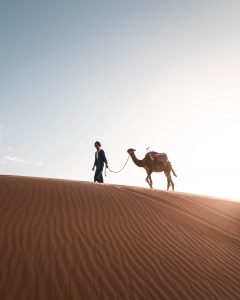
One of the most underappreciated aspects of choosing between Merzouga and M’Hamid is that the journey to each passes through entirely different landscapes — and both routes are among the most beautiful drives in Morocco.
The Route to Merzouga: Kasbahs, Gorges, and Oases
The classic route from Marrakech to Merzouga travels south over the Tizi n’Tichka pass, through the UNESCO World Heritage ksar of Ait Benhaddou, past Ouarzazate (Morocco’s film capital), through the rose-filled Dades Valley, into the slot canyon drama of the Todra Gorge, across the oasis-rich Ziz Valley, and finally into Merzouga. This is the famous Road of a Thousand Kasbahs — arguably one of the ten most scenic road routes in the world. Every stop on it is worthy of its own visit. The route passes through our full Morocco road trip guide in detail.
The Route to M’Hamid: The Draa Valley
The route to M’Hamid travels south from Marrakech over the Tizi n’Tichka or via the Tizi n’Test pass, through Ouarzazate, and then south along the Draa Valley — one of Morocco’s most beautiful and least-visited major routes. The Draa is Morocco’s longest river, and its valley is a 200-kilometre corridor of date palm groves, ancient mud-brick kasbahs, small Berber villages, and the dramatic contrast between the green oasis corridor and the burning ochre desert on either side. The towns of Agdz and Zagora are worth stops — both have excellent local markets and kasbah-rich old quarters. The final stretch from Zagora to M’Hamid passes through increasingly sparse, increasingly beautiful desert landscape that prepares you emotionally for the Erg Chigaga ahead.
For travellers considering a self-drive, the Draa Valley route is less driven than the Dades/Todra circuit and arguably more rewarding for it — quieter roads, fewer tourists, and the sensation of genuinely penetrating deep into the Moroccan south. Combine it with our Morocco road trip guide for a full self-drive itinerary.
🐪 Not Sure Which Desert Is Right for You?
Tell us your travel dates, group size, budget, and what kind of experience you are looking for. We have guided travellers to both Merzouga and M’Hamid for fifteen years — and we will give you an honest recommendation, not a sales pitch.
Side-by-Side Comparison: Which Desert Is Right for You?
✅ Choose Merzouga (Erg Chebbi) if:
- This is your first time visiting a Moroccan desert
- You have 3 days or fewer available for the desert portion of your trip
- You are travelling with children, elderly relatives, or anyone with mobility considerations
- You want the widest range of accommodation options including verified luxury camps
- You want to combine desert with the Dades Valley, Todra Gorge, and Ait Benhaddou on a single route
- You want activity options: quad biking, sandboarding, Gnawa music, fossil shopping
- You are on a shared tour or budget tour
✅ Choose M’Hamid (Erg Chigaga) if:
- You have visited Merzouga before and want a deeper, more remote experience
- You have 4+ days available for the desert portion
- Genuine solitude and vast, untouched dune landscapes matter more to you than convenience
- You are travelling in a group of 2–6 on a private tour (4×4 required)
- You want to experience the Draa Valley — one of Morocco’s most beautiful and least-visited routes
- You are a photographer, writer, or traveller for whom the authenticity and scale of the landscape is paramount
- You want an experience that very few other travellers have had
Can You Visit Both Merzouga and M’Hamid?
Yes — and for travellers with 7 or more days for southern Morocco, combining both deserts on a single loop is one of the greatest itineraries Morocco offers. The classic combined route runs: Marrakech → Ait Benhaddou → Dades Valley → Todra Gorge → Merzouga (1–2 nights) → Rissani → Erfoud → Tinerhir → Ouarzazate → Zagora → M’Hamid (1–2 nights at Erg Chigaga) → Draa Valley → Ouarzazate → Marrakech. This loop covers the full southern circuit and puts both great desert experiences within a single, coherent itinerary.
The loop is approximately 1,600 kilometres and takes a minimum of 7 days to do meaningfully — more if you want time to breathe at each stop rather than simply transit. It requires a private vehicle (4×4 recommended for the M’Hamid section) and a driver-guide who knows both routes well. Our 2 weeks in Morocco guide includes a full 14-day itinerary that incorporates both deserts with the right pacing, and the 9-day southern Morocco desert tour offers a guided version of this circuit.
Costs: Merzouga vs M’Hamid
🏷️ Desert Tour Cost Comparison — Per Person from Marrakech (2026)
| Tour Type | Merzouga | M’Hamid / Erg Chigaga |
|---|---|---|
| Shared 3-day/2-night | $80–160 pp | Not available (4×4 required) |
| Private 3-day/2-night | $200–420 pp (group of 2–4) | $280–500 pp (group of 2–4) |
| Private 4-day/3-night | $280–520 pp | $380–650 pp |
| Combined loop (7–10 days) | $600–1,200 pp for both deserts | |
The M’Hamid premium reflects the 4×4 requirement, longer distances, and smaller pool of operators. For a complete cost framework, see our full Morocco trip cost guide.
Best Time to Visit Each Desert
Both Merzouga and M’Hamid share the same seasonal logic — the Sahara is a year-round destination, but conditions vary enormously:
- October–November: Excellent for both. Warm days, cool evenings, clear skies, not yet crowded. One of the most reliable windows.
- December–February: Peak season for Merzouga — camps are at capacity, prices are highest, and the cold nights (2–8°C) are part of the drama. M’Hamid in winter is extraordinary and quieter. Read our Morocco winter holiday guide.
- March–April: Best overall for both. Comfortable temperatures, wildflowers in the Draa Valley, the Valley of Roses in bloom nearby. Avoid Easter week if possible — it is the busiest week of the year at Merzouga. See our Morocco in April guide.
- May: Still very good. Temperatures rising (30–38°C by day) but evenings and early mornings are perfect. Our Morocco in May guide covers what to expect.
- June–August: Avoid for both deserts unless heat is genuinely your preference. Temperatures at Merzouga and M’Hamid regularly exceed 45°C in July and August. Camel treks in this heat are inadvisable for most travellers.
- September: Transitional. Late September is pleasant and increasingly reliable. M’Hamid in particular recovers its character quickly once the summer heat breaks.
For the full seasonal breakdown, our best time to visit Morocco guide covers every month in detail.
Practical Tips: Merzouga and M’Hamid
- Pack layers regardless of season. The temperature swing between desert midday and desert midnight is one of the largest on earth — 20–25°C is common. Warm layers for camp nights are essential from October through April. The Morocco packing list has a desert-specific section.
- Carry cash. ATMs are scarce east of Ouarzazate and do not exist in M’Hamid. Bring sufficient Moroccan Dirhams before leaving Marrakech or Agadir. Our cash guide for Morocco advises on exact amounts.
- Book travel insurance before you go. Both destinations are remote. Medical facilities in Merzouga are basic; in M’Hamid, they are minimal. Comprehensive travel insurance covering emergency evacuation is essential. See our Morocco travel insurance guide.
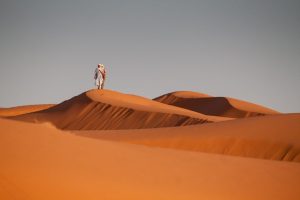
- Respect the light. The best photography at both deserts happens in the 45 minutes before and after sunrise and sunset. Plan your camel trek or dune walk around this window — not the middle of the day. Your guide will know exactly where to position you.
- Tip your camel handler. At both destinations, the person walking alongside your camel through the dunes earns very little from the tour price itself. 50–100 MAD per person is appropriate and genuinely appreciated by these communities.
- For M’Hamid, book early and verify your operator’s 4×4 knowledge. The piste to Erg Chigaga changes seasonally and is not signposted. Only an operator with genuine local knowledge should take you there. Our camel riding guide and Sahara trekking guide cover the activity dimensions of both destinations.

Frequently Asked Questions: Merzouga vs MHamid
Which has bigger dunes — Merzouga or M’Hamid?
M’Hamid’s Erg Chigaga has larger dunes — reaching up to 300 metres compared to Erg Chebbi’s 150 metres — and covers a significantly larger area (approximately 150 km² versus 50 km²). For travellers whose priority is the sheer scale and grandeur of the dune landscape, Erg Chigaga is the more impressive of the two. That said, Erg Chebbi’s dunes are still extraordinarily beautiful — their visual impact on arrival, rising abruptly from the flat hammada, is arguably more dramatic precisely because the transition is so sudden.
Is M’Hamid safe to visit?
Yes. M’Hamid and the Erg Chigaga area are safe for tourists, as are all major desert destinations in southern Morocco. The area near the Algerian border requires some navigation awareness — guided tours are strongly recommended, and independent travel deep into the desert is not advisable without a knowledgeable local guide. Our Morocco safety guide covers the full safety picture for southern Morocco.
Can I visit Erg Chigaga (M’Hamid) without a 4×4?
No. The 50-kilometre piste from M’Hamid to Erg Chigaga is an unpaved desert track that requires a proper 4×4 vehicle with an experienced driver. It is not accessible in a standard car or a shared minibus. This is one of the primary reasons M’Hamid remains less visited than Merzouga — it is genuinely only viable on a private, 4×4-equipped tour.
Which desert is better for a honeymoon or romantic trip?
Both are extraordinary for couples — the Sahara at night, under an unpolluted sky, with a fire and the sound of desert silence, is one of the world’s great romantic settings. For luxury and a wide choice of private tent options, Merzouga has the edge in terms of availability and verified camp quality. For absolute solitude and the feeling of having the Sahara entirely to yourselves, Erg Chigaga is incomparable. Our Morocco for couples guide and honeymoon in Morocco guide have more tailored suggestions.
How do I get to M’Hamid from Marrakech?
The most practical way to reach M’Hamid is by private vehicle — either a self-drive 4×4 or with a private tour operator. Public transport connections exist (CTM bus to Zagora, then onward transport to M’Hamid) but are slow and logistically complex for anyone also wanting to reach Erg Chigaga. We strongly recommend a private tour for M’Hamid given the 4×4 requirement for the final desert section. See our hire a car in Morocco guide if you are considering self-drive.
Which desert is better for solo travellers?
Merzouga is significantly more practical for solo travellers — shared tours run daily from Marrakech and make the destination accessible on a budget without the need for a private vehicle. M’Hamid requires a private tour and the 4×4 costs are harder to share alone. Solo travellers with a larger budget or who connect with other travellers for a small group private tour can make M’Hamid work — and for the right solo traveller, the solitude of Erg Chigaga is the entire point. See our solo travel Morocco guide for the full picture.