Morocco is one of the most rewarding international destinations an American can choose — and one of the most underrated. While Southeast Asia and Europe fill most American travel itineraries, Morocco sits just 9 hours from New York on a direct flight, requires no visa, costs significantly less than most European destinations, and delivers a depth of history, landscape, and cultural experience that genuinely changes how you see the world. The Sahara desert, the imperial medinas, the Atlas Mountains, the Atlantic coast — all of this is accessible, all of it is safe, and all of it is within reach of any American with 10 days of vacation.
This guide covers everything an American traveller needs to plan a Morocco trip in 2026: flights, entry requirements, the best itineraries, what things cost, practical tips for American visitors specifically, and how to get the most out of a country that rewards preparation.
⚡ Travel to Morocco from USA — Essential Facts
- Visa required? No — Americans get 90 days visa-free on arrival
- Direct flights from USA: New York JFK → Casablanca CMN (Royal Air Maroc, ~7.5 hrs)
- Connecting flights from USA: Via Madrid, Paris, London, Amsterdam — 11–14 hrs total
- Best US gateway cities to fly from: New York, Washington DC, Miami, Los Angeles
- Time difference: Morocco is 5 hours ahead of EST / 8 hours ahead of PST
- Currency: Moroccan Dirham (MAD) — 1 USD ≈ 10 MAD (excellent exchange rate)
- Credit cards: Visa/Mastercard accepted in hotels and some restaurants — carry cash for medinas
- Language: French is the tourist language — English increasingly spoken in major cities
- Best months for Americans: March–May and September–November
- Recommended trip length: 10–14 days for a complete first Morocco experience
Do Americans Need a Visa for Morocco?
No. American passport holders can enter Morocco visa-free and stay for up to 90 days. You will receive an entry stamp at the airport on arrival — no application, no fee, no pre-travel paperwork required. Your US passport must be valid for at least 6 months beyond your planned entry date. Keep your passport with you throughout your trip as accommodation requires it for registration. For the most current entry requirements, the US Embassy Morocco entry page is the official reference.
Flights from USA to Morocco: What to Know
Getting from the United States to Morocco is more straightforward than most Americans expect, and the flight options have improved significantly over the past five years.
Direct Flights from USA to Morocco
Royal Air Maroc operates the only direct nonstop service between the USA and Morocco — from New York JFK to Casablanca Mohammed V Airport (CMN). The flight takes approximately 7.5 hours eastbound and departs several times weekly. Casablanca is Morocco’s main international hub, with onward connections to Marrakech, Fes, Agadir, and Tangier. This direct route is the fastest and usually the best value for East Coast travellers. See our full flights to Morocco from USA guide for current schedules and booking tips.
Connecting Flights from USA to Morocco
Travellers from other US cities — Los Angeles, Chicago, Miami, Dallas, Washington DC, Boston — typically connect through European hubs. The most common and most comfortable routing is via Madrid (Iberia), Paris CDG (Air France or Royal Air Maroc), Amsterdam (KLM), or London Heathrow (British Airways + Royal Air Maroc). Total journey time from the US West Coast is typically 14–17 hours including connection. From the East Coast via Europe, expect 11–14 hours total.
Which Airport to Fly Into?
For most American first-time visitors, Marrakech Menara Airport (RAK) is the best arrival point — it puts you directly in the most popular starting city without the additional Casablanca–Marrakech connection (3 hours by train). If your routing brings you into Casablanca Mohammed V (CMN) anyway, the ONCF airport train to Casablanca city centre runs every 30 minutes for 35 MAD. Onward trains from Casablanca to Marrakech take 3 hours and cost approximately 95–110 MAD.
Flight Price Ranges from USA to Morocco (2026)
- New York JFK → Casablanca (direct, Royal Air Maroc): $500–900 round trip
- New York → Marrakech (via Madrid or Paris): $550–950 round trip
- Los Angeles → Marrakech (via Europe): $650–1,100 round trip
- Miami → Casablanca (via Madrid or London): $580–950 round trip
- Chicago → Marrakech (via Paris or Amsterdam): $600–1,050 round trip
- Best booking window: 3–5 months in advance for March–May peak season
- Cheapest travel months: January, February, September (shoulder season)
What Does Morocco Cost for Americans?
Morocco is one of the best-value international destinations for Americans. The USD-to-MAD exchange rate is consistently favourable — approximately 10 MAD per dollar — which means American purchasing power in Morocco is extraordinary compared to equivalent experiences in Europe or the Caribbean.
💰 Morocco Daily Budget for Americans
- Budget traveller: $30–45/day — hostel dorm, street food, public transport
- Mid-range: $80–140/day — boutique riad, sit-down restaurants, private transfers for key journeys
- Comfort/luxury: $200–500+/day — luxury riads, private tours, fine dining, spa
- Street meal (harira + bread + tea): $2–4
- Sit-down restaurant dinner (local, medina): $8–18 per person
- Boutique riad room (Marrakech): $60–180/night
- Luxury riad (Marrakech, pool): $180–500+/night
- 3-day Sahara desert tour (private, 2 people): $300–550 per person
Full breakdown in our Morocco trip cost guide.
Morocco Itinerary for Americans: 10 Days
Ten days is the ideal length for a first Morocco trip from the USA — enough time to recover from jet lag on Day 1, experience the major highlights without rushing, and still feel the country rather than just photograph it. This is the itinerary we build most often for American visitors flying in via Casablanca or Marrakech.
📍 10-Day Morocco Itinerary for Americans
Day 1 — Arrive Marrakech: Land, transfer to your riad in the medina, walk to Jemaa el-Fnaa for your first taste of the city. Keep it easy — recover from the flight, drink mint tea on a rooftop, sleep early.
Days 2–3 — Marrakech: Full medina experience. Bahia Palace, Saadian Tombs, Ben Youssef Madrasa, Majorelle Garden and YSL Museum, the souks (go early morning), traditional hammam, and the evening magic of Jemaa el-Fnaa. Our 3-day Marrakech guide has the optimised order.
Day 4 — Atlas Mountains day trip: Private car to Imlil in the High Atlas — a 10–15°C temperature drop, walnut orchards, Berber villages, mule tracks. The most dramatic landscape change imaginable in 45 minutes from Marrakech. Our Atlas day trip guide covers every option.
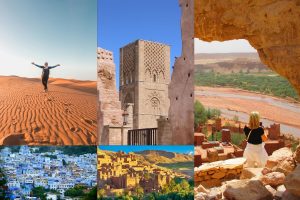
Days 5–7 — Sahara Desert (3-day private tour): The centrepiece of any Morocco trip. South from Marrakech via Ait Benhaddou (the Game of Thrones filming location), Ouarzazate, Dades Valley, Todra Gorge, and the Ziz Valley to Merzouga. Camel trek into Erg Chebbi at sunset. Camp overnight. Sunrise from the dune top. Return via the Road of a Thousand Kasbahs. This is the experience Americans tell us changed their lives. See our desert tour page.
Day 8 — Travel to Fes or Essaouira: Two options. Fly Marrakech → Fes (1 hour, ~$50–80) for an imperial city experience. Or take the 2.5-hour bus west to Essaouira on the Atlantic for ocean, blue boats, and the best grilled fish in Morocco.
Days 9–10 — Fes or Essaouira: Two days in either city. Fes gives you the world’s largest medieval Islamic medina, the Chouara Tanneries, and the Al-Qarawiyyin Mosque (founded 859 CE). Essaouira gives you ocean air, the whitewashed medina, and the most relaxed atmosphere in Morocco. Both are extraordinary. Our Marrakech vs Fes guide helps you decide.
Morocco Itinerary for Americans: 2 Weeks (14 Days)
Two weeks allows Americans to experience the full range of Morocco without rushing — the imperial north, the Sahara south, the Atlantic coast, and the mountain interior. This is our recommended circuit for American visitors with flexible vacation time.
📍 14-Day Morocco Itinerary for Americans
- Days 1–3: Marrakech — medina, souks, hammam, palaces, Majorelle
- Day 4: Atlas Mountains day trip (Imlil or Ouzoud Falls)
- Days 5–7: Sahara desert circuit — Ait Benhaddou, Dades, Todra, Merzouga
- Day 8: Travel to Fes (fly or overnight train via Casablanca)
- Days 9–10: Fes — medina, tanneries, Al-Qarawiyyin, Bou Inania Madrasa
- Day 11: Chefchaouen — the blue city, 4 hours from Fes by bus
- Day 12: Chefchaouen — Spanish Mosque hike, blue alleys, mountain food
- Day 13: Essaouira — fly or bus from Marrakech (return there first); ocean air, blue boats, port fish
- Day 14: Return to Marrakech for evening flight, or fly Fes → home directly
Full route details in our 2 weeks in Morocco guide.
Practical Tips for American Travellers in Morocco
Money and Payments
The Moroccan Dirham (MAD) is the only currency you should use — never pay in dollars. Bring a debit card with low foreign transaction fees (Charles Schwab, Wise, and Capital One 360 all work well in Morocco). Withdraw MAD from ATMs on arrival — they are plentiful in city centres and airports. Carry cash for medina restaurants, taxis, souks, and tips. Credit cards work in hotels and some restaurants but not in the traditional economy. Our Morocco payment guide and cash guide cover this fully.
Phone and Data
US carriers charge high international roaming fees in Morocco. The smart move: buy a local SIM on arrival (Maroc Telecom, Orange, or Inwi — 40–80 MAD for generous data). Alternatively, get a Moroccan eSIM before you leave via Airalo or Nomad. Download Google Maps for Morocco offline before you land — essential for medina navigation. See our Morocco internet guide.
Electrical Adapters
Morocco uses Type C and Type E plugs (European standard, 220V). American devices use 110V — most modern US electronics (phone chargers, laptops) handle 100–240V automatically and just need a plug adapter. Older devices (hair dryers, some travel irons) may need a voltage converter. Pack a Type C/E adapter before you leave.
Health and Safety
No vaccinations are required for Morocco, though hepatitis A and typhoid are recommended by the CDC for travellers who will be eating outside tourist establishments. There is no malaria risk in Morocco’s tourist areas. Tap water is not recommended for drinking — stick to bottled water, which is inexpensive everywhere. Register your trip with the US State Department STEP program before departure — it takes 2 minutes and ensures the embassy can reach you in any emergency. See our Morocco safety guide and healthcare guide.
Travel Insurance
American health insurance — including Medicare — typically does not cover international medical expenses. Purchase a comprehensive travel insurance policy before departure that includes medical evacuation coverage. This is especially important for the desert and mountain portions of your itinerary, where hospital access is limited. Our Morocco travel insurance guide explains exactly what to look for.
Tipping Culture
Americans are used to 18–20% restaurant tipping. In Morocco, 10% at sit-down restaurants is generous and appreciated. For tour guides, 100–200 MAD ($10–20) per day is appropriate for good service. For desert camp camel handlers, 50–100 MAD per person. For hotel staff, 20–50 MAD for housekeeping. The full guidance is in our Morocco tipping guide.
Is Morocco Safe for American Travellers?
Yes. The US State Department currently rates Morocco at Level 1 — “Exercise Normal Precautions” — the same rating as France, Germany, and most of Western Europe. Morocco has a long history of welcoming American tourists and a stable political environment. The primary safety concern for American visitors is petty tourism-related scams and overcharging in Marrakech’s medina — not violent crime or political instability.
American travellers should be aware that Morocco’s scam culture — informal guides, commission-based shops, fake police — targets tourists of all nationalities. Arriving with knowledge of how these work (our scams guide covers every scenario) means they lose their power entirely. The US Embassy in Casablanca and the US Consulate in Casablanca are available 24/7 for American citizens in genuine emergencies — details at the US Embassy Morocco website. We also have a full US Embassy in Morocco guide covering locations and contact information.
What Americans Love Most About Morocco
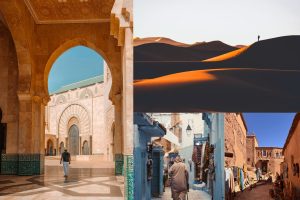
After fifteen years of welcoming American visitors, we see the same things move them every time. The Sahara desert at dawn — the combination of silence, scale, and beauty that most Americans have no cultural reference point for. The medina of Fes — a medieval Islamic city that has been continuously inhabited since the 9th century, with a complexity and a depth that makes the most visited US historical sites feel newly built. The Moroccan hospitality — the tea, the conversation, the genuine interest in where you come from and what you think. And the food — tagines, couscous, pastilla, harira, fresh-baked khobz — which surprises almost every American with its depth and quality at its price point. Our Moroccan food guide is the complete reference.
Ready to Plan Your Morocco Trip from the USA?
We are a Berber family from Morocco who has built itineraries for American travellers from every state. Tell us your dates, your group, and what excites you — we will build your perfect Morocco trip.
We reply within 24 hours · No obligation · Free itinerary planning
Frequently Asked Questions: Americans Travelling to Morocco
Do Americans need a visa to visit Morocco?
No. US passport holders enter Morocco visa-free for up to 90 days. No application or fee required — just a valid US passport with at least 6 months validity beyond your travel dates.
How long is the flight from the USA to Morocco?
The direct Royal Air Maroc flight from New York JFK to Casablanca takes approximately 7.5 hours. Connecting flights from other US cities via European hubs take 11–17 hours total depending on your departure city and connection.
Is Morocco expensive for Americans?
No — Morocco is one of the most affordable international destinations for Americans. With the USD trading at approximately 10 MAD, a good restaurant dinner costs $10–18, a boutique riad room costs $60–180, and the full 3-day Sahara desert tour runs $300–550 per person on a private tour. Morocco offers European-quality experiences at a fraction of European prices.
What is the best time of year for Americans to visit Morocco?
March through May is the most popular and most rewarding period — warm temperatures, clear skies, and green Atlas foothills. September through November is excellent and less crowded. Avoid July and August for the southern desert and Marrakech (extreme heat). Our best time to visit Morocco guide covers every month.
Can Americans drink the tap water in Morocco?
No. Tap water in Morocco is technically treated but can cause stomach issues for visitors whose digestive systems are not accustomed to local bacteria. Bottled water is inexpensive everywhere. See our tap water safety guide.
How much cash should Americans bring to Morocco?
Withdraw Moroccan Dirhams from ATMs on arrival — better rates than airport currency exchanges in the US. As a general guide, carry 500–1,000 MAD ($50–100) in cash per person per day for medina spending, taxis, tips, and meals outside tourist establishments. See our Morocco cash guide.