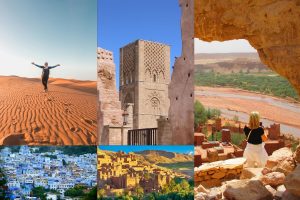
Morocco is one of the most rewarding international destinations a Canadian can choose — and far more accessible than most Canadians realise. From Toronto or Montreal, you are approximately 8–9 hours from Casablanca on a direct or single-connection flight. No visa is required for Canadian passport holders. The Canadian dollar performs well against the Moroccan Dirham. And the country delivers a quality and depth of experience — the Sahara desert, the imperial medinas, the Atlas Mountains, the Atlantic coast — that is genuinely difficult to find anywhere else at this price point.
This guide covers everything a Canadian traveller needs for Morocco in 2026: flights from Canadian cities, entry requirements, the best itineraries, what things cost in Canadian dollars, practical Canada-specific tips, and how to get the most out of one of Africa’s most extraordinary countries.
⚡ Travel to Morocco from Canada — Essential Facts
- Visa required? No — Canadians get 90 days visa-free on arrival
- Best Canadian gateway for direct/near-direct flights: Montreal (YUL) and Toronto (YYZ)
- Direct flights to Morocco from Canada: Montreal YUL → Casablanca CMN (Air Canada/Royal Air Maroc)
- Typical flight time: ~7.5 hrs Montreal → Casablanca direct; 10–13 hrs from Toronto via connection
- Time difference: Morocco is 5 hours ahead of EST (Toronto, Montreal); 8 hrs ahead of PST (Vancouver)
- Currency: Moroccan Dirham (MAD) — 1 CAD ≈ 7.2 MAD (strong value for Canadians)
- Language: French is widely spoken — a major advantage for Quebec travellers
- Best months for Canadians: March–May and September–November
- Recommended trip length: 10–14 days for a complete first Morocco experience
- GHIC equivalent: Canadian provincial health insurance does not cover Morocco — travel insurance is essential
Do Canadians Need a Visa for Morocco?
No. Canadian passport holders can enter Morocco visa-free and stay for up to 90 days. You receive an entry stamp on arrival — no application form, no consulate visit, no fee required. Your Canadian passport must be valid for at least 6 months beyond your intended departure from Morocco. Keep your passport on you throughout your trip as hotels require it for registration. For the most current entry requirements, the Government of Canada Morocco travel advisory is the official reference and is updated regularly.
Flights from Canada to Morocco: What to Know
Canada has some of the best flight connections to Morocco in North America, particularly from Montreal and Toronto. The routing is logical — Morocco sits almost directly east of the Canadian Atlantic seaboard — and connection times through European hubs are generally efficient.
Flights from Montreal to Morocco
Montreal YUL has the strongest Morocco connections of any Canadian airport, partly because of the large Moroccan diaspora community in Quebec and partly because of the shared French-language connection. Royal Air Maroc operates seasonal direct service between Montreal and Casablanca (CMN), making this the fastest routing available from Canada. Air Canada, Air Transat, and Air France also serve the Montreal–Casablanca route via Paris CDG. Total journey time: 7.5–9 hours depending on routing. For French-speaking Canadians, Montreal is the obvious gateway — and Morocco’s French-language environment makes everything from restaurant menus to taxi negotiations easier. See our full Morocco flights guide for current operator and pricing information.
Flights from Toronto to Morocco
Toronto Pearson (YYZ) is Canada’s largest hub and offers strong connecting service to Morocco via European carriers. The most popular routings are via Paris CDG (Air France), London Heathrow (British Airways + Royal Air Maroc), Amsterdam (KLM), and Madrid (Iberia + Royal Air Maroc). Total journey time: 10–13 hours including connection. The Paris connection is particularly smooth — Air France’s YYZ–CDG frequency is excellent, and the CDG–Casablanca or CDG–Marrakech onward legs are short (2.5–3 hours).
Flights from Vancouver to Morocco
Vancouver YVR travellers typically connect through Toronto or a European hub. The most efficient routing for West Coast Canadians is YVR → YYZ → CDG → CMN or RAK, with total journey times of 16–19 hours. An alternative worth checking: Air Transat occasionally offers Montreal connections from Vancouver with competitive through-fares to Morocco in peak season.
Which Airport to Fly Into?
For most Canadian first-time visitors, Marrakech Menara (RAK) is the best arrival airport — it puts you directly in Morocco’s most popular starting city without an additional transfer. Casablanca Mohammed V (CMN) works well if you fly direct from Montreal; the city has excellent onward connections by train to Marrakech (3 hrs, 95–110 MAD), Fes (3.5 hrs), and Rabat (45 min).
Flight Prices from Canada to Morocco (2026, in CAD)
- Montreal → Casablanca (direct, Royal Air Maroc seasonal): CAD $700–1,200 return
- Montreal → Marrakech (via Paris or Madrid): CAD $750–1,300 return
- Toronto → Marrakech (via Paris or London): CAD $850–1,450 return
- Toronto → Casablanca (via Paris or Amsterdam): CAD $800–1,400 return
- Vancouver → Marrakech (via Toronto + Europe): CAD $950–1,600 return
- Best booking window: 3–5 months ahead for March–May peak season
- Cheapest months to fly: January, February, late September
What Does Morocco Cost for Canadians?
Morocco is outstanding value for Canadian travellers. At approximately 7.2 MAD to 1 CAD, your Canadian dollar goes significantly further in Morocco than in Europe, the Caribbean, or the United States. A dinner at a good medina restaurant costs CAD $12–25. A boutique riad room costs CAD $80–220 per night. A private 3-day Sahara desert tour for two people runs CAD $400–750 per person. By any Canadian comparison point, Morocco delivers exceptional quality at a fraction of what equivalent experiences cost in other international destinations.
💰 Morocco Daily Budget for Canadians (in CAD)
- Budget traveller: CAD $40–60/day — hostel dorm, street food, public transport
- Mid-range: CAD $110–180/day — boutique riad, sit-down restaurants, key private transfers
- Comfort/luxury: CAD $270–650+/day — luxury riads, private tours, fine dining, spa
- Street meal (harira + bread + tea): CAD $3–5
- Sit-down restaurant dinner: CAD $11–24 per person
- Boutique riad room (Marrakech): CAD $80–240/night
- 3-day Sahara desert private tour (2 people): CAD $400–750/person
Full breakdown in our Morocco trip cost guide.
Morocco Itinerary for Canadians: 10 Days
Ten days is the sweet spot for a first Morocco trip from Canada — enough to recover from the time difference, experience the four great highlights (Marrakech, the Sahara, Fes or the Atlantic coast, and the mountains), and feel the country at a human pace. This is our most requested itinerary for Canadian visitors.
📍 10-Day Morocco Itinerary for Canadians
Day 1 — Arrive Marrakech: Land, transfer to your medina riad, take a slow evening walk to Jemaa el-Fnaa. The first view of Morocco’s main square — smoke from the grill stalls, the call to prayer from the Koutoubia, the noise and colour of it all — is genuinely unforgettable. Rest and acclimatise.
Days 2–3 — Marrakech: Bahia Palace, Saadian Tombs, Ben Youssef Madrasa, Majorelle Garden, YSL Museum, the souks (best before 10am), a traditional hammam, and the evening food stalls. Our 3-day Marrakech itinerary has the perfect order.
Day 4 — Atlas Mountains: Private car to the Berber village of Imlil at 1,740m — walnut orchards, Atlas streams, mule tracks, mountain air. The drive over the Tizi n’Test is one of the most spectacular road experiences in North Africa. Our Atlas day trip guide covers every option.
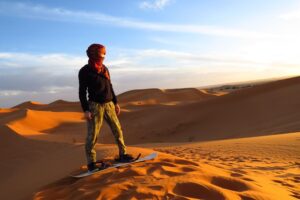
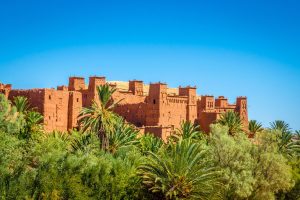
Days 5–7 — Sahara Desert (3-day private tour): South from Marrakech via Ait Benhaddou (Game of Thrones and Gladiator filming location), Ouarzazate, the Dades Valley gorge, the slot canyons of Todra, and the oasis-lined Ziz Valley to Merzouga. Sunset camel trek into Erg Chebbi. Camp overnight under the Sahara stars. Sunrise from the dune summit. Return via the Road of a Thousand Kasbahs. This is the experience Canadians consistently tell us was the best of their travel lives. See our desert tour page.
Day 8 — Travel north: Fly Marrakech → Fes (1 hour, ~CAD $60–110), or take the train via Casablanca to Fes (5–6 hours, very comfortable). Check into a medina riad.
Days 9–10 — Fes: The most complete medieval Islamic city on earth, and the highlight of every Morocco trip for culturally curious travellers. The Chouara Tanneries — a working leather dyeing operation unchanged since the 11th century — seen from the balconies above at golden hour, is one of the great visual experiences in world travel. The Al-Qarawiyyin Mosque and University, founded in 859 CE, predates the University of Oxford by two centuries. Our Fes guide covers the full city.
Morocco Itinerary for Canadians: 2 Weeks (14 Days)
Two weeks from Canada allows you to experience Morocco’s full range — south and north, desert and ocean, mountain and medina — without the pressure of a rushed circuit. This is the itinerary we most often recommend to Canadians who are coming for the first time and want to see the country properly.
📍 14-Day Morocco Itinerary for Canadians
- Days 1–3: Marrakech — medina, hammam, souks, Majorelle, palaces
- Day 4: Atlas Mountains day trip — Imlil or Ouzoud Falls waterfalls
- Days 5–7: Sahara desert circuit — Ait Benhaddou, Dades Gorge, Todra Gorge, Merzouga
- Day 8: Travel Marrakech → Essaouira (2.5 hrs by bus, ~CAD $10) — the Atlantic coast
- Days 9–10: Essaouira — whitewashed medina, blue fishing boats, ocean ramparts, grilled port fish, Gnawa music
- Day 11: Return to Marrakech, fly or train to Fes
- Days 12–13: Fes — tanneries, Al-Qarawiyyin, Bou Inania Madrasa, the full medina labyrinth
- Day 14: Chefchaouen (4 hrs from Fes by bus) — the blue city for a final night before flying home from Fes or returning to Casablanca
Full route details in our 2 weeks in Morocco guide.
Practical Tips for Canadian Travellers in Morocco
For French-Speaking Canadians (Quebec)
French is Morocco’s primary tourist language and is spoken by virtually all guides, hotel staff, restaurant owners, and shopkeepers in the tourist circuit. Quebec French is easily understood throughout Morocco — you will not need English at any point. This is a significant practical advantage: price negotiations, directions, restaurant orders, and conversations with locals all happen naturally in French. Morocco’s French-language connection makes it one of the most linguistically accessible non-English-speaking countries in the world for Quebecers.
Money and Payments
The best approach for Canadians: use a debit card with low foreign transaction fees (Wise, STACK, or a Scotiabank account with international benefits work well) to withdraw Moroccan Dirhams from ATMs on arrival. ATMs are widely available at airports and in city centres. Avoid exchanging Canadian dollars for Dirhams in Canada — rates are poor. Never pay in Canadian dollars in Morocco. Our Morocco payment guide and cash guide cover this fully.
Phone and Data
Canadian carrier roaming fees in Morocco are high. The practical solution: buy a local Moroccan SIM card on arrival (Maroc Telecom, Orange, or Inwi — 40–80 MAD for generous data). Alternatively, purchase a Moroccan eSIM before you leave via Airalo or Nomad (available for both Canadian iOS and Android devices). Download Google Maps for Morocco offline before landing. Our Morocco internet guide has the full details.
Health and Safety
No vaccinations are required for Morocco, though the Public Health Agency of Canada recommends hepatitis A and typhoid for travellers eating outside tourist restaurants. There is no malaria risk in Morocco’s tourist areas. Canadian provincial health insurance does not cover medical expenses outside Canada — comprehensive travel insurance including medical evacuation is essential, particularly for the remote desert and mountain portions of your itinerary. Register your trip with Registration of Canadians Abroad (takes 3 minutes) before you leave. Our Morocco travel insurance guide explains exactly what Canadians need.
Electrical Adapters
Morocco uses Type C and Type E plugs at 220V. Canadian devices run on 110V — most modern electronics (phone chargers, laptops) handle 100–240V and only need a plug adapter. Check your device’s power brick for the voltage range. Older appliances like some hair dryers may need a voltage converter. Pack a Type C/E adapter from any Canadian electronics store before departure.
Tipping in Morocco
Canadian tipping norms (15–20%) are higher than what is standard in Morocco. At sit-down restaurants, 10% is generous and appreciated. For tour guides, 100–200 MAD (~CAD $14–28) per day. For desert camp camel handlers, 50–100 MAD per person. For hotel housekeeping, 20–50 MAD. Full guidance in our Morocco tipping guide.
Is Morocco Safe for Canadian Travellers?
Yes. The Government of Canada currently advises Canadians to exercise normal security precautions in Morocco — the same level as France, Spain, and Portugal. Morocco is one of Africa’s most stable and tourist-friendly countries, with a long history of welcoming Canadian visitors. The primary concern for Canadian travellers is petty tourist-targeted scams and overcharging in the medinas — not violent crime or political instability.
The Canadian Embassy in Rabat is available for Canadians in genuine emergencies. Contact details and location at the Global Affairs Canada Morocco page. For day-to-day scam avoidance, our scams in Morocco guide and safety guide cover everything a Canadian visitor needs to know.
What Canadians Love Most About Morocco
After fifteen years of welcoming Canadian guests, we know what moves them. Quebec travellers love the French-language ease and the depth of Islamic architecture in Fes and Marrakech. English-speaking Canadians love the Sahara — the scale and silence of it is unlike any landscape experience available in Canada. Canadians from outdoor backgrounds (hikers, skiers, cyclists) are consistently overwhelmed by the Atlas Mountains — a mountain range that rivals the Rockies in drama but feels entirely different. And almost universally, Canadians respond to Moroccan hospitality in a way that stays with them: the tea, the conversation, the genuine interest in who you are and where you come from. Our Morocco bucket list covers the 25 experiences that most move visitors, whatever their background.
Ready to Plan Your Morocco Trip from Canada?
We are a Berber family from Morocco who has built itineraries for Canadian travellers from every province. Tell us your dates, your group, and what excites you — we will build your perfect Morocco trip.
We reply within 24 hours · No obligation · Free itinerary planning
Frequently Asked Questions: Canadians Travelling to Morocco
Do Canadians need a visa for Morocco?
No. Canadian passport holders enter Morocco visa-free for up to 90 days. No application, no fee — just a valid Canadian passport with at least 6 months validity beyond your travel dates. Check current requirements at the Government of Canada Morocco page.
Is there a direct flight from Canada to Morocco?
Yes — Royal Air Maroc operates seasonal direct service from Montreal YUL to Casablanca CMN. This is the only direct Canada–Morocco routing currently available. Travellers from other Canadian cities (Toronto, Vancouver, Calgary, Ottawa) connect via European hubs — Paris, London, Madrid, or Amsterdam.
Is Morocco expensive for Canadians?
No — Morocco is outstanding value for Canadians. At approximately 7.2 MAD per CAD, a dinner at a good local restaurant costs CAD $12–24, a boutique riad room costs CAD $80–240, and a private 3-day Sahara desert tour runs CAD $400–750 per person. Morocco consistently delivers more quality per Canadian dollar than almost any other international destination.
Do I need travel insurance for Morocco?
Yes — this is non-negotiable for Canadians. Provincial health insurance (OHIP, MSP, RAMQ, etc.) does not cover medical expenses outside Canada. You need a policy that covers emergency medical treatment and medical evacuation, particularly for the desert and mountain portions of your itinerary where hospital access is limited. Our Morocco travel insurance guide explains exactly what to look for.
Can Canadians drink the tap water in Morocco?
No. Tap water in Morocco can cause stomach issues for visitors. Bottled water is inexpensive and widely available everywhere. See our tap water safety guide for the full picture.
Is French useful in Morocco for Canadians?
Extremely. French is Morocco’s primary tourist language — virtually every guide, hotel receptionist, restaurant server, and shopkeeper in the tourist circuit speaks it fluently. For Quebec travellers in particular, Morocco is one of the most linguistically accessible international destinations outside of France itself. English is also increasingly spoken in major tourist cities but French remains the most useful second language in Morocco.
What is the best time of year for Canadians to visit Morocco?
March through May is the most popular and most rewarding — warm temperatures, clear skies, and the landscapes at their most beautiful. September through November is excellent and less crowded. Both periods compare favourably to Canada’s mud season (spring) and grey November. Our best time to visit Morocco guide covers every month in detail.