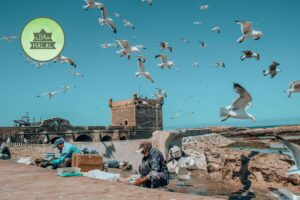
There is something quietly profound about visiting a country where your faith is not an afterthought — where the call to prayer echoes across the medina five times a day, where every restaurant menu begins with Bismillah, where the question “is this halal?” is met with a look of gentle surprise that you felt the need to ask. Morocco is one of the world’s most welcoming destinations for Muslim travellers, and not because it has been retrofitted for halal tourism. It is welcoming because it has always been this way.
With a Muslim population of over 99%, Morocco is an Islamic country in the deepest, most everyday sense of the word. Halal food is the default, not the exception. Mosques are never more than a few minutes’ walk away in any city. Modesty is respected and understood. Ramadan is a collective celebration rather than an inconvenience. For Muslim travellers — whether from the Gulf, Southeast Asia, Europe, or North America — Morocco offers something rare: a genuinely Islamic country that is simultaneously one of the most beautiful, historically rich, and travel-ready destinations on earth.
This guide covers everything a Muslim traveller needs to plan a halal holiday in Morocco: accommodation, food, prayer facilities, modest dress, Ramadan travel, luxury resorts, and the best cities to visit.
☪️ Morocco Halal Travel — Essential Facts for 2026
- Official religion: Islam (Sunni Maliki school) — 99%+ Muslim population
- Halal food availability: Universal — virtually all meat in Morocco is halal by default
- Alcohol: Available in tourist restaurants, Western hotels, and licensed venues — but entirely avoidable
- Prayer facilities: Mosques in every neighbourhood; prayer rooms in major airports and shopping centres
- Qibla direction: Northeast from Morocco (roughly 60–65° from true north)
- Friday prayers: Jumu’ah at noon — some businesses close briefly; most tourist sites remain open
- Ramadan: Observed nationally — an extraordinary time to visit for Muslim travellers
- Dress code: Modest dress respected and appreciated throughout the country
Why Morocco Is One of the World’s Best Halal Holiday Destinations
For Muslim travellers, the most exhausting part of international travel is often not the journey itself but the constant vigilance it requires: researching whether restaurants are truly halal, finding a clean space for prayer, managing modest dress in environments that do not understand it, explaining dietary requirements to hotel staff who have never encountered them before.
In Morocco, almost none of this applies. The country’s Islamic identity is structural, not cosmetic. The halal food question resolves itself immediately — all meat slaughtered in Morocco follows halal practice by law and cultural default. The prayer question resolves itself within minutes of arriving in any Moroccan city, where mosques are so numerous that the maximum walk from any point in a medina to the nearest one is rarely more than five minutes. The modesty question resolves itself culturally — Morocco’s dress norms align naturally with Islamic modest standards, particularly outside the tourist beach resorts.
What makes Morocco exceptional for halal tourism is the combination of this Islamic foundation with world-class travel infrastructure: excellent riads and luxury hotels, extraordinary food culture, one of Africa’s most developed road and rail networks, and landscapes ranging from the Sahara desert to Atlantic beaches to the snow-capped Atlas Mountains. It is a destination that requires no compromises. See our overview of what Morocco is known for to understand the full depth of what awaits.
Halal Food in Morocco: What to Know
Halal food in Morocco is not a niche category — it is simply food. With the exception of a small number of tourist-oriented Western restaurants and licensed hotel bars, every restaurant, every street food stall, every home kitchen, and every market in Morocco operates on halal principles as a cultural and religious baseline.
Meat and Poultry
All commercially slaughtered meat in Morocco is halal. Lamb, beef, chicken, and goat are the primary meats — all prepared according to Islamic practice. Street-grilled meats (kefta, merguez, brochettes), tagines, and roasted meats at mechoui stalls are all halal without exception. You do not need to ask. You do not need to verify. The question simply does not arise in the way it does in non-Muslim countries.
The Alcohol Question
Morocco is an Islamic country but not a dry one — alcohol is legally produced and sold, primarily in Western-style restaurants, licensed tourist hotels, and a limited number of bars in major cities. The important point for Muslim travellers is that alcohol is entirely easy to avoid. The traditional Moroccan restaurant — the kind serving tagine, couscous, harira, and pastilla in a medina setting — does not serve alcohol. Street food does not involve alcohol. The overwhelming majority of riads and traditional guesthouses do not serve it. If alcohol-free dining and accommodation matter to you, Morocco is straightforward to navigate: stay in a traditional riad, eat in medina restaurants, and you will encounter it rarely if at all.
Our honest advice: when booking a riad or guesthouse, simply confirm in advance that they do not serve alcohol if this is important to you. Most traditional riads — particularly family-run ones — do not. See our Moroccan wine guide for context on where alcohol does and does not appear in Morocco’s food culture.
Must-Try Halal Moroccan Dishes
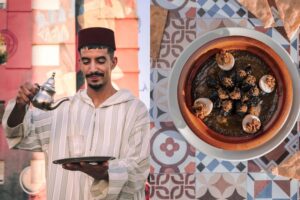
Moroccan cuisine is one of the world’s great food traditions — and it is entirely halal. Do not leave Morocco without experiencing: lamb tagine with preserved lemon and olives, the definitive Moroccan dish slow-cooked to falling-tender perfection; couscous with seven vegetables, traditionally served on Fridays after Jumu’ah prayers as a family meal; bastilla, the extraordinary pigeon (or chicken) pie wrapped in warqa pastry with almonds and cinnamon; harira, the spiced tomato and lentil soup that breaks the Ramadan fast every evening across the country; and Moroccan mint tea, the three-glass ritual of hospitality that accompanies every meeting, every meal, and every transaction in Morocco. Our full Moroccan food guide covers the complete cuisine in detail.
Prayer Facilities Across Morocco
Morocco has approximately 50,000 mosques — one of the highest mosque densities per capita in the world. In Marrakech’s medina alone, there are over 100. Finding a place to pray in Morocco is never a logistical challenge — it is simply a matter of walking for a few minutes in any direction in any city or town.
Key practical notes for Muslim travellers regarding prayer in Morocco:
- Non-Muslims cannot enter mosques in Morocco, with the sole exception of the Hassan II Mosque in Casablanca, which offers guided tours for non-Muslim visitors. For Muslim travellers, all mosques are accessible for prayer.
- Prayer times follow the official Moroccan Ministry of Habous and Islamic Affairs schedule, which is published daily and available on apps such as Muslim Pro, Athan, and the official Habous app.
- Wudu facilities are standard in all mosques. Many major tourist sites — including the Bahia Palace, Badi Palace, and Saadian Tombs in Marrakech — have prayer rooms and wudu facilities on site or immediately adjacent.
- Major airports (Marrakech Menara, Casablanca Mohammed V, Fes-Saïss, Agadir Al Massira) all have dedicated prayer rooms, clearly signposted in both Arabic and English.
- Shopping centres in Casablanca, Marrakech, and Rabat have prayer rooms, typically on the upper floors near the food court.
For visiting the Al-Qarawiyyin Mosque in Fes — the world’s oldest continuously operating university and one of Islam’s most significant scholarly institutions — Muslim visitors can pray in its historic courtyard, a genuinely moving experience.
Muslim-Friendly Hotels and Luxury Halal Resorts in Morocco
Morocco’s accommodation landscape offers exceptional options for Muslim travellers across every budget level — from intimate family-run riads in the medina to genuinely world-class luxury resorts with full halal certification and alcohol-free environments.
Traditional Riads: The Ideal Muslim-Friendly Stay
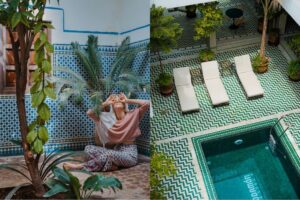
A riad — the traditional Moroccan townhouse built around a central courtyard garden — is inherently well-suited to Muslim travellers. The architecture itself reflects Islamic values: inward-facing, private, modest from the outside while extraordinarily beautiful within. Many riads are family-run by Moroccan Muslim families who do not serve alcohol, serve exclusively halal food, and understand their guests’ needs instinctively. Staying in a riad places you within walking distance of mosques, hammams, souks, and the heart of Moroccan Islamic culture. Our guide to the 15 best riads in Marrakech includes notes on which properties are alcohol-free.
Luxury Halal Resorts in Morocco
For Muslim travellers seeking luxury resort experiences — spa facilities, pools, high-end dining — Morocco has a growing number of properties specifically catering to halal tourism standards:
- Royal Mansour Marrakech — one of the world’s finest hotels, built by Royal Commission and staffed entirely by Moroccan artisans. Alcohol is available but completely avoidable; the property offers dedicated halal dining options, a world-class spa with separate male/female facilities, and service that understands Muslim guests’ needs without needing to be educated. It is widely regarded as one of the best luxury halal-friendly hotels in Africa. See the property on Royal Mansour’s official website.
- Amanjena, Marrakech — a pavilion-style resort outside the medina walls, built around a Moorish basin and palm garden. Exceptional privacy and spa facilities with separate areas. One of the most architecturally beautiful hotels in Morocco. Explore via Aman’s official site.
- La Mamounia, Marrakech — the legendary grand hotel rebuilt in Moorish style. Offers halal dining options, separate-gender spa hours on request, and one of the most famous gardens in Morocco.
- Mazagan Beach Resort, El Jadida — one of Morocco’s largest beach resorts on the Atlantic coast, offering a fully halal-certified catering option and Muslim-friendly facilities. Located near the historic El Jadida Portuguese Cistern. Official details at Mazagan’s official website.
- Kasbah Tamadot, Atlas Mountains — Richard Branson’s Virgin Limited Edition property in the Atlas Mountains above Marrakech. Halal food available throughout; exceptional mountain setting with views over the Asni Valley. Details via Virgin Limited Edition.
For a wider selection of verified halal-friendly hotels and resorts across Morocco, the platform HalalTrip Morocco offers reviewed and rated properties with halal certification details.
🕌 What to Look for When Booking a Halal-Friendly Hotel in Morocco
- Confirmation that the kitchen serves exclusively halal-certified meat (standard in traditional properties — worth confirming in international chain hotels)
- Availability of alcohol-free dining spaces or entirely alcohol-free property
- Separate-gender or private spa and pool facilities, or timed sessions available on request
- Qibla direction markers in rooms (increasingly standard in Moroccan hotels; easy to determine with any compass app if not provided)
- Prayer mat and Quran available in rooms (standard in many traditional riads and Islamic-heritage hotels)
- Proximity to a mosque for Fajr, Dhuhr, and Jumu’ah prayers
Muslim-Friendly Travel Guide to Marrakech
Marrakech is the most visited city in Morocco and one of the world’s great Islamic heritage cities. For Muslim travellers, it offers a rare combination: profound Islamic history and living religious culture within a city that is fully equipped for modern international tourism.
Islamic Heritage Sites in Marrakech
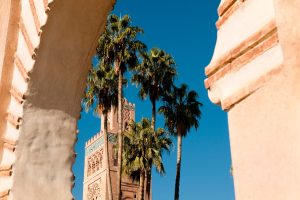
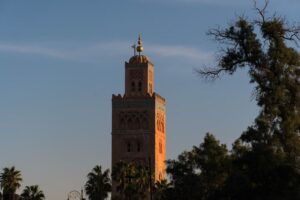
The Koutoubia Mosque — Marrakech’s 12th-century Almohad minaret and the architectural model for the Giralda in Seville and the Hassan Tower in Rabat — dominates the skyline and anchors the city’s Islamic identity. The minaret is visible from almost everywhere in Marrakech; the mosque is open to Muslim worshippers for all five daily prayers and particularly magnificent at sunset. Read our full guide to the Koutoubia Mosque.
The Ben Youssef Madrasa — a 14th-century Marinid Islamic school — is one of the most beautiful examples of Islamic architecture in North Africa. The central courtyard’s carved cedar, zellij tilework, and stucco panels represent the height of Moroccan Islamic art. It is open to all visitors including non-Muslims and is the best place in Marrakech to experience the country’s Islamic architectural tradition up close.
Jemaa el-Fnaa, Marrakech’s famous main square, transforms completely after Iftar during Ramadan — it becomes one of the most extraordinary collective experiences in the Islamic world. See our full Jemaa el-Fnaa guide for what to see and when.
Halal Restaurants in Marrakech
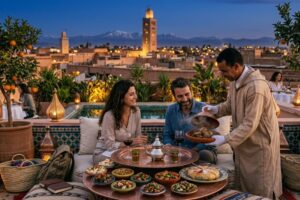
The overwhelming majority of restaurants in Marrakech’s medina are halal without exception — this is simply Moroccan food culture. For the best halal dining experiences, focus on: Café des Épices on Rahba Kedima square for Moroccan salads and mint tea with views over the spice souk; Nomad on Derb Aarjan for modern Moroccan cuisine in a rooftop setting; traditional mechoui restaurants near the Rahba Kedima for whole-roasted lamb sold by weight; and the evening food stalls of Jemaa el-Fnaa for grilled meats, harira, and Moroccan sweets. Our best restaurants in Marrakech guide covers the top options with notes on atmosphere and halal status.
The Hammam Experience
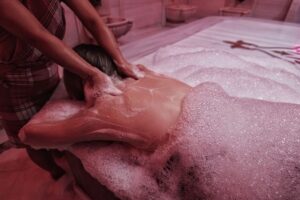
The traditional Moroccan hammam — the public bathhouse — is an Islamic institution as much as a cultural one, rooted in the Islamic emphasis on ritual cleanliness and purification. For Muslim travellers, visiting a traditional hammam in Marrakech is both a practical and spiritually resonant experience. All traditional hammams operate with strict gender separation. Our Moroccan hammam guide explains exactly what to expect and how to prepare.
Travelling in Morocco During Ramadan
Many Muslim travellers specifically choose to visit Morocco during Ramadan — and it is one of the most rewarding decisions they make. Ramadan in Morocco is not a time of reduced services or disrupted tourism. It is a time when the country’s Islamic soul becomes fully visible.
The medinas come alive after Iftar in a way that is unlike any other time of year. Families gather in the squares, food stalls appear selling harira, chebakia, and sellou, and the atmosphere is simultaneously festive and spiritually charged. The Tarawih prayers at night fill the mosques to overflowing, with the sound of Quran recitation carrying through the narrow alleys of the medina. For Muslim travellers who fast, breaking fast with Moroccan families — invited in from the street, as happens regularly — is among the most moving travel experiences Morocco offers.
Practical Ramadan travel notes: most tourist restaurants remain open for non-fasting visitors during the day, though many local establishments close between dawn and Iftar. Pace your sightseeing to the evening hours when the cities are at their most beautiful and alive. Read our complete guide to things to do in Marrakech during Ramadan and our broader Eid in Morocco guide for the celebratory days that follow.
Modest Dress for Muslim Travellers in Morocco
Morocco’s mainstream dress culture aligns naturally with Islamic modest standards, particularly in the medinas, rural areas, and southern regions. For Muslim women travellers, hijab is entirely normal and respected throughout the country — you will see it worn by the majority of Moroccan women in traditional areas. Abaya and niqab are seen regularly in Moroccan cities and attract no negative attention.
For male Muslim travellers, modest dress (covering the shoulders and wearing trousers rather than shorts) is appropriate in mosques and religious sites, and is respected in medina environments generally. The Morocco dress guide covers the full dress context for all areas of the country, including the more relaxed coastal resort towns. The complete dos and don’ts of attire in Morocco is worth reading before your trip.
Best Cities in Morocco for Muslim Travellers
Fes — The Spiritual Capital
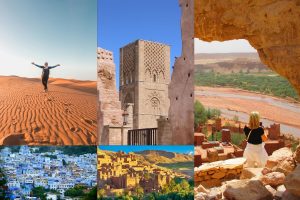
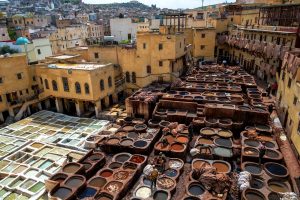
For Muslim travellers with a deep interest in Islamic heritage, Fes is arguably the most important destination in Morocco — and one of the most important in the entire Islamic world. The city’s 9th-century medina is a UNESCO World Heritage Site and the largest living medieval Islamic city on earth. The Al-Qarawiyyin Mosque and University — founded in 859 CE, predating Oxford by two centuries — remains an active centre of Islamic scholarship. The Andalusian Mosque, the Attarine and Bou Inania Madrasas, and the dozens of neighbourhood mosques make Fes a city of profound Islamic depth that rewards multiple days of exploration. Compare the two cities in our Marrakech vs Fes guide.
Marrakech — History, Culture, and Luxury
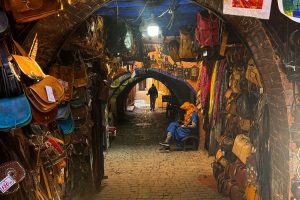
The most internationally connected Moroccan city for tourism, Marrakech combines 12th-century Almohad monuments with world-class hotels and restaurants. The best base for desert tours, Atlas Mountains day trips, and luxury halal resort stays. Our full 3-day Marrakech itinerary is designed to cover the essential highlights efficiently.
Chefchaouen — The Blue Mountain City
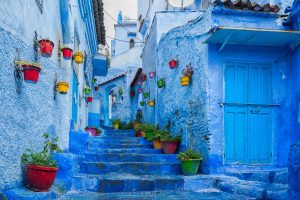
The mountain city of Chefchaouen, with its blue-painted medina rising against the Rif Mountains, is one of Morocco’s most photogenic cities and one of the most peaceful for Muslim travellers. The city is deeply traditional, largely alcohol-free in its medina core, and has a relaxed, spiritually calm atmosphere that many Muslim visitors find particularly restorative. Our Blue City of Morocco guide covers the full Chefchaouen experience.
Casablanca — Modern Islamic Architecture
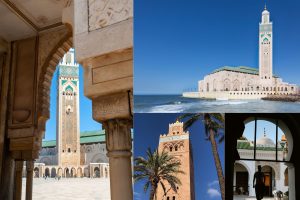
Home to the Hassan II Mosque — the largest mosque in Africa and the third largest in the world, built on a promontory over the Atlantic Ocean — Casablanca is an essential stop for any Muslim traveller interested in contemporary Islamic architecture at its most ambitious. The mosque’s minaret at 210 metres is the tallest religious structure in the world. Non-Muslim visitors can join guided tours; Muslim visitors can pray inside. Our Hassan II Mosque complete guide covers the visit in full detail.
🌙 Plan Your Halal Holiday in Morocco
We are a Muslim Berber family who understands exactly what a halal holiday in Morocco should feel like. Tell us your dates, travel style, and requirements — we will build a trip that honours your values and exceeds your expectations.
Halal Tourism in Morocco: Practical Tips Before You Travel
- Download a reliable prayer time app before you arrive. Muslim Pro, Athan, and the official Moroccan Habous app all provide accurate local prayer times adjusted for Morocco’s time zone. Morocco does not observe daylight saving time consistently — verify the current offset before travel.
- Carry a small prayer mat if you prefer your own. Many riads provide them, but having your own compact travel mat removes any uncertainty. A compass app for Qibla direction is also useful outside of mosques.
- Learn the Arabic greetings. “As-salamu alaykum” opens every door in Morocco. Responding to “Alhamdulillah” when asked how you are will earn you immediate warmth from every Moroccan you meet. Our Berber language guide and broader language guide to what language is spoken in Marrakech will help you navigate.
- Budget generously for food. Moroccan food is extraordinary and inexpensive by international standards. Eating well — really well — in halal restaurants throughout Morocco costs a fraction of what the equivalent quality costs in Europe or the Gulf. Our Morocco trip cost guide has a full food budget breakdown.
- Purchase travel insurance that covers the full trip. Even in a Muslim-majority country with excellent healthcare in the major cities, comprehensive travel insurance is essential for any international trip. Our Morocco travel insurance guide explains what to look for.
- Consider visiting during Ramadan deliberately. For Muslim travellers, Ramadan in Morocco is not a logistical challenge to manage — it is one of the most beautiful travel experiences available anywhere in the Islamic world. The atmosphere is unlike any other time of year.
Frequently Asked Questions: Morocco Halal Holidays
Is all food in Morocco halal?
Virtually all food in Morocco is halal by default — this is an Islamic country where halal slaughter is the standard practice for all commercially sold meat. The only exceptions are a small number of Western-style tourist restaurants and international hotel chains that serve non-halal imported products. In traditional medina restaurants, street food stalls, local markets, and family-run guesthouses, halal food is universal. You do not need to ask or verify in the vast majority of eating situations in Morocco.
Can I find alcohol-free hotels in Morocco?
Yes, easily. Traditional riads and family-run guesthouses in the medinas of Marrakech, Fes, Chefchaouen, and other cities typically do not serve alcohol — it is simply not part of their culture or business model. When booking, it takes only one confirmation question to verify. International chain hotels and luxury beach resorts vary — some are fully halal-certified and alcohol-free; others serve alcohol in dedicated bars that are easy to avoid. The HalalTrip Morocco directory lists properties with verified halal certification.
Is Morocco safe for Muslim travellers from non-Arab countries?
Morocco is exceptionally welcoming to Muslim travellers from all backgrounds — Southeast Asian, South Asian, Western Muslim, and Gulf Arab visitors all report feeling immediately at home in the country’s Islamic environment. The shared faith creates an instant connection with local people that transcends language and cultural differences. See our full Morocco safety guide for a comprehensive assessment.
What is the best time of year for a halal holiday in Morocco?
For most Muslim travellers, October to April offers the best combination of comfortable weather and travel conditions. Ramadan is a particularly special time to visit — the country comes alive with collective iftar, nightly prayers, and a spiritual atmosphere unlike any other period. Spring (March–April) combines excellent weather with the Valley of Roses in bloom and a festive calendar of local events. Our best time to visit Morocco guide covers the full year.
Are there halal tour operators in Morocco?
Yes — and booking with a Muslim Moroccan tour operator (rather than an international platform) gives you an operator who shares your values and understands your needs without explanation. At Days Morocco Tours, we are a Muslim Berber family who has been organising halal-compatible tours for Muslim travellers from the Gulf, UK, Malaysia, Indonesia, and beyond for 15 years. Contact us directly to discuss your trip.
Can Muslim women travel safely in Morocco?
Yes. Morocco is one of the safer destinations in the Muslim world for women travelling alone or in groups. Hijab is common and respected. The medina environments of Fes and Marrakech are walkable and well-populated. Our detailed solo female travel Morocco guide addresses safety, dress, cultural navigation, and practical advice specifically for women.