Taxis in Morocco are one of those topics that every traveller eventually Googles at 11pm in a Marrakech medina, phone in one hand and a driver asking for three times the correct price on the other. The system is not complicated once you understand it — but it is different enough from what most visitors expect that arriving without the right knowledge guarantees at least one overpriced ride, and possibly several frustrating arguments you did not need to have.
Morocco has two entirely separate taxi systems operating simultaneously: the petit taxi (small, coloured, metered, city-only) and the grand taxi (large, shared, intercity, unmetered). They look different, work differently, cost differently, and serve different purposes. Add to this the growing presence of ride-hailing apps — and the question of which app actually works in which city — and you have a transport ecosystem that rewards preparation.
This guide covers everything you need for Taking Taxis in Morocco: the difference between petit and grand taxis, exact price ranges for every major city, how to use the meter, how to negotiate when there is no meter, which apps work in Morocco, the specific taxi culture of Marrakech, and the scams to know about and avoid. By the time you finish reading, you will get around Morocco like a local.

⚡ Taxis in Morocco — Essential Facts for 2026
- Two systems: Petit taxi (city only) + Grand taxi (intercity / longer routes)
- Petit taxi meter: Mandatory by law — always insist on it being turned on
- Typical city ride (petit taxi): 10–30 MAD / $1–3 within city centres
- Night surcharge: 50% added after 8pm on the metered price — legal and standard
- Grand taxi (shared, intercity): Fixed per-seat price — always negotiate before entering
- Grand taxi (private/charter): You pay for all 6 seats — useful for groups or comfort
- Apps available: inDrive, Careem (selected cities), and local alternatives
- Airport taxis: Fixed official rate — confirm before departure, not on arrival
- Tipping: Rounding up is appreciated; not obligatory
- Currency: Always pay in Moroccan Dirhams (MAD) — never accept quoted prices in euros
The Two Types of Taxis in Morocco: Petit vs Grand
Understanding this distinction is the single most important piece of taxi knowledge you can have in Morocco. The two systems exist side by side in every Moroccan city, they look completely different, and confusing them — particularly taking a grand taxi for a short city journey or a petit taxi for an intercity route — will cost you time, money, or both.
Petit Taxi — The City Taxi
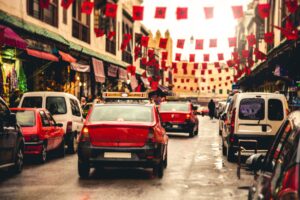
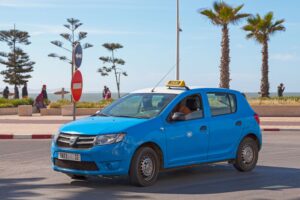
The petit taxi is the small, colour-coded city cab that operates exclusively within a city’s municipal limits. Each Moroccan city has its own colour: Marrakech’s are beige/cream, Casablanca’s are red, Fes’s are red, Agadir’s are orange, Rabat’s are blue, Tangier’s are blue, Meknes’s are green, and Essaouira’s are green. The colour coding means you always know immediately whether the taxi you are flagging is a city cab or something else.
Petit taxis are metered — by law, the driver must use the meter for every journey. A standard city ride costs between 10 and 30 MAD ($1–3) in most Moroccan cities. The meter starts at around 2.50 MAD and runs at approximately 3–4 MAD per kilometre during the day. A 50% surcharge is applied automatically after 8pm — this is legal, standard, and should appear on the meter automatically when the driver switches to night rate (tariff 2).
Petit taxis can carry a maximum of three passengers. They do not leave the city — if you need to reach an airport outside the city boundary, get to a bus terminal in another city, or travel to a site beyond the municipal limits, you need a grand taxi or another form of transport.
Grand Taxi — The Intercity and Regional Taxi
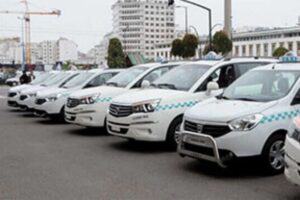
The grand taxi is the large shared vehicle — typically an ageing Mercedes 240D or Peugeot 504, though newer models are increasingly common — that operates intercity and longer regional routes. Grand taxis are not metered. They operate on a shared system: each taxi has six seats (two in the front including the driver, four in the back) and departs when all seats are filled. Each passenger pays a fixed per-seat price for the route — these prices are broadly standardised by route and visible at the taxi rank, though mild negotiation is normal for tourists.
Grand taxis depart from fixed taxi ranks (stations de grand taxi) that are usually located near the main bus station or at the edge of the medina. They are the fastest and most flexible option for shorter intercity routes (under 100 km) where buses run infrequently — Marrakech to Essaouira, Chefchaouen to Fes, Meknes to Volubilis, and dozens of similar connections.
You can also charter a grand taxi privately — paying for all six seats — if you want the vehicle to yourself, if you want a specific departure time rather than waiting for it to fill, or if you are travelling with a group of four or more people. Private charter prices for a grand taxi are typically 5–6 times the per-seat shared price, which for a group of four makes them extremely cost-effective compared to other private transport options.
🚕 Petit Taxi vs Grand Taxi — Quick Reference
| Petit Taxi | Grand Taxi | |
|---|---|---|
| Size | Small car (max 3 passengers) | Large car (max 6 passengers) |
| Colour | City-specific colour coding | Usually white, beige, or grey |
| Meter | Yes — mandatory by law | No — fixed route price |
| Operates | Within city limits only | Between cities / longer routes |
| Shared? | Sometimes (2–3 passengers) | Standard — departs when full |
| Typical cost | 10–30 MAD city ride | 20–150 MAD per seat by route |
| Book in advance? | No — hail on the street | No — arrive at rank and wait |
Taxis in Marrakech: Everything You Need to Know
Marrakech deserves its own section because it is where the majority of visitors to Morocco first encounter the taxi system — and where the majority of taxi-related frustrations occur. Marrakech’s taxis are beige/cream coloured, abundant, and range from excellent to extremely frustrating depending on the driver and your knowledge of the rules.
The Marrakech Petit Taxi: Rules and Realities
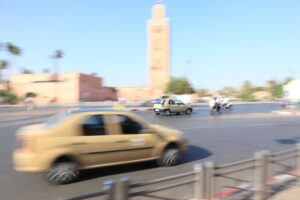
Marrakech petit taxis are metered and should always use the meter. The meter starts at approximately 2.50 MAD and a typical journey within the city — from the medina to Gueliz (the new city), from Jemaa el-Fnaa to the train station, from the medina to Menara Mall — costs between 15 and 35 MAD during the day and 22–50 MAD at night (night rate applies from 8pm). The journey from Marrakech Menara Airport to the medina costs approximately 70–100 MAD by meter or fixed rate — confirm the price before entering and insist on the meter or a pre-agreed MAD price.
The single most important rule for petit taxis in Marrakech: always insist on the meter being turned on before the journey begins. The phrase is “compteur, s’il vous plaît” (French, widely understood) or “al-3addad, afak” (Darija). If the driver claims the meter is broken, get out and take another taxi. There are always others. A working meter is your legal right and your practical protection against overcharging.
Petit Taxi Price Guide for Marrakech (2026)
🏷️ Common Marrakech Petit Taxi Journeys — Approximate Metered Prices
- Jemaa el-Fnaa → Gueliz (new city): 15–20 MAD day / 22–30 MAD night
- Medina → Marrakech train station: 20–30 MAD day / 30–45 MAD night
- Medina → Majorelle Garden: 15–25 MAD day / 22–35 MAD night
- Medina → Menara Mall: 25–35 MAD day / 35–50 MAD night
- Airport → Medina: 70–100 MAD (fixed or metered — confirm before entering)
- Medina → Palmeraie: 35–50 MAD day (outside city limits — negotiate as grand taxi fare)
Note: These are honest metered estimates. Any driver quoting significantly above these prices without the meter is overcharging. Any driver quoting prices in euros is attempting a scam — always pay and agree in MAD.
Marrakech Taxi Ranks
Petit taxis in Marrakech can be hailed anywhere on the street by raising your hand. The busiest reliable ranks are on the north and south sides of Jemaa el-Fnaa, outside the Koutoubia Mosque, at the Marrakech train station, and on the main boulevard of Gueliz (Avenue Mohammed V). Grand taxi ranks in Marrakech are located near Bab Doukkala (for Essaouira and Casablanca direction) and near the bus station on Rue Abou Bakr Seddiq.
Sharing a Petit Taxi in Marrakech
Petit taxis in Marrakech — and in all Moroccan cities — legally carry up to three passengers, and drivers may stop to pick up additional passengers going in the same direction even if you are already in the taxi. This is normal and legal. Each passenger pays their own metered portion. If you do not want to share, tell the driver “wahdna” (just us) at the start — some drivers will agree, some will add a small premium for exclusivity. Sharing is common during busy periods and is a good way to reduce cost on longer city journeys.
Grand Taxi in Morocco: How It Really Works
The grand taxi system is one of the most useful and most misunderstood elements of Moroccan transport. Once you understand the mechanics, it becomes your most flexible and affordable tool for short-to-medium intercity travel.
Finding the Grand Taxi Rank
Every Moroccan city has at least one grand taxi station (station de grand taxi or simply “taxi station”), usually situated near the main CTM or Supratours bus terminal or at one of the major city gates. In Marrakech, the main grand taxi rank for destinations south and east (Essaouira, Ouarzazate, Ait Benhaddou) is near Bab Doukkala. In Fes, it is adjacent to the CTM station. In Chefchaouen, it is just outside the medina walls near the main entrance. Ask your hostel or riad for the specific location in whichever city you are in — this is always the most accurate information. Our Morocco train guide covers how grand taxis connect with the rail network for longer journeys.
The Shared Grand Taxi System
Grand taxis for a specific destination cluster together in a section of the rank. Find the group going to your destination, confirm the per-seat price (it should be standardised — ask two or three drivers and compare), take a seat, and wait for the taxi to fill. When all six seats are occupied, the taxi departs. Waiting time varies from a few minutes on busy routes to 45 minutes on less-travelled ones. If you are in a hurry or the taxi is not filling, you can negotiate to pay for the remaining empty seats yourself (this is called “completing” the taxi) — always cheaper than a full private charter.
Private Charter Grand Taxi
Chartering a grand taxi privately — paying for all six seats — is the right choice when you have a group of four or more people, when you want a specific departure time, when you are carrying large bags, or when the route is not served by regular shared taxis. Private charter prices are negotiable and should be agreed explicitly before departure. As a general guide: a private grand taxi for Marrakech to Essaouira costs approximately 500–700 MAD total (split between 4–6 people, this is extremely competitive); Fes to Chefchaouen approximately 400–600 MAD total. Our hire a car in Morocco guide compares private grand taxi with self-drive rental for longer journeys.
Grand Taxi Price Reference — Common Routes (2026)
🏷️ Grand Taxi Per-Seat Prices — Common Moroccan Routes
| Route | Per Seat (shared) | Approx. Duration |
|---|---|---|
| Marrakech → Essaouira | 90–120 MAD | 2.5–3 hrs |
| Fes → Chefchaouen | 70–90 MAD | 4 hrs |
| Chefchaouen → Tangier | 60–80 MAD | 3 hrs |
| Meknes → Volubilis | 15–20 MAD | 45 min |
| Marrakech → Ouarzazate | 80–100 MAD | 3.5–4 hrs |
| Casablanca → Rabat | 40–55 MAD | 1 hr |
| Zagora → M’Hamid | 40–60 MAD | 1.5 hrs |
Prices are per person for a shared seat and are approximate — slight variation is normal. Always confirm before boarding.
Taxi Apps in Morocco: What Works and Where
Morocco’s ride-hailing app ecosystem is developing rapidly and is increasingly useful in the major cities — though it is not yet as comprehensive as the equivalent scene in Southeast Asia or the Gulf. Here is the honest picture for 2026:
inDrive
inDrive is currently the most widely used ride-hailing app in Morocco across multiple cities including Marrakech, Casablanca, Rabat, Fes, and Agadir. It works on a bidding model — you propose a price, drivers counter-offer, and you accept or continue negotiating. This eliminates the need for street-side price negotiations and produces reliable, trackable rides with a driver rating system. Download it before you travel and set up your account with a local or international number. It is the app we recommend most consistently for Morocco in 2026. Download from the inDrive official site.
Careem
Careem — owned by Uber — operates in Casablanca and Rabat with reasonable coverage and professional driver standards. It is less present in Marrakech and Fes than inDrive. If you are spending significant time in Casablanca, Careem is worth installing as a backup. Available via the Careem official site.
Heetch
Heetch is a French-origin ride-hailing app with growing presence in Casablanca and Rabat, popular with younger Moroccan urban professionals. Coverage is limited outside the two largest cities but growing. Worth checking if inDrive is unavailable in your specific location.
Uber
Uber does not operate in Morocco. Do not waste time looking for it.
When Apps Are Better Than Street Taxis
Apps are particularly valuable in four situations: late at night when street-hailed taxis are more likely to attempt flat-rate overcharging; at airports where the official rate taxi line occasionally has long waits; when you have heavy luggage and want a confirmed vehicle before you walk outside; and when you want a price record for expense purposes. The app price is nearly always close to or below what a metered taxi would charge — and the accountability of a named, rated driver prevents the worst pricing games entirely.
Taxi Scams in Morocco: Know Before You Go
The taxi-related scams in Morocco are well-documented, not particularly sophisticated, and entirely avoidable with the right knowledge. Our full scams in Morocco guide covers the broader picture, but the taxi-specific ones are worth memorising:
- “The meter is broken.” It almost certainly is not. This is the most common taxi scam in Morocco, used to justify a flat rate that is two to four times the correct metered price. Response: get out and take another taxi. There are always others nearby, particularly in city centres. Do not negotiate — the existence of a “broken meter” is itself the red flag.
- Quoting prices in euros. Some drivers — particularly at airports and near major tourist hotels — quote prices in euros, knowing that many visitors do not know the euro-to-MAD conversion well enough to recognise the overcharge. Always agree and pay in Moroccan Dirhams (MAD). The phrase “combien en dirhams?” (how much in dirhams?) ends this immediately.
- The “your hotel is closed / full / burned down” driver. A driver who spontaneously suggests your booked accommodation has a problem and offers to take you to “a better one” (his commission partner) is running one of Morocco’s oldest and most persistent scams. Your hotel is fine. Keep your booking, insist on your destination, or get out. This is particularly common at airports and train stations.
- No change available. Having the exact fare or small notes ready eliminates the common tactic of claiming change is unavailable for a large note. Keep a supply of 10 and 20 MAD notes for taxis. See our Morocco cash guide for how to manage currency throughout your trip.
- Shared taxi without your consent. If you have agreed a private price and the driver picks up additional passengers, you are entitled to renegotiate the price downward or ask them to stop. Confirm “wahdna” (just us) at the start of any ride where you have paid a private fare.
- Airport fixed-rate overcharging. Official fixed-rate taxis at Marrakech Menara Airport should charge 70–100 MAD to the medina. The “official” looking men outside the terminal who approach you before you reach the taxi rank are often not official at all — they are commission touts leading you to unmarked vehicles at inflated prices. Walk to the marked taxi rank and take a clearly identified petit taxi.
Taxis to and from Moroccan Airports
Airport taxi connections are among the most important journeys to plan in advance, and also the journeys where overcharging is most prevalent. Here are the honest fare expectations for Morocco’s main airports:
✈️ Airport Taxi Fares — Morocco’s Main Airports (2026)
- Marrakech Menara Airport → Medina / Gueliz: 70–100 MAD (petit taxi, metered or fixed) / ~20 min
- Casablanca Mohammed V Airport → Casablanca city centre: Train is strongly recommended (35 MAD, 35 min). Taxi: 200–300 MAD / 40–60 min depending on traffic
- Fes-Saïss Airport → Fes medina: 80–120 MAD petit taxi / 15–25 min
- Agadir Al Massira Airport → Agadir city centre: 100–150 MAD / 20–30 min
- Tangier Ibn Battuta Airport → Tangier medina: 80–120 MAD / 15–20 min
- Essaouira Mogador Airport → Essaouira medina: 80–120 MAD / 10–15 min
Always confirm the price in MAD before entering the taxi. For Casablanca, the train from the airport (Mohammed V → Casa Voyageurs) is faster, cheaper, and completely avoids the taxi question. See our Morocco train guide for full details.
🚗 Want Private, Hassle-Free Transport Across Morocco?
Skip the taxi negotiation entirely. We organise private transfers between any two cities in Morocco — airport pickups, city-to-city, desert circuit and back. Fixed price, named driver, door to door. Our drivers have been doing this for fifteen years and they know every route, every shortcut, and every stop worth making en route.
Taxis in Other Moroccan Cities
Taxis in Casablanca
Casablanca’s petit taxis are red and metered. The city’s size and traffic mean taxi journeys can be long — the train and the tramway are often faster for cross-city journeys. The Mohammed V International Airport is best connected to the city by the ONCF airport train (every 30 minutes, 35 MAD, 35 minutes to Casa Voyageurs station) rather than taxi. See our Casablanca city guide for the full transport picture.
Taxis in Fes
Fes petit taxis are red and metered. The city’s medina geography — the largest pedestrian-only urban area in the world — means taxis cannot enter most of the old city. You will be dropped at the nearest accessible gate (Bab Boujloud for the western medina, Bab Guissa for the north) and walk from there. Factor this into journey time calculations. Grand taxi ranks in Fes are near the CTM station for Casablanca, Rabat, and Marrakech directions. Our full Fes to Chefchaouen guide covers the grand taxi option for this popular route in detail.
Taxis in Chefchaouen
Chefchaouen is a small city and petit taxis are rarely needed within the medina itself — the blue city is compact enough to walk entirely. Grand taxis from Chefchaouen serve Tetouan, Fes, and Tangier and depart from the main rank just outside the medina entrance. For the Fes direction, confirm whether the grand taxi goes direct or via a connection in Ouazzane.
Taxis in Agadir
Agadir’s petit taxis are orange-coloured and metered. The city’s layout is more spread out than Marrakech or Fes — taxis are genuinely necessary for getting between the beach, the city centre, and the souk. Grand taxis serve Essaouira and Taroudant. Our Agadir things to do guide includes transport notes for the city.
Practical Tips: Taking Taxis in Morocco
- Learn the meter phrase in French and Darija. “Compteur, s’il vous plaît” (French) or “al-3addad afak” (Darija) — use it every single time you enter a petit taxi before it moves. Make it automatic.
- Carry small notes. Having exact change or near-exact change for taxi fares removes the most common friction point. Keep a stock of 10, 20, and 50 MAD notes in your pocket separate from your main wallet. Our Morocco payment methods guide covers the full cash management strategy.
- Know your destination address in Arabic or have it written down. Many petit taxi drivers in smaller cities have limited French or English. Having your destination written in Arabic (ask your riad or hostel to write it for you) or shown on a map eliminates confusion immediately.
- Use the app for late-night returns. After midnight in Marrakech, Casablanca, or Fes, street-hailed taxis are more expensive and more difficult to find. inDrive works reliably in these cities late at night and gives you a named, rated driver.
- For the airport, pre-book if arriving late. Ask your accommodation to arrange a pickup — most riads and hotels have trusted drivers at fixed rates that are often competitive with or below official taxi prices, with the added benefit of someone waiting with your name on a sign when you arrive exhausted from a long flight.
- Don’t negotiate aggressively for tiny amounts. If the meter reads 28 MAD and you have a 50 MAD note, accepting 22 MAD change without counting it in the driver’s face is the right call. Moroccan hospitality culture notices generosity — and it tends to be repaid.
Frequently Asked Questions: Taxis in Morocco
Do taxis in Morocco take cards?
No — virtually all petit and grand taxis in Morocco are cash only. Always carry sufficient Moroccan Dirhams for taxi journeys. ATMs are widely available in city centres. Our Morocco payment methods guide and ATMs in Morocco guide cover the full cash access picture across the country.
Is Uber available in Morocco?
No. Uber does not operate in Morocco. The primary ride-hailing alternatives are inDrive (available in Marrakech, Casablanca, Rabat, Fes, Agadir) and Careem (Casablanca and Rabat). For most journeys, a street-hailed metered petit taxi remains the most practical option.
How much is a taxi from Marrakech airport to the medina?
The correct metered or officially fixed price for a petit taxi from Marrakech Menara Airport to the medina or Gueliz is 70–100 MAD ($7–10). Any price significantly above this is overcharging. Walk to the clearly marked taxi rank rather than accepting offers from men approaching you inside the terminal.
Can I take a petit taxi from Marrakech to Essaouira?
No — petit taxis only operate within city limits. For Marrakech to Essaouira (approximately 180 km), your options are: CTM bus (2.5 hrs, ~70–80 MAD), Supratours bus (same price and time), or a private grand taxi charter (500–700 MAD for the whole vehicle, shared between your group). Our Morocco transport guide covers all intercity options in full.
Is it safe to take taxis alone at night in Morocco?
Generally yes, with the standard precautions: use an app-based taxi (inDrive) for late-night journeys where possible, always sit in the back seat, share your live location with someone, and trust your instincts. See our Morocco safe at night guide and solo female travel Morocco guide for the full safety picture by city.
What is the difference between a taxi and a “false guide” in Morocco?
A petit taxi is a licensed, colour-coded, metered vehicle operated by a registered driver. A “false guide” is a person — not a taxi driver — who approaches you on foot claiming to show you somewhere or offering transport in an unmarked personal vehicle. Never enter an unmarked vehicle in Morocco regardless of how official or friendly the offer appears. Legitimate taxis are always clearly identifiable by their city colour, their taxi license plate, and their meter. Our Morocco scams guide covers every variation of the false guide and false taxi scenario.