Morocco Backpacking will surprise you. It almost always does. You arrive expecting a budget destination that requires constant vigilance, constant negotiation, and constant management of the gap between what you read online and what you find on the ground — and then something happens, usually on the second or third day, when the walls come down and the country opens up. A tea invitation you almost declined. A medina alley that leads somewhere no map knew about. A sunset over the dunes that rearranges how you think about beauty. Morocco rewards backpackers who come with patience and genuine curiosity more generously than almost any other country in the world.
It is also genuinely affordable, historically extraordinary, culinarily magnificent, and logistically more manageable than most first-time visitors expect. The train network is excellent. The buses are reliable. The food is cheap and extraordinary. The landscapes — from the Atlantic coast to the Sahara to the Atlas Mountains — are among the most varied and dramatic on earth. And the culture, once you understand a few of its unspoken rules, is one of the warmest and most hospitable you will encounter anywhere.
This guide covers everything you need to backpack Morocco in 2026: the honest budget breakdown, the best itineraries for 2 to 3 weeks, safety, the unspoken rules that every backpacker needs to know, the best cities for budget travellers, how to handle the medina, and exactly what your money gets you.
⚡ Backpacking Morocco — Essential Facts for 2026
- Currency: Moroccan Dirham (MAD) — 1 USD ≈ 10 MAD / 1 EUR ≈ 10.8 MAD
- Daily budget (shoestring): 200–300 MAD / $20–30 per day
- Daily budget (comfortable backpacker): 350–550 MAD / $35–55 per day
- Is $200 a lot in Morocco? Yes — $200 covers 6–10 days of comfortable backpacker travel
- Hostel dorm bed: 80–150 MAD / $8–15 per night in major cities
- Street meal (harira + bread + tea): 20–40 MAD / $2–4
- Marrakech to Fes by bus: 100–130 MAD / $10–13
- Marrakech to Casablanca by train: 95–160 MAD / $9.50–16
- Visa: Free for most nationalities (US, EU, UK, Canadian) — check current requirements
- Best backpacking months: October–November and March–May
Is Morocco Good for Backpackers? The Honest Answer
Yes — with important caveats that most budget travel guides either gloss over or get wrong.
Morocco is excellent for backpackers in the ways that matter most: it is affordable, it is accessible by an extensive public transport network, it is safe for most travellers most of the time, it has a well-developed hostel scene in every major city, and it delivers extraordinary experiences — Sahara sunsets, ancient medinas, Atlas mountain villages, hammam rituals, and Moroccan food that will make you question every meal you have eaten before — at a price point that is genuinely remarkable by any international standard.
The caveats are real but manageable. Morocco’s medinas — particularly Marrakech — can be overwhelming and occasionally exhausting for first-time visitors. The informal guide culture, the commission-based shop network, and the persistence of some street touts require a specific kind of relaxed confidence that takes a day or two to develop. Moroccan time operates differently from what most Western travellers expect. And the country rewards travellers who approach it with respect, curiosity, and a willingness to slow down far more generously than it rewards those who treat it as a backdrop for content creation.
Experienced backpackers who have travelled Southeast Asia, South America, or Eastern Europe will find Morocco’s logistics familiar and its culture deeper than almost anything they have encountered. First-time international backpackers will find it challenging in the best possible way — the kind of challenge that produces the travel stories you tell for years.
Is Morocco Safe for Backpacking? The Real Picture
Morocco is one of the safer countries in Africa and the broader Middle East and North Africa region for backpackers. The country is politically stable, the tourist infrastructure is well-developed, and the vast majority of travellers — including solo women — complete their Morocco trips without any serious incident.
The safety challenges that do exist in Morocco are almost entirely concentrated in one category: petty tourism-related harassment and scams, primarily in the tourist cores of Marrakech and, to a lesser extent, Fes. These range from the minor (persistent salespeople, unsolicited “guides” who follow you through the medina) to the occasionally frustrating (the false friend who steers you to a carpet shop, the fake police officer who claims your accommodation is “closed”), but they are not dangerous. They are annoying, and they are manageable with the right preparation and mindset.
Physical safety — violent crime, theft, assault — is a genuinely low concern in Morocco’s tourist destinations. The country’s medinas are densely populated, well-lit at night, and watched by communities who have a strong cultural investment in their reputation for hospitality. Our full Morocco safety guide and the dedicated scams in Morocco guide cover every specific scenario with practical responses. The is Morocco safe at night guide addresses the specific concern of evening and late-night movement.
For solo female backpackers, Morocco requires more active management of personal space and attention than some destinations — the solo female travel Morocco guide is essential reading, written with the kind of honest specificity that the usual reassuring generalisations cannot replace.
The Morocco Backpacker Budget: What Does It Actually Cost?
This is the most important section of this guide, and the one where most online resources get it wrong by presenting either an unrealistically low “shoestring” figure or a comfortable mid-range budget marketed as “budget travel.”
Here is the honest breakdown for 2026, in real daily averages rather than theoretical minimums:
💰 Morocco Daily Budget Breakdown (Per Person)
| Category | Shoestring ($20–30/day) | Comfortable ($35–55/day) |
|---|---|---|
| Accommodation | Hostel dorm: $8–12 | Private hostel room / budget riad: $18–35 |
| Food | Street food + local cafés: $5–8 | Mix of local and sit-down: $10–15 |
| Transport | Buses + trains: avg $4–6/day | Buses + trains + occasional taxi: $6–10 |
| Activities | Walking + free sites: $2–4 | Paid sites + hammam: $5–10 |
| Miscellaneous | SIM card, water: $1–2 | SIM + extras: $2–5 |
| TOTAL | $20–32/day | $41–75/day |
Is $200 a lot in Morocco? Yes — $200 covers 6–10 days of comfortable backpacker travel including accommodation, food, transport, and activities, depending on your city mix. In cheaper cities like Chefchaouen, Meknes, or Essaouira, $200 stretches further. In Marrakech — Morocco’s most expensive city for tourists — you will spend more, but still far less than equivalent cities in Europe. A detailed breakdown by city and travel style is in our what $50 a day gets you in Morocco guide and the comprehensive full Morocco trip cost guide.
The Unspoken Rules of Morocco That Every Backpacker Must Know
This section is the one that most travel guides either skip entirely or handle with patronising vagueness. These are the real, specific, practical rules of Moroccan social culture that will determine whether your experience is extraordinary or exhausting.
1. Tea is Never Just Tea
When a shopkeeper invites you in for tea, it is a genuine expression of Moroccan hospitality — and it also means you will be shown merchandise. This is not dishonest; it is how the medina economy works and has worked for centuries. The rules: you are never obligated to buy anything. You can drink the tea, admire the craftsmanship, and leave with a genuine “shukran, la shukran” (thank you, no thank you) and no hard feelings. What you should not do is accept the invitation, drink the tea, and then act offended when merchandise appears. Go in knowing the deal and it is a genuinely enjoyable experience. Our bargaining guide covers the full negotiation culture.
2. “Where Are You Going?” Is Not Small Talk
In the medinas of Marrakech and Fes, a stranger who approaches you asking where you are going is almost always offering to show you there — for a fee. This is the informal guide system. If you accept the offer and they take you somewhere useful, you owe them something (20–50 MAD is reasonable for a short navigation assist). If you do not want a guide, the correct response is to make confident eye contact, say “labas, ana aref” (I’m fine, I know the way), and keep walking. Hesitation is interpreted as openness. Confidence is respected and accepted.
3. Dress is Respect, Not Restriction
Morocco is a Muslim country and modest dress is a genuine cultural value, not a tourist recommendation. In medinas, religious sites, and rural areas, covering your shoulders and knees is the minimum standard of respect — for both men and women. Women who dress modestly will notice an immediate and significant reduction in street harassment. Men in shorts and sleeveless shirts in a medina are making a cultural statement they may not intend. Beach and resort areas operate by different standards. Our Morocco dress code guide is the full reference.
4. Ramadan Changes Everything — in the Best Way
If your Morocco trip falls during Ramadan, do not panic and do not reschedule. Ramadan in Morocco is one of the most extraordinary travel experiences in the Islamic world. The medinas come alive after Iftar. The food is extraordinary. The collective atmosphere of a country fasting and praying together is moving in a way that is impossible to replicate outside the month. As a non-fasting visitor, eat and drink discreetly during the day out of respect — don’t stand on the street eating a sandwich. Read our Ramadan in Marrakech guide and our Eid in Morocco guide for what to expect.
5. Friday Has Its Own Rhythm
Friday is the Islamic holy day. Jumu’ah (Friday noon prayer) means that many local businesses — particularly in smaller cities and medina neighbourhoods — close for 1–2 hours around midday. Plan your Friday sightseeing around this rhythm rather than against it. The afternoon and evening of Friday are often the most vibrant and family-oriented times of the week in any Moroccan city. Our Friday in Morocco guide has the full practical picture.
6. Photographing People Requires Permission
Morocco’s street photography culture is a contested space. Many Moroccans — particularly in souks and traditional craft areas — object strongly to being photographed without consent. Pointing a camera at a person without asking is considered rude. Asking (“mumkin tsawerni?” — can I photograph you?) and accepting the answer — yes or no — is the correct approach. Offering a small payment (10–20 MAD) for a posed portrait in the medina is expected in some contexts. Our photography guide for Morocco covers the full etiquette.
7. Bargaining is a Social Transaction, Not a Battle
Prices in the medina souks are not fixed. Bargaining is expected, enjoyed, and considered polite — a price accepted without negotiation can actually seem rude, as if you consider the shopkeeper’s time not worth engaging with. The standard starting position for a tourist is to offer 40–50% of the asking price and work upward to a mutually acceptable middle. Keep it friendly. Smile. Walk away if the price doesn’t work — the shopkeeper will almost certainly call you back. Never make an opening offer unless you are genuinely willing to buy at that price if accepted. Full technique in our bargaining like a local guide.
Best Cities for Backpackers in Morocco
Backpacking Marrakech
Marrakech is where most backpackers begin — and it is the right place to start, even though it is also Morocco’s most touristy and most expensive city. The medina of Marrakech is one of the great urban experiences of the world: Jemaa el-Fnaa, the main square, operates as a continuous open-air theatre from morning to midnight, shifting from juice vendors and henna artists by day to snake charmers, storytellers, acrobats, and a hundred food stalls by night. The souks that radiate from the square are organised by craft — the dyers’ souk, the leather souk, the spice souk, the brass souk — and navigating them is simultaneously bewildering and magnificent.
Budget tips for backpacking Marrakech:
- Stay in the medina, not Gueliz (the new city) — the medina’s hostels are cheaper, the location is better, and the experience is incomparably richer
- Eat at the small local restaurants on the streets behind Jemaa el-Fnaa rather than the tourist-facing stalls on the square itself — same food, half the price
- The Saadian Tombs, Bahia Palace, Ben Youssef Madrasa, and Majorelle Garden all charge entrance fees (30–150 MAD each) — budget accordingly
- The free counterpart to Majorelle is the Agdal Garden — vast, peaceful, and almost entirely tourist-free
- A hammam in the medina costs 15–60 MAD depending on the establishment. A tourist hammam costs ten times more. Ask your hostel to direct you to the neighbourhood one
Our 3-day Marrakech itinerary is built with backpackers in mind — covering the essential sights in the right order without wasted movement. The complete Marrakech medina guide goes deeper on every quarter. For Instagram-worthy spots without the entry fees, our Marrakech photo spots guide is useful.
Backpacking Essaouira
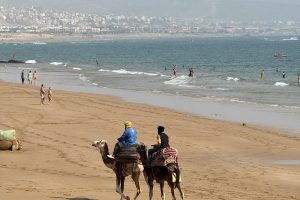
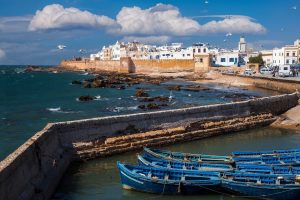
Essaouira is the antidote to Marrakech — and every backpacker who makes the 2.5-hour journey west to the Atlantic coast understands immediately why it is so beloved. Where Marrakech is overwhelming, Essaouira is calm. Where Marrakech’s medina is a commercial labyrinth, Essaouira’s is a whitewashed, blue-shuttered grid of art galleries, music venues, and cats sleeping in doorways. The ramparts that line the Atlantic coast are free to walk and offer some of the most dramatic ocean views in Morocco. The beach stretches for kilometres south of the city and is one of the finest windsurfing and kitesurfing destinations in Africa.
Budget tips for backpacking Essaouira:
- Accommodation is cheaper than Marrakech — a hostel dorm runs 60–100 MAD / $6–10, and budget riads are 150–200 MAD per night
- Fish is the local speciality and it is extraordinary — the port-side grill stalls sell fresh-caught fish by weight, grilled over charcoal, for 40–80 MAD per generous plate. This is one of the great cheap meals in Morocco
- The Gnawa Music Festival (usually held in June) draws international artists and tens of thousands of visitors — spectacular and largely free to attend
- Wind is constant and strong in Essaouira (it is called “the wind city of Africa” for a reason) — pack a layer even in summer
- Day-trip from Marrakech or stay 2–3 nights — most backpackers regret not staying longer
Essaouira deserves its own dedicated read — our full guide to the Essaouira excursion covers the highlights, and the surfing in Essaouira guide is essential for anyone who surfs or wants to learn.
Fes — The Medieval City
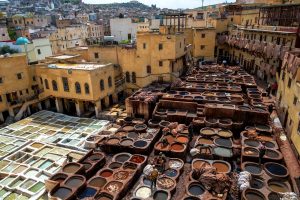
Fes el Bali — the old medina of Fes — is the largest living medieval Islamic city in the world and the most challenging, most rewarding, and most genuinely disorienting place in Morocco. Getting lost in Fes is not a metaphor — it is a literal condition that affects almost every first-time visitor to the 9,000-alley labyrinth of the medina, where streets are too narrow for cars, the buildings lean together overhead, and the only reliable navigation tool is a local guide or a very good offline map. For backpackers, Fes is extraordinary precisely because of this difficulty. The Chouara Tannery — the medieval leather dyeing operation visible from the balconies of surrounding leather shops — is one of the most photographed working craft sites in the world. The Al-Qarawiyyin Mosque and University, founded in 859 CE, is the world’s oldest continuously operating educational institution.
Fes is also cheaper than Marrakech and less tourist-saturated, which makes it a better destination for backpackers who want to experience authentic Moroccan medina life without the commercial intensity of the Marrakech tourist economy. Our top 16 things to do in Fes covers the full city. Compare the two in our Marrakech vs Fes guide.
Chefchaouen — The Blue City
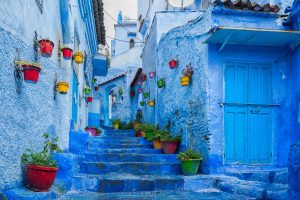
No backpacker itinerary in Morocco is complete without Chefchaouen — the small mountain city in the Rif whose medina is painted in infinite shades of blue and white, whose streets are clean and navigable, whose cafés face the mountains, and whose atmosphere is the most genuinely relaxed of any city in Morocco. Chefchaouen is also where most backpackers exhale for the first time after the intensity of Marrakech and Fes. Two or three days here, walking the blue alleys, hiking up to the Spanish Mosque at sunset, and eating fresh mountain food at medina restaurants, is the Morocco reset that most travellers need by mid-trip. Our Blue City of Morocco guide covers everything.
Merzouga and the Sahara Desert
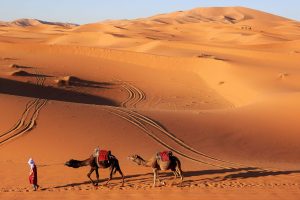
The Sahara desert is the centrepiece of most Morocco backpacking itineraries — and even on a shoestring budget, it is accessible. Shared 3-day/2-night tours from Marrakech to Merzouga run from $80–140 per person, including transport, accommodation, camel trek, and a night in a desert camp. This is one of the best budget-to-experience ratios in world travel. Our shared desert tour guide covers the best current operators. For the full desert experience context, the Sahara desert experience guide is essential reading before you book.
🎒 Need Help Planning Your Morocco Backpacking Trip?
We are a Berber family from Morocco who has been organising budget and group desert tours for backpackers for 15 years. Whether you need a shared tour to the Sahara, an honest itinerary review, or just advice from someone who actually lives here — we are here.
Morocco Backpacking Itinerary: 2 Weeks
This is the most popular Morocco backpacking itinerary — fourteen days that cover the essential cities, the Atlantic coast, the Atlas Mountains, and the Sahara without feeling rushed. It is designed to use public transport throughout and is fully achievable on a budget of $35–50 per day.
📍 2-Week Morocco Backpacking Itinerary
- Days 1–3 — Marrakech: Arrive and acclimatise. Jemaa el-Fnaa, souks, Bahia Palace, Ben Youssef Madrasa, hammam, rooftop mint tea. Allow one day to simply get lost intentionally.
- Days 4–5 — Essaouira: CTM bus from Marrakech (2.5 hrs, ~60 MAD). Blue boats, ocean ramparts, port fish grills, medina wandering. Stay 2 nights minimum.
- Day 6 — Return to Marrakech, then overnight bus north: CTM overnight bus Marrakech to Chefchaouen (9–10 hrs, ~130 MAD). This saves a night’s accommodation cost and maximises time.
- Days 7–8 — Chefchaouen: Blue medina walks, Spanish Mosque sunset hike, local mountain food, the most peaceful 48 hours of your Morocco trip.
- Day 9 — Fes: Bus from Chefchaouen (4 hrs, ~60 MAD). Arrive and check in. Afternoon orientation walk in Fes el Bali.
- Day 10 — Fes: Full day — Chouara Tannery, Al-Qarawiyyin, Bou Inania Madrasa, medina lunch, Andalusian quarter.
- Days 11–13 — Sahara Desert (Merzouga): Join a shared 3-day/2-night tour from Fes or Marrakech (travel back to Marrakech on Day 11 morning by CTM if needed, ~120 MAD). The desert tour covers Ait Benhaddou, Dades Valley, Todra Gorge, Merzouga dunes, camel trek, camp overnight, sunrise, return.
- Day 14 — Marrakech departure: Return from desert, evening free in Marrakech, onward flight or ferry.
Morocco Backpacking Itinerary: 3 Weeks
Three weeks in Morocco allows for proper depth — longer stays in each city, the addition of Tangier and the north, and the option of slower travel between cities. This itinerary builds on the 2-week route above with a week added to the north.
📍 3-Week Morocco Backpacking Itinerary (add to 2-week base)
- Days 1–3 — Tangier: Fly into Tangier (often cheapest entry point from Europe). The Kasbah, the Grand Socco, the Hercules Caves, the Continental Hotel terrace, the Strait of Gibraltar views. Our 14 things to do in Tangier guide has the full picture.
- Days 4–5 — Asilah or Tetouan: The whitewashed Atlantic port of Asilah (40 min from Tangier by train) is one of Morocco’s most beautiful and least visited small cities. Tetouan’s medina is a UNESCO World Heritage Site and genuinely undervisited.
- Days 6–7 — Chefchaouen (then continue the 2-week itinerary above from Day 7)
- Final extra days — Meknes and Volubilis: If you have 2 spare days, Meknes is Morocco’s most underrated imperial city — quieter than Fes, beautiful, and adjacent to Volubilis, the best-preserved Roman ruins in North Africa. See our Volubilis guide and Meknes guide.
Backpacking Morocco: Transport Guide
Morocco’s transport network is one of the best in Africa and is backpacker-friendly in the ways that matter most: it is cheap, it is extensive, and with the right apps and booking habits, it is reliable.
Trains (ONCF)
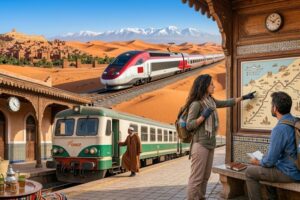
Morocco’s national rail network connects Tangier, Rabat, Casablanca, Fes, Meknes, and Marrakech with comfortable, punctual, and inexpensive trains. A second-class seat from Marrakech to Casablanca costs approximately 95–110 MAD ($9.50–11) and takes around 3 hours. Marrakech to Fes (via Casablanca) runs around 200–240 MAD ($20–24). Book online at ONCF’s official website or via the ONCF app to secure seats in advance during peak periods. Trains do not serve Chefchaouen, Essaouira, Merzouga, or Zagora — buses and shared taxis cover these routes.
CTM and Supratours Buses
CTM (Compagnie de Transports au Maroc) is Morocco’s premium long-distance bus operator — clean, air-conditioned, reliable, and only marginally more expensive than the local alternatives. Supratours (ONCF’s bus subsidiary) serves many of the same routes with similar standards. Both can be booked online at CTM’s official website. For routes CTM doesn’t cover, local bus companies (Ghazala, Satas) are cheaper and still perfectly functional.
Grand Taxis
The shared grand taxi (large Mercedes or Peugeot saloon) is the standard intercity transport for shorter routes — particularly useful for Chefchaouen to Fes, Marrakech to Essaouira, and routes where buses run infrequently. Grand taxis fill up to 6 passengers (3 in front, 3 in back — compact) and run when full. They are faster than buses on mountain routes and cheaper per seat. Negotiate the seat price before getting in.
Getting Internet in Morocco
Buy a local SIM card immediately on arrival — Maroc Telecom (IAM), Orange, and Inwi all offer tourist SIM cards with generous data packages for 40–80 MAD ($4–8). Having offline maps (Maps.me or Google Maps downloaded for Morocco) loaded before you arrive is strongly recommended for medina navigation. Full details in our Morocco internet guide.
What to Pack for Backpacking Morocco
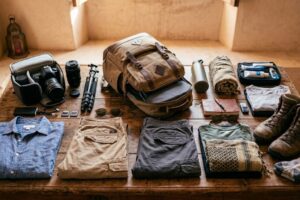
Morocco’s combination of urban medinas, mountain trekking, desert camping, and Atlantic coast means your pack needs to cover more environmental range than most single-country trips. The key principles:
- Modest clothing is non-negotiable — light, loose layers that cover shoulders and knees for medina environments. You can always adapt for beaches and resorts. See the full Morocco packing list for the complete guide.
- A good pair of walking shoes — medina cobblestones and mountain trails both punish inadequate footwear
- A warm layer for desert nights — even in October and April, desert camp temperatures drop sharply after sunset
- A daypack with a lockable zip — for medina days when your main pack stays at the hostel
- A reusable water bottle with filter — tap water in Morocco is generally not recommended for drinking; bottled water is inexpensive but a filter bottle reduces both cost and plastic waste. Our guide on tap water safety in Morocco covers the full picture.
- Travel insurance documents — always. Our Morocco travel insurance guide explains what coverage backpackers specifically need.
Frequently Asked Questions: Backpacking Morocco
Is Morocco good for backpackers?
Yes — Morocco is one of the world’s great backpacker destinations, combining extraordinary affordability, historical depth, landscape variety, and cultural richness in a compact, transport-connected country. The learning curve is steeper than Southeast Asia but the rewards are proportionally greater. Most backpackers who visit Morocco once go back. The country has a way of unfinishing itself for you — every trip reveals another layer. For full context, the Lonely Planet Morocco overview and the Broke Backpacker Morocco guide both offer useful independent perspectives to complement this one.
Is Morocco safe for backpacking?
Largely yes, with the specific caveat that the tourist cores of Marrakech and Fes require active situational awareness for scam avoidance. Physical safety for most travellers in most situations is genuinely good. Solo female backpackers should read the dedicated solo female travel Morocco guide before departure. The full safety guide covers every scenario.
Is $200 a lot of money in Morocco?
Yes. On the shoestring budget of $20–25 per day, $200 covers 8–10 days including accommodation, food, transport, and activities. On a comfortable backpacker budget of $40–50 per day, $200 covers 4–5 days. Morocco’s affordability — particularly outside of Marrakech’s tourist core — is one of its greatest assets for budget travellers.
What are the unspoken rules in Morocco?
The key ones: accept tea invitations knowing merchandise will follow and you are never obligated to buy; don’t photograph people without permission; dress modestly in medinas and religious areas regardless of gender; bargain with friendliness, not aggression; respect Ramadan fasting hours and don’t eat openly on the street during the day; say “As-salamu alaykum” — it opens every door.
How long do I need to backpack Morocco?
Ten days is the minimum for a meaningful Morocco trip covering Marrakech, one other imperial city, and the Sahara. Two weeks is the ideal backpacker duration — enough for Marrakech, Essaouira, Chefchaouen, Fes, and the Sahara without feeling rushed. Three weeks allows for the north (Tangier, Tetouan) and slower, more immersive travel throughout. See our 7-day itinerary and 2-week Morocco itinerary for planned routes.
What is the best hostel app to use in Morocco?
Hostelworld has the most complete Morocco hostel inventory with verified reviews. Booking.com also lists most Moroccan hostels and budget riads. For off-the-beaten-path destinations, asking at your current hostel for a recommendation in the next city often produces the best results — the backpacker network in Morocco is well-connected and local knowledge travels fast.