The Moroccan Souk Etiquette — the traditional covered market at the heart of every medina — is one of the great sensory experiences of world travel. Wandering through the leather souk of Marrakech, the spice market of Fes, the metalwork quarter of Meknes, the blue-and-white ceramics quarter of Safi — these are not tourist attractions in the conventional sense. They are living, functioning marketplaces where skilled artisans work by hand using techniques unchanged for centuries, where transactions happen in three languages simultaneously, and where the entire economic and social life of the medina intersects in a labyrinth of covered alleys filled with colour, smell, and sound.
They can also be genuinely overwhelming and occasionally frustrating for visitors who arrive without the right knowledge. The souk has its own rules — unwritten but well understood by everyone who participates in it — and knowing them is the difference between an experience that is joyful and one that is exhausting. This guide gives you those rules, honestly and specifically, so that you can walk into any Moroccan souk with the right knowledge and the right attitude.
⚡ Moroccan Souk — Quick Reference
- Bargaining: Expected and culturally normal in souks — not optional
- Fixed prices: In supermarkets, pharmacies, and shops with marked price tags — not in souks
- Opening hours: Generally 9am–8pm, Monday–Saturday; many close for Friday Jumu’ah noon prayer
- Best time to visit: Early morning (8–10am) — least crowded, best light, most relaxed atmosphere
- Tea invitation: Genuine hospitality — but means merchandise will be shown; you are never obligated to buy
- Photography: Always ask permission before photographing artisans or people at work
- Touching goods: Generally fine for ceramics, textiles, and leather — use judgement for fragile items
- Unofficial guides: Common at souk entrances — politely decline if you have your own guide or prefer to explore alone
- Payment: Cash in Moroccan Dirhams (MAD) — most small souk stalls do not accept cards
Understanding What a Souk Actually Is
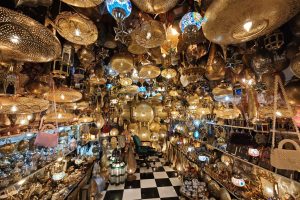
Before rules, context: a souk is not a bazaar in the tourist-market sense. Morocco’s medina souks are working professional environments — the leather souk is where the city’s leather workers have their workshops and sell their products, the spice souk is where cooks and pharmacists source their ingredients, the carpenters’ souk is where the city’s woodworkers make furniture to order. Many souk artisans are working in the same family business their great-grandfather established, in the same alley, using the same techniques. This context matters because it shapes the entire etiquette: you are walking through someone’s professional environment, not a theme park version of one.
The souks of Marrakech, Fes, Meknes, and Essaouira are each organised by trade — a system inherited directly from medieval Islamic urban planning, in which each craft had its own quarter of the medina. The spice souk and the food markets are closest to the main mosque (for reasons of daily traffic). The leatherworkers are near the water source. The metalworkers are furthest from the central mosque because of noise. Walking through a Moroccan medina souk with this knowledge transforms it from chaos into a legible, logical city — and our ultimate guide to Marrakech’s markets maps the specific quarters in detail.
Rule 1: Bargaining Is Not Optional — It Is the System
The single most important piece of souk etiquette for visitors to understand is this: in a Moroccan souk, the first price quoted is a starting position, not a final price. This is not a trap, a tourist tax, or a deception — it is simply how the pricing system works, understood and accepted by everyone who participates in it. The shopkeeper expects to negotiate. Accepting the first price without negotiating can actually seem strange — as if you are not taking the transaction seriously, or as if you do not respect the craft enough to engage with the process.
The standard starting strategy for most souk goods: counter at 40–50% of the asking price and work upward from there toward a mutually agreed middle ground. Neither party expects to get their opening position — the final price is typically somewhere between 50% and 70% of what was first quoted for most goods. The important rule: do not name a price you are not willing to actually pay if accepted. If a shopkeeper accepts your counter-offer immediately, you have made a commitment and should honour it.
Bargaining in Morocco should always be done with good humour, patience, and respect. It is a social transaction, not a battle. Aggressive, contemptuous, or hectoring bargaining is considered deeply rude and will not produce a better price — it will produce a shopkeeper who decides they would rather not sell to you at all. Smile. Take your time. Enjoy the conversation. Accept that the shopkeeper has expertise in their craft that you do not, and that a fair price for both parties is a better outcome than “winning.” Our full bargaining like a local guide covers the full technique and etiquette in depth.
Rule 2: Tea Means Something — But You Are Never Obligated
This is where many visitors misread the souk culture and end up either missing a genuine experience or feeling manipulated. When a shopkeeper invites you in for tea, both things are true simultaneously:
- It is a genuine expression of Moroccan hospitality — real tea, real welcome, real interest in you as a human being
- It is also an understood part of the commercial transaction — merchandise will be shown, conversation will naturally drift toward what you might like to buy
Neither of these facts cancels the other. You can drink the tea, genuinely enjoy the conversation, look at the carpets or the leather goods or the ceramics with real interest, and then leave without buying anything — and do so with a warm “shukran, ma kayfeesh” (thank you, I don’t need anything) and no hard feelings. What you should not do is accept the invitation while secretly resenting the commercial context, drink the tea while pointedly refusing to engage with what is being shown, or act offended when merchandise appears after you sat down. The rules of the transaction are transparent on both sides — enter with that understanding and the tea invitation becomes exactly what it is: one of the genuinely warm and interesting human encounters that makes Morocco memorable.
Rule 3: “Just Looking” Is Completely Fine — Say It Clearly
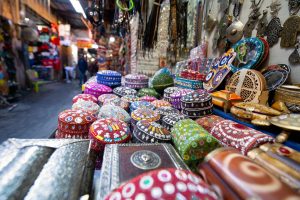
You are under no obligation to buy from any souk stall, no matter how long you have been looking, how much conversation has been exchanged, or how many items have been unfolded, unrolled, or brought down from the shelf. In a souk, looking without buying is entirely normal — shopkeepers understand this and accept it. The correct approach: be clear and direct from the beginning if you are purely browsing. “Ana katshoof bass” (I’m just looking) said pleasantly and confidently at the beginning of your time in a shop sets the right expectation and is respected. What creates friction is prolonged engagement that implicitly suggests serious interest, followed by an abrupt departure — this leaves a shopkeeper who has invested significant time feeling genuinely misled. Be clear early, and everyone’s time is respected.
Rule 4: The Walking-Away Move — How and When
Walking away from a negotiation that hasn’t reached a price you’re comfortable with is one of the most effective tools in souk bargaining — but it needs to be done correctly. The souk version of walking away is not an aggressive move; it is a calm, friendly departure signalling that the gap between your price and theirs is too large. Smile, say “shukran” (thank you), and begin to leave. In most cases — perhaps 60–70% — the shopkeeper will call after you with a lower price. If they don’t, it means the price was already at their genuine minimum, and you were actually offering too little. This is useful information. Never walk away in anger, and never walk away from a price you have already agreed to — that is a genuine breach of souk etiquette that causes real offence.
Rule 5: Know What You Are Looking At Before You Negotiate
The most common mistake visitors make in Moroccan souks is attempting to bargain without any reference point for what the goods are actually worth. A hand-knotted Berber rug that took two women three months to make in the Middle Atlas is not the same object as a machine-made carpet from a factory in Casablanca — but they may look superficially similar to someone who has never been in a Moroccan rug shop before. The same distinction applies to leather goods (hand-tanned genuine leather vs synthetics), to argan oil (pure food-grade argan vs diluted oil), and to ceramics (hand-painted originals vs mass-produced replicas).
The best way to build this knowledge quickly: spend your first hour in the souk looking and asking questions without any intention to buy. Most shopkeepers are genuinely happy to explain their craft — where the wool comes from, how the dye is made, how you distinguish hand-knotted from machine-made by looking at the reverse of the rug. This knowledge makes you a more interesting person to negotiate with, a more confident buyer, and virtually immune to the most common overpricing tactics. Our guides to Moroccan rugs, Moroccan argan oil, and Marrakech crafts give this background knowledge before you arrive.
Rule 6: Photography Etiquette in the Souk
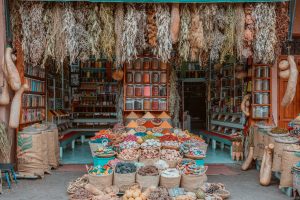
The souks of Marrakech and Fes are among the most photographed places in the world, and for good reason — the light through the latticed roofs of the leather souk, the colour of the spice pyramids, the artisans bent over their work in workshops no larger than a closet. Photography is entirely possible and welcomed in most of the souk environment. The specific rules:
- Photographing the goods, the architecture, the alleys: Generally fine without asking
- Photographing artisans at work: Ask first — “mumkin tsawerni?” (may I photograph you?). Most will agree, some will decline, and some will expect a small payment (10–20 MAD) for a posed portrait. All three responses are entirely legitimate.
- Photographing people without asking: Considered rude and will cause genuine offence, particularly with older Moroccan men and women in traditional dress
- The Chouara Tannery in Fes: The famous leather tannery is always photographed from above (from the leather shop balconies). Tip: you will usually be offered a sprig of mint to hold against the smell — accept it. The smell is genuine and intense.
- Being asked to pay for photos: In tourist areas, some individuals actively pose for tourists and will ask for payment afterward. If someone poses deliberately for you or you photograph them with their knowledge, a small payment (10–20 MAD) is entirely appropriate.
Our full photography guide for Morocco covers the complete etiquette across all contexts.
Rule 7: How to Handle Unofficial Guides and Commission Touts
At the entrances to the major medina souks — particularly in Marrakech near Jemaa el-Fnaa and in Fes near Bab Bou Jeloud — you will encounter men who offer to show you around the souk. Some are genuinely helpful licensed guides. Others are commission-based touts who will lead you through a curated selection of shops where they receive payment for every tourist they bring in, and where the prices are inflated accordingly to cover that commission.
The clearest signal of a commission-based arrangement: a “guide” who steers every conversation toward specific shops and seems uninterested in any shop you choose yourself. A genuine guide takes you where you want to go and explains what you are seeing. A commission tout takes you where they want to go and explains what you should buy.
If you want a guide for the souk — which is genuinely useful for navigating the larger medinas like Fes and for understanding the craft quarters — the best approach is to book one through your riad or hotel, who will recommend a licensed guide with a genuine reputation. Our broader scams in Morocco guide covers the commission guide dynamic in full context.
Rule 8: Touching and Handling Goods
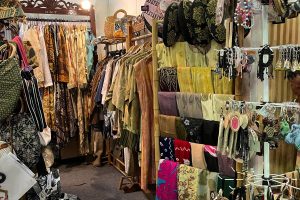
In Moroccan souks, touching textiles, leather goods, and ceramics before purchasing is entirely normal — how else would you evaluate the quality of a hand-stitched leather bag or feel the weight and pile of a Berber rug? Shopkeepers expect it. The etiquette: handle goods with respect for their craftsmanship, not with the carelessness of someone who knows they are not going to buy. Fragile items (blown glass, fine ceramics, some metalwork) should be handled carefully or not touched unless invited to by the shopkeeper. Unrolling and unfolding goods — rugs, textiles, clothing — is expected if you are seriously interested, and the shopkeeper will often do this themselves to show you the full extent of the piece.
Rule 9: Dress and General Demeanour in the Souk
The souk is a professional working environment in a conservative Muslim city, and your dress and demeanour matter in ways they might not in a shopping mall. Modest dress — shoulders covered, knees covered for both men and women — is appropriate and will affect how you are received. Loud or aggressive behaviour, shouting down prices in a crowded souk, or treating vendors with contempt is considered extremely rude and will close conversations that might otherwise have been warm and interesting. The Moroccan souk operates on a social currency of mutual respect — bring that, and you will be welcomed. Our Morocco dress code guide covers what to wear throughout the country, and the Morocco rules for tourists page covers the broader cultural context.
Rule 10: Paying — Always in Dirhams, Always Cash
Most souk stalls and small workshops operate on a cash-only basis — credit and debit cards are typically not accepted. Always carry sufficient Moroccan Dirhams (MAD) for souk shopping, negotiated in MAD from the beginning of any price discussion. Shopkeepers who quote prices in euros or dollars are typically doing so because they expect tourists to have less clear sense of the Dirham value — always respond by asking the price in Dirhams (“shhal f-derham?”) and negotiate in Dirham from that point. Never accept a price quoted in a foreign currency without converting it explicitly — the conversion may not be in your favour. Our cash guide for Morocco advises on how much to carry specifically for souk shopping.
What to Buy in a Moroccan Souk: Quality Indicators
Part of good souk etiquette is understanding what you are buying well enough to assess quality — this protects you from being overcharged for inferior goods and helps you properly value the extraordinary craftsmanship of the genuine article.
🛍️ Quality Indicators for Common Souk Purchases
- Rugs and carpets: Turn over and check the back — hand-knotted rugs show irregular, individual knots on the reverse; machine-made rugs show perfectly uniform machine stitching. Hand-knotted always costs more and is worth it.
- Leather goods: Genuine Moroccan leather has a distinctive earthy, slightly tannic smell from the traditional tanning process. Synthetic “leather” smells like plastic. The Marrakech and Fes tanneries produce some of the finest natural leather in the world — goods made from it are worth the premium.
- Argan oil: Pure food-grade argan oil is golden-yellow with a distinctively nutty, slightly earthy smell. Heavily diluted or cosmetic-grade oil being sold as food-grade is a common souk fraud. Our argan oil guide explains how to test for quality on the spot.
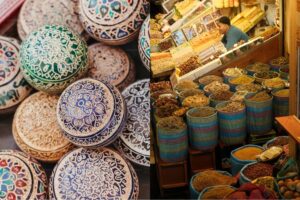
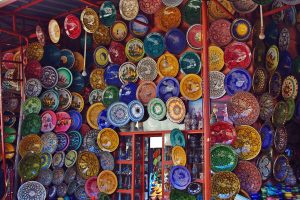
- Ceramics: Hand-painted Moroccan ceramics (particularly from Fes and Safi) show slight imperfections in the brushwork that are a mark of authenticity. Machine-printed versions are perfectly uniform. Run your finger across the painted surface — hand-painted work has slight texture; printed work is completely flat.
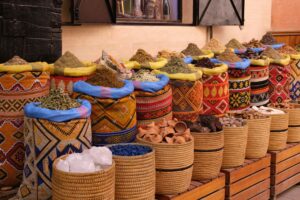
- Spices: The best souk spices smell intensely of themselves — fresh cumin is almost aggressively aromatic, good saffron from Taliouine is deeply floral. Pre-packaged spices from tourist-oriented displays are often older and less potent than what the spice merchant sells by weight to local customers. Ask for fresh by-weight quantities.
Souk Vocabulary: Useful Darija Phrases
🗣️ Essential Moroccan Darija for the Souk
- Shhal hada? / Bshhal? — How much is this?
- Ghali bzaf — That’s too expensive
- Mashi mushkil — No problem / That’s fine
- Shukran — Thank you
- La shukran — No thank you
- Ana katshoof bass — I’m just looking
- Wakha / Mzyan — OK / Good
- Ma kayfeesh — I don’t need it
- Shhal f-derham? — How much in Dirhams?
- Mumkin tsawerni? — May I photograph you?
- Bssaha — Bon appétit / Said when someone is eating near you
- As-salamu alaykum — Peace be upon you (standard greeting that opens every door)
Even a handful of Darija phrases used with genuine good humour transforms how you are received in the souk — shopkeepers who might otherwise run through the transactional tourist routine immediately shift into something warmer and more genuine when a visitor demonstrates any authentic interest in the language. You do not need to be fluent. A sincere attempt at “as-salamu alaykum” and “shukran” is enough to change the entire texture of an interaction.
The Best Souks in Morocco
Marrakech Souks
The most visited souk complex in Morocco, radiating north from Jemaa el-Fnaa in a series of distinct craft quarters: the Souk des Teinturiers (dyers’ souk — wool hanging in vivid skeins above the narrow alley), the Souk des Babouches (the famous Moroccan slipper market, hundreds of pairs in every colour), the Souk Smarine (the main commercial artery), the Rahba Kedima (the spice and herbal remedy souk, one of the most photographed squares in Morocco), and the Souk des Ferronniers (the metalworkers, where artisans hammer lanterns from raw sheet copper). Our ultimate Marrakech markets guide maps every quarter in detail.
Fes Souks
The souks of Fes el Bali are the most complex and most traditionally authentic in Morocco — less tourist-oriented than Marrakech’s and more genuinely integrated with the everyday life of the medina’s 150,000 residents. The Chouara Tannery area (reached through the leather souk) and the Souk Attarine (the spice souk adjacent to the Al-Qarawiyyin Mosque) are the essential stops. Allow a full day and hire a guide — the Fes medina has over 9,000 alleys and getting genuinely lost is a real possibility. Our Fes guide covers the medina in full.
Essaouira Souk
Essaouira’s compact medina souk is the most relaxed and least pressured of any major Moroccan city — smaller scale, more art galleries and craft studios than commercial souk, and a notably lower intensity of salesmanship than Marrakech or Fes. Particularly known for thuya wood crafts (an aromatic Moroccan wood unique to the Essaouira region) and for the quality of its silver jewellery and painted canvas work.
Experience the Souk the Right Way
The souk is at its best when you know what you are looking at, who you are talking to, and what the rules are. Our private guides have been navigating these alleys for decades — they know which dyer uses natural pigments, which carpet merchant is a third-generation master, and exactly when the light falls perfectly through the tannery roof. Let us show you.
We reply within 24 hours · No obligation
Frequently Asked Questions: Moroccan Souk Etiquette
Is it rude not to bargain in a Moroccan souk?
It can seem odd to a shopkeeper if you accept the first price immediately — they may wonder whether you understood the price, or whether you are simply very wealthy. Bargaining is the expected social form of the transaction. A brief, friendly negotiation — even one that doesn’t reduce the price dramatically — is the culturally appropriate way to engage with a souk purchase.
What is a fair price in a Moroccan souk?
There is no single answer, as it depends entirely on the item, the quality, the city, and how genuine the craft is. The useful framework: research typical prices for specific items before you arrive (our rug guide and crafts guide include price ranges), aim for 50–70% of the first asking price as your final position, and trust your sense of whether the item is genuinely hand-made and well-crafted.
Can I say no to a shopkeeper without being rude?
Absolutely. A clear, warm “la shukran” (no thank you) or “ma kayfeesh” (I don’t need it) said with a smile is entirely acceptable and is respected. What causes friction is not a clear no — it is a prolonged engagement that implies interest followed by an abrupt departure without explanation. Be clear and early about your intentions, and interactions remain warm.
Do I have to buy something if I drink a shopkeeper’s tea?
No — accepting tea does not create a purchase obligation. It does mean you have accepted hospitality in a context where merchandise will be shown. You can drink the tea, look at what is shown with genuine interest, and leave without buying, with a sincere “shukran” and good humour. This is entirely normal souk behaviour.
What should I do if I feel harassed in a souk?
Walk away calmly and confidently, without engaging with aggressive follow-ups. Do not respond to pressure with aggression — this escalates rather than resolves the situation. A quiet, confident demeanour and purposeful walking is the most effective response. If you feel genuinely unsafe, enter any open shop or café and ask for help — Moroccan shop owners will always assist a visitor in genuine discomfort.
What is the best time of day to visit a Moroccan souk?
Early morning — between 8 and 10am — is when the souks are at their most authentic, least crowded, and most photogenic. The shopkeepers are setting up, the light is beautiful, and the pressure of the peak tourist hours has not yet built. This is also when you are most likely to see artisans actually working rather than purely selling, and when genuine conversations are most natural.