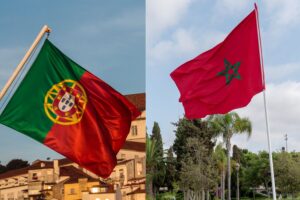
Morocco and Portugal sit at opposite ends of the Strait of Gibraltar — just 14 kilometres of water separating them — yet they are among the most different travel experiences in the world. One is a Muslim North African kingdom of ancient medinas, Sahara dunes, and mint tea rituals. The other is a European Atlantic nation of tile-covered cities, wine, fado, and some of the finest beaches on the continent. They share a climate zone, a similar price bracket (by European standards), and a proximity to each other that makes a combined trip entirely feasible.
The question of Morocco vs Portugal comes up constantly among travellers planning their first serious trip to either region — and it is a genuinely interesting one, because the two countries appeal to many of the same travellers but for completely different reasons. This guide compares them honestly across every dimension that matters for a travel decision: cost, weather, safety, food, beaches, culture, ease of travel, and the specific experiences each does better than the other.
⚡ Morocco vs Portugal — At a Glance
| Morocco | Portugal | |
|---|---|---|
| Budget (mid-range/day) | $50–100 | $100–160 |
| Language for English speakers | French + some English | English widely spoken |
| Visa (US/UK/EU/Canada) | 90 days visa-free | 90 days (Schengen) |
| Alcohol | Available in licensed venues | Freely available everywhere |
| Best beaches | Atlantic coast (Essaouira, Agadir, Dakhla) | Algarve, Alentejo coast |
| Cultural depth | Extraordinary — 1,000+ years of medina life | Rich — Moorish heritage + Age of Discovery |
| Ease of independent travel | Moderate — medinas require orientation | Very easy |
| Landscape variety | Extreme — Sahara to Atlas to Atlantic | Good — coast, vineyards, Alentejo plains |
| Safety for tourists | Good — scam awareness needed | Excellent — among Europe’s safest |
| Food | World-class — tagine, couscous, pastilla | Excellent — seafood, pastéis, petiscos |
| Best months | Mar–May, Sep–Nov | Apr–Jun, Sep–Oct |
Cost Comparison: Morocco vs Portugal
Cost is often the deciding factor for travellers choosing between Morocco and Portugal — and Morocco wins this comparison clearly, though the gap is smaller than it was five years ago as Portugal’s tourism boom has pushed prices upward significantly, particularly in Lisbon and the Algarve.
Morocco Budget
- Budget daily (hostel, street food, public transport): $25–40
- Mid-range daily (boutique riad, local restaurants, private transfers): $70–130
- Luxury daily: $250–600+
- Street meal (harira + bread + tea): $2–4
- Sit-down restaurant dinner: $8–18 per person
- Boutique riad, Marrakech: $60–180/night
- Beer or wine at a licensed restaurant: $3–6
- 3-day Sahara desert private tour: $250–550/person
Portugal Budget
- Budget daily (hostel, petiscos, metro): $55–80
- Mid-range daily (guesthouse, sit-down meals, trains): $100–160
- Luxury daily: $300–700+
- Pastel de nata + coffee: $2–3
- Sit-down restaurant dinner: $15–35 per person
- Central Lisbon guesthouse: $90–250/night
- Algarve hotel room (peak season): $150–400/night
- Glass of wine at a wine bar: $4–8
Verdict: Morocco is meaningfully cheaper at every level, particularly for accommodation and food. A comfortable mid-range trip to Morocco costs roughly 40–50% less per day than equivalent Portugal travel. For budget-conscious travellers, the gap is even larger. Portugal’s affordability advantage over other Western European destinations has narrowed considerably since 2019 — it is no longer as dramatically cheap as it once was relative to Morocco.
Weather and Climate: Morocco vs Portugal
Both countries sit within the same Mediterranean-influenced Atlantic climate zone, and their best travel months broadly overlap. The key differences are in extremes — Morocco’s summer heat (particularly inland at Marrakech and the south) is significantly more intense than Portugal’s, and Morocco’s climate varies far more dramatically by region due to the Atlas Mountains and the Sahara.
| Period | Morocco | Portugal |
|---|---|---|
| Jan–Feb | Cool (15–18°C Marrakech). Desert cold at night. Snow in Atlas. | Mild (14–17°C Lisbon). Rainy season. Very off-peak. |
| Mar–May ✅ | Excellent (22–30°C). Best travel season. Landscapes at their most beautiful. | Excellent (18–25°C). Less crowded than summer. Ideal for Lisbon. |
| Jun–Aug | Very hot inland (38–44°C). Coast and mountains fine. Desert: avoid unless heat-tolerant. | Hot and peak crowded (28–35°C Algarve). Beaches at their best but prices and crowds peak. |
| Sep–Nov ✅ | Excellent (25–32°C). Desert pleasant again. Off-peak crowds. | Excellent (20–28°C). Quieter than summer. Best value month. |
| Dec | Cool (16–20°C). Christmas festive. Desert peak season. | Cool (14–17°C). Quiet and atmospheric in cities. |
Verdict: Both countries are best in spring (March–May) and autumn (September–October). Morocco’s summer heat is the more significant challenge for most visitors, but Morocco also offers desert and mountain alternatives to the hot cities during summer. Portugal is more reliably comfortable year-round with fewer extreme temperature concerns.
Food: Morocco vs Portugal
This is where the comparison becomes most interesting — because both countries have food traditions that are genuinely world-class, but they are completely different from each other.
Moroccan Food
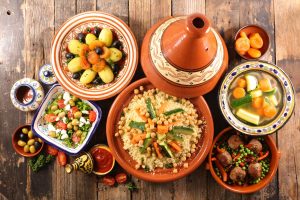
Moroccan cuisine is one of the great culinary traditions of the world — a synthesis of Berber, Arab, Andalusian, and sub-Saharan African influences that produces dishes of extraordinary complexity and depth. The slow-braised tagine (lamb with preserved lemon, chicken with olives, kefta with egg) is the most famous, but the full range covers the paper-thin warqa pastry of a bastilla (pigeon with almonds and cinnamon), the enormous Friday communal couscous with seven vegetables and slow-cooked lamb, the souk street food of brochettes and mechoui, the breakfast ritual of msemen with amlou and Moroccan mint tea, and a spice market tradition (cumin, saffron, ras el hanout) that changes the fundamental taste palette of everything it touches. Our full Moroccan food guide is the complete reference.
Portuguese Food
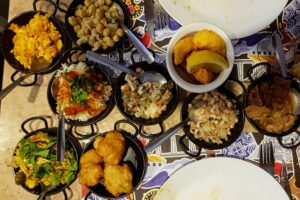
Portuguese cuisine is defined by extraordinary seafood — the grilled sardines of Lisbon, the bacalhau (salt cod, with reportedly over 365 preparation methods), the cataplana (seafood stew of the Algarve) — alongside deeply satisfying meat dishes like leitão (suckling pig from Bairrada), cozido à portuguesa (a great Portuguese stew), and an exceptional cheese and charcuterie tradition. The pastry and dessert culture is outstanding — the pastel de nata (custard tart) is among the world’s great pastries, and Portuguese tarts, rice puddings, and almond sweets are genuinely addictive. Portuguese wine, particularly from the Douro, Alentejo, and Vinho Verde regions, is among Europe’s best-value fine wine.
Verdict: Both countries have extraordinary food traditions. Morocco wins on spice complexity, cultural depth of the food experience, and sheer diversity from street food to fine riad dining. Portugal wins on seafood quality, wine, and the ease of accessing good food at every level. For travellers who drink alcohol freely, Portugal’s wine culture adds a significant dimension. For travellers interested in non-Western culinary traditions, Morocco is irreplaceable.
Culture and History: Morocco vs Portugal
Morocco’s Cultural Depth
Morocco’s cultural offer is defined above all by its living Islamic heritage. The medinas of Marrakech, Fes, Meknes, and Rabat are not museums — they are functioning cities, inhabited as they have been for centuries, where daily life unfolds within 12th-century walls in the same narrow alleys, the same craftsmen’s quarters, and the same neighbourhood mosques that have defined urban Moroccan life for a thousand years. Fes el Bali, the world’s largest living medieval Islamic city, contains the Al-Qarawiyyin mosque and university — founded in 859 CE, the world’s oldest continuously operating educational institution. The architecture of Morocco — the carved cedar, the geometric zellige tilework, the painted plasterwork of the imperial palaces — represents a craft tradition of extraordinary sophistication. And the Sahara desert itself, with its Berber and nomadic Tuareg traditions, adds a cultural dimension entirely unavailable in Europe.
Portugal’s Cultural Depth
Portugal’s cultural identity is shaped by its paradox: a small nation on Europe’s western edge that once built the world’s most extensive trading empire. The Age of Discovery — the 15th and 16th century Portuguese voyages that opened sea routes to India, Brazil, and sub-Saharan Africa — left an architectural legacy (the Manueline style, ornate with maritime motifs) and a cultural self-image of bittersweet nostalgia expressed through fado, the melancholic music unique to Portugal. Lisbon’s Alfama district, Porto’s Ribeira, the hill towns of Alentejo, the monasteries of Batalha and Jerónimos — all offer a richness of European heritage that is genuinely world-class. The Moorish influence on Portuguese culture is also significant and immediate, particularly in the south — the Alentejo and Algarve carry centuries of Islamic architectural heritage that creates a subtle but real connection to Morocco just across the water.
Verdict: Both countries offer deep, genuinely rewarding cultural experiences. Morocco’s culture is more challenging, more different from Western norms, and ultimately more transformative for travellers who engage with it fully. Portugal’s culture is immediately accessible, deeply beautiful, and delivers one of Europe’s richest heritage experiences. If you want to be significantly outside your comfort zone culturally — in the best possible way — Morocco. If you want a deeply cultural European experience with minimal cultural adjustment required, Portugal.
Beaches: Morocco vs Portugal
Morocco’s Beaches
Morocco has over 3,500 km of Atlantic and Mediterranean coastline and some genuinely excellent beaches — but the beach experience in Morocco is different from Portugal. Agadir is Morocco’s most developed beach resort, with a long sandy bay, good water temperatures from May through October, and a full resort infrastructure. Essaouira is more atmospheric — a windswept, culturally rich Atlantic town with a long beach that is one of the world’s best windsurfing and kitesurfing destinations. Dakhla in the far south is extraordinary for water sports in a lagoon setting. Mediterranean beaches near Tetouan and Al Hoceima are calmer and warmer in summer. Morocco’s beaches are less developed for mass tourism than Portugal’s Algarve, which is either an advantage or a limitation depending on what you want.
Portugal’s Beaches
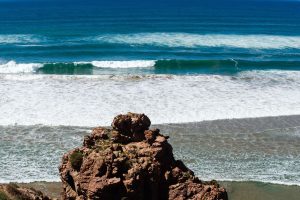
The Algarve — Portugal’s southern coast — is widely considered one of the finest beach destinations in Europe, with an extraordinary combination of golden sea-stacks and cove beaches (particularly around Lagos and the Ponta da Piedade formations), warm Atlantic water, excellent infrastructure, and reliable summer sunshine. The Silver Coast (Alentejo and Estremadura) north of Lisbon is wider, wilder, and significantly less touristy. The Portuguese Atlantic coast also has some of the world’s finest surf — Nazaré is famous for the world’s largest rideable waves (up to 30 metres), and the break at Peniche is internationally regarded. Water temperatures on both Moroccan and Portuguese Atlantic coasts are similar — the Canary Current keeps them cooler than Mediterranean beaches even in peak summer.
Verdict: Portugal wins on beach infrastructure, accessibility, and the sheer visual drama of the Algarve’s rock formations. Morocco wins on cultural context around the beach experience (particularly Essaouira) and on water sports specialisation (Dakhla, Taghazout). For a classic beach holiday, Portugal is the stronger choice. For combining beaches with a far richer cultural and landscape itinerary, Morocco holds its own.
Safety: Morocco vs Portugal
Portugal is consistently ranked among the safest countries in the world for tourists — top 5 on the Global Peace Index annually, with extremely low violent crime, minimal scam culture, and an environment where solo female travellers, LGBTQ+ visitors, and independent backpackers all report feeling genuinely comfortable.
Morocco is safe in the ways that matter most — violent crime against tourists is rare, the country is politically stable, and the vast majority of visitors complete their trip without any serious incident. The primary safety challenge in Morocco is petty scam culture concentrated in the medina tourist zones of Marrakech and Fes — informal guides, commission-based shops, occasional overcharging — which is manageable with preparation and knowledge but does require active awareness that Portugal simply does not. LGBTQ+ travellers face genuine legal and social restrictions in Morocco that do not exist in Portugal. Solo female travellers in Morocco need more active management of personal space and attention than in Portugal.
Verdict: Portugal is objectively safer and easier to navigate for all categories of traveller. Morocco is safe for most tourists most of the time, but requires more active engagement with personal safety and cultural awareness. For travellers who prefer to travel with minimal active vigilance, Portugal. For travellers comfortable with a higher-engagement travel style and prepared with the right knowledge, Morocco presents no serious safety concerns — see our Morocco safety guide and scams guide for the full picture.
Ease of Travel: Morocco vs Portugal
Portugal is among the easiest countries in the world to travel independently. Road signs are clear and distances are manageable. English is widely spoken by service staff across the country, including in small towns. Public transport (Lisbon Metro, Intercidades trains, regional buses) is reliable and well-signed. Food and accommodation are ordered in the same way as anywhere in Europe. There are virtually no cultural practices that require prior knowledge to navigate correctly. Driving is straightforward. Getting around by Uber, train, or rental car is entirely intuitive.
Morocco has a steeper learning curve. The medinas — the walled old cities at the heart of every major Moroccan destination — are designed to disorient outsiders (this was their original defensive purpose) and require genuine navigation orientation. French, not English, is the primary tourist language, and outside major hotels and tourist-focused restaurants, English is less reliably spoken than in Portugal. The taxi and grand taxi system has its own rules. The bargaining culture requires knowledge and practice. Ramadan, dress expectations, photography sensitivities, and social customs all require prior awareness. None of this is insurmountable — it is simply more active engagement than Portugal requires. Most travellers who do the preparation find it richly rewarding rather than stressful. Our Morocco rules for tourists guide covers everything first-time visitors need to know.
Verdict: Portugal is significantly easier to travel independently, especially for first-time international travellers. Morocco rewards preparation and delivers a deeper, less templated travel experience as a result of that greater engagement. If this is your first significant international trip, Portugal is more forgiving. If you are an experienced traveller who wants to be genuinely outside your comfort zone, Morocco delivers something Portugal fundamentally cannot.
Which Should You Visit: Morocco or Portugal?
✅ Choose Morocco if you want:
- A travel experience that is genuinely, radically different from Europe or North America
- Ancient Islamic heritage cities that are still fully, vibrantly alive — not museum pieces
- The Sahara desert: one of the world’s great landscape experiences
- The most affordable mid-range travel available in the wider Mediterranean region
- A food culture of extraordinary depth and complexity that is unlike anything else
- An active, high-engagement travel experience that produces the stories you tell for years
- Atlas Mountains, nomadic Berber culture, and landscapes utterly unlike anything in Europe
✅ Choose Portugal if you want:
- One of Europe’s finest and most accessible cultural experiences with minimal adjustment required
- World-class beaches, particularly the Algarve’s dramatic cove coastline
- Exceptional wine and seafood culture in a European setting
- Genuinely relaxed, stress-free independent travel — no cultural navigation required
- A completely safe, LGBTQ+-friendly, solo-travel-easy destination
- Fado, Manueline architecture, and the melancholic beauty of a nation shaped by the sea
- A base for a Schengen Europe trip that combines easily with Spain, France, or beyond
✈️ Or: Visit Both
Morocco and Portugal are just 14 km of water apart at the Strait of Gibraltar. Tarifa (Spain) to Tangier by ferry takes 35 minutes and costs €35–50 — making a combined trip genuinely feasible. The contrast between the two countries experienced in a single trip — from Lisbon’s tile-covered hills to the medina of Fes, or from the Algarve’s cove beaches to the Sahara’s dune ridges — is extraordinary, and many travellers find that each country makes the other more vivid by comparison. Our Morocco road trip guide and 2-week Morocco itinerary cover the Moroccan side of a combined trip.
Ready to Choose Morocco?
If Morocco is calling you — and after reading this, perhaps it is — we are a Berber family who has been planning perfect Morocco trips for travellers from every background for 15 years. Tell us your dates and what excites you. We will build something remarkable.
We reply within 24 hours · No obligation · Free itinerary advice
Frequently Asked Questions: Morocco vs Portugal
Is Morocco cheaper than Portugal?
Yes — significantly. A comfortable mid-range Morocco trip costs $70–130/day, compared to $100–160/day in Portugal. Budget travel in Morocco can cost as little as $25–40/day. The gap has narrowed as Portugal’s tourism boom has pushed Lisbon and Algarve prices upward, but Morocco remains meaningfully more affordable at every level.
Is Morocco safer than Portugal?
Portugal is objectively safer — it consistently ranks in the top 5 globally for safety and has virtually no scam culture or social safety concerns for any type of traveller. Morocco is safe in the most important senses (violent crime against tourists is rare) but requires active awareness of scam culture in medina tourist zones and carries legal/social restrictions relevant to LGBTQ+ travellers that Portugal does not.
Which has better food — Morocco or Portugal?
Both are exceptional but entirely different. Morocco excels in spice complexity, the cultural depth of the food experience, and the unique ingredients (argan oil, preserved lemons, ras el hanout) that make its cuisine genuinely irreplaceable. Portugal excels in seafood quality, exceptional wine, and the pleasure of a European dining culture with petiscos (small plates), superb pastas de nata, and one of the world’s most underrated fine dining traditions. Most travellers who love food would rather visit both than choose.
Can you visit Morocco and Portugal on the same trip?
Absolutely — the two countries are separated by just 14 km of water. A Tarifa (Spain) to Tangier ferry takes 35 minutes and costs around €35–50. Many travellers combine a week in Portugal with a week in Morocco, typically entering Morocco via Tangier and making their way south. See our Tangier guide for the natural entry point from Portugal.
Which is better for first-time travellers — Morocco or Portugal?
Portugal is more immediately accessible and requires no prior cultural knowledge to navigate comfortably. Morocco is more rewarding for experienced travellers who are comfortable with a higher-engagement travel style — but genuinely excellent Morocco travel resources (including this site) mean that first-time visitors who arrive prepared consistently have extraordinary trips. Morocco is more challenging; it is also more transformative.
Which has better beaches — Morocco or Portugal?
Portugal’s Algarve has the edge on developed beach infrastructure and visual drama (the sea-stack rock formations are spectacular). Morocco’s Atlantic coast has the edge on raw atmosphere (Essaouira), world-class water sports (Dakhla, Taghazout), and the experience of a beach destination that has not been fully absorbed into the European resort economy. For a pure beach holiday, Portugal. For combining beaches with cultural depth, Morocco.