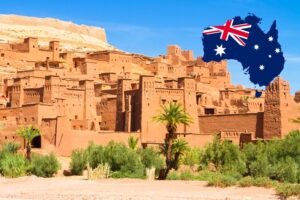
Morocco is further from Australia than it is from almost anywhere else in the world — and that is precisely what makes it so extraordinary when Australians arrive. For most Australian travellers, Morocco represents a first genuine encounter with Islamic culture, with medieval city life unchanged over centuries, with the Sahara desert, and with a food tradition of astonishing depth. The distance is real — expect 20–28 hours of travel depending on routing — but the Morocco that waits at the end of that journey consistently ranks among the most life-changing travel experiences Australian visitors ever have.
This guide covers everything: Morocco for Australians, flights from Australia to Morocco, entry requirements, what things cost in Australian dollars, the best itineraries, safety, practical Australia-specific tips, and how to make the most of what may be the longest trip you ever take.
⚡ Morocco from Australia — Essential Facts for 2026
- Visa required? No — Australians get 90 days visa-free on arrival
- Flight time: 20–28 hours total including connection (no direct flights from Australia)
- Best Australian gateway cities: Sydney, Melbourne, Perth (better for Middle East connections)
- Common connection hubs: Dubai (DXB), Abu Dhabi (AUH), Doha (DOH), London (LHR), Paris (CDG)
- Currency: Moroccan Dirham (MAD) — 1 AUD ≈ 6.5–7 MAD
- Time difference: Morocco is 9–11 hours behind AEST (Sydney) depending on season
- Language: French widely spoken — a plus for educated Australians who studied French
- Best months for Australians: March–May and September–November
- Recommended trip length: 14–21 days to justify the long journey
- Travel insurance: Essential — Australian Medicare does not cover Morocco
Do Australians Need a Visa for Morocco?
No. Australian passport holders can enter Morocco visa-free and stay for up to 90 days. You receive an entry stamp on arrival at any Moroccan international airport — no prior application, no fee, no form to complete in advance. Your Australian passport must be valid for at least 6 months beyond your intended departure from Morocco. Hotels and riads require your passport for registration, so keep it with you throughout your stay. For the most current entry requirements, the Australian Government Smartraveller Morocco page is the authoritative reference and is updated regularly.
Flights from Australia to Morocco
There are no direct flights between Australia and Morocco. All routings involve at least one — and often two — connections. The total journey time from Sydney or Melbourne is typically 22–28 hours; from Perth, the Middle East hub connections are shorter and more efficient.
Best Routing Options from Australia
- Via Dubai (Emirates): Sydney/Melbourne/Perth → Dubai DXB → Casablanca CMN or Marrakech RAK. Excellent schedules, high frequency, very comfortable. One of the most popular Australia–Morocco routings. Total travel: 22–26 hours.
- Via Abu Dhabi (Etihad): Sydney/Melbourne → Abu Dhabi AUH → Casablanca. Good business class product for those travelling premium. Total travel: 22–25 hours.
- Via Doha (Qatar Airways): Sydney/Melbourne/Perth → Doha DOH → Casablanca or Marrakech. Qatar Airways consistently rated among the world’s best — excellent connection times at Doha’s Hamad International. Total travel: 22–26 hours.
- Via London (Qantas + British Airways/Royal Air Maroc): Sydney → London LHR → Casablanca or Marrakech. Longer overall travel time (26–30 hours) but allows a London stopover, which many Australians use. Qantas operates direct Perth–London, which reduces the eastbound leg significantly.
- Via Paris (Air France): Sydney/Melbourne → Paris CDG → Marrakech or Casablanca. Good option for those wanting a Paris stopover, particularly on a longer trip combining both France and Morocco.
Which Airport to Fly Into?
Marrakech Menara Airport (RAK) is the best arrival point for most Australian first-time visitors to Morocco — it puts you directly in the country’s most popular and most immediately impressive city without an additional domestic transfer. Casablanca Mohammed V Airport (CMN) is the main hub for Emirates, Qatar, and Etihad connections and has excellent onward train service to Marrakech (3 hours, ~100 MAD) and Fes (3.5 hours). Many Australians arrive into Casablanca and take the train to Marrakech the same day.
Flight Prices from Australia to Morocco (2026, in AUD)
- Sydney → Casablanca (via Dubai or Doha): AUD $1,400–2,200 return economy
- Melbourne → Marrakech (via Dubai or Doha): AUD $1,500–2,400 return economy
- Perth → Casablanca (via Dubai): AUD $1,200–2,000 return economy (Perth benefits from shorter Middle East leg)
- Business class (Sydney → Casablanca): AUD $4,000–8,000 return
- Best booking window: 3–5 months ahead for March–May peak season
- Cheapest travel months: January–February and late September
For the full context of Morocco flight options, see our Morocco flights guide.
What Does Morocco Cost for Australians?
At approximately 6.5–7 MAD to the Australian dollar, Morocco represents excellent value for Australian travellers. The cost comparison is particularly stark for Australians accustomed to Sydney or Melbourne prices — a full restaurant dinner in Marrakech costs what a coffee costs in the CBD, and a stay in a beautiful medina riad costs what a modest Airbnb in inner-city Sydney would charge.
💰 Morocco Daily Budget for Australians (AUD)
- Budget (hostel, street food, public transport): AUD $40–65/day
- Mid-range (boutique riad, local restaurants, key private transfers): AUD $110–200/day
- Luxury (high-end riads, private tours, fine dining): AUD $380–900+/day
- Street meal (harira + bread + tea): AUD $3–6
- Sit-down restaurant dinner, local medina: AUD $14–28 per person
- Boutique riad room, Marrakech: AUD $90–260/night
- 3-day Sahara private tour (2 people): AUD $380–850/person
Full cost breakdown in our Morocco trip cost guide.
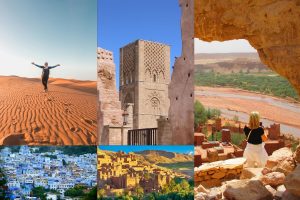
Morocco Itinerary for Australians: 14 Days
Given the long-haul journey from Australia, two weeks is the minimum that justifies the trip — and 14 days delivers a deeply satisfying Morocco experience that covers the essential highlights at a genuinely humane pace. This is the itinerary we most commonly build for Australian visitors.
📍 14-Day Morocco Itinerary for Australians
Days 1–2 — Marrakech (arrival and acclimatise): Land, transfer to your medina riad. Day 1 is gentle — the time difference from Australia is 9–11 hours, and jet lag on eastbound long-hauls is real. Evening walk to Jemaa el-Fnaa. Day 2: first full medina day — Koutoubia Mosque, the souks in the morning, Bahia Palace, Jemaa el-Fnaa food stalls at night. Our 3-day Marrakech itinerary covers the optimised order.
Day 3 — Marrakech in depth: Majorelle Garden at 8am sharp (book in advance), Ben Youssef Madrasa, YSL Museum, traditional hammam. Rooftop dinner over the medina.
Day 4 — Atlas Mountains day trip: Private car to Imlil at 1,740m — walnut orchards, Berber villages, cool air, mule tracks. Return to Marrakech for the evening. Our Atlas day trip guide covers options from gentle walks to serious ridges.
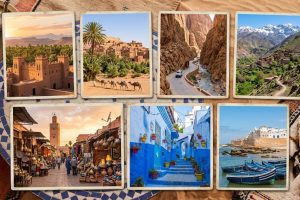
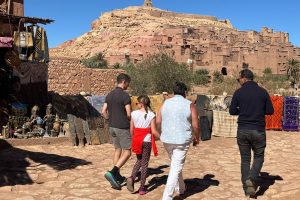
Days 5–7 — Sahara Desert (3-day private tour): South via the Tizi n’Tichka mountain pass, Ait Benhaddou (Game of Thrones and Gladiator location), Ouarzazate (Morocco’s “Hollywood”), the extraordinary Dades Valley, Todra Gorge’s 300-metre slot canyons, and the Ziz Valley’s date palms to Merzouga. Sunset camel trek into Erg Chebbi. Camp overnight. Sunrise from the dune summit. This is what Australian travellers consistently tell us was the best experience of their entire trip. Our desert tour page covers the full circuit.
Days 8–9 — Fes: The world’s largest living medieval Islamic city. The Chouara Tanneries seen from above at golden hour, Al-Qarawiyyin University (founded 859 CE — older than any university in the southern hemisphere by over 900 years), Bou Inania Madrasa, the full medina labyrinth with a private guide. Our Fes guide covers it all.
Days 10–11 — Chefchaouen: The Blue City in the Rif Mountains — four hours from Fes by bus. The most photographed medina in Morocco, and the most genuinely peaceful. Hike to the Spanish Mosque at sunset. Eat in the small family restaurants above the alleys. Our Chefchaouen guide has the full picture.
Days 12–13 — Essaouira: Return to Marrakech (train or bus via Casablanca), then take the 2.5-hour bus west to Essaouira on the Atlantic. Blue boats in the port, ocean ramparts, grilled fish at the port stalls, Gnawa music venues. Morocco’s most purely enjoyable city — calm, beautiful, and a perfect wind-down before a long flight home.
Day 14 — Return: Return to Marrakech for your evening or overnight flight. Final mint tea on the riad rooftop as the city wakes around you.
Morocco Itinerary for Australians: 3 Weeks (21 Days)
For Australians who can stretch to three weeks — and given the journey involved, this is the length we genuinely recommend — Morocco reveals layers that two weeks can only hint at. Add the following to the 14-day itinerary above:
- Tangier (Days 15–16): Morocco’s northern gateway — the Kasbah, the Grand Socco, the Strait of Gibraltar views, Café Hafa where Jimi Hendrix and The Rolling Stones sat. Our Tangier guide covers every worthwhile stop.
- M’Hamid and Erg Chigaga (extend desert to Days 9–11): For adventurous Australians, replace the standard Merzouga camp with a 4×4 expedition to Erg Chigaga near M’Hamid — Morocco’s largest and most remote dune field, accessible only across open desert piste. See our Merzouga vs M’Hamid guide for the comparison.
- Volubilis Roman ruins: An afternoon from Fes or Meknes — the best-preserved Roman ruins in North Africa. Extraordinary for Australians who have rarely encountered ancient Roman infrastructure of this quality. Our Volubilis guide covers everything.
- Dakhla (add a southern extension): Morocco’s far-south Atlantic lagoon city is one of the world’s finest kitesurfing and windsurfing destinations. See our Dakhla guide.
Is Morocco Safe for Australians?
Yes. The Australian Government’s Smartraveller currently rates Morocco at “Exercise Normal Safety Precautions” — the lowest advisory level, equivalent to most of Europe. Morocco is a politically stable country with a long history of welcoming Australian tourists. The primary safety concern for Australian visitors is petty scams and overcharging in the medinas of Marrakech and Fes — not violent crime, terrorism risk, or political instability.
Australian travellers are statistically savvy — arriving with preparation on the specific dynamics of Moroccan medina culture (the informal guide system, commission-based shops, taxi pricing) removes the risk almost entirely. Our scams in Morocco guide and full safety guide cover every scenario in detail. Register your trip with DFAT’s Overseas Registration before departure — it takes 3 minutes and ensures the Australian Embassy in Rabat can reach you in a genuine emergency.
Practical Tips for Australian Travellers in Morocco
Beating the Jet Lag
The 9–11 hour time difference between Sydney/Melbourne and Morocco (westward travel, which is generally easier for the body than eastward) means most Australians feel surprisingly functional on arrival — but the 20+ hours of travel means genuine fatigue regardless. Build Day 1 of your Morocco itinerary as a half-day: arrive, check in, short evening walk, early sleep. Day 2 begins your real itinerary. Most Australian travellers find they are fully adjusted by Day 3.
Money and Currency
Withdraw Moroccan Dirhams from ATMs on arrival — far better exchange rates than exchanging Australian dollars at Australian banks or airport currency counters before departure, where Morocco isn’t typically a supported currency. Cards with low foreign transaction fees (Wise, ING, or Macquarie debit cards all perform well in Morocco) are the best tool. Carry cash for medina restaurants, taxis, souks, and tips. Our Morocco payment guide covers the full picture.
Travel Insurance
Australian Medicare provides no coverage outside Australia. Comprehensive travel insurance covering emergency medical treatment and evacuation is non-negotiable for any trip to Morocco, and is particularly important for the remote desert and mountain sections of your itinerary. Ensure your policy covers adventure activities if you plan to do any trekking or desert activities. Our Morocco travel insurance guide specifies exactly what Australians need.
SIM Card and Data
Australian carrier international roaming in Morocco is expensive. Buy a local Moroccan SIM card on arrival (Maroc Telecom, Orange, or Inwi — 40–80 MAD for a generous data package), or purchase a Moroccan eSIM before departure via Airalo (available for Australian iOS and Android devices). Download Google Maps for Morocco offline before arriving — essential for medina navigation. Our Morocco internet guide covers all the options.
Electrical Adapters
Morocco uses Type C and Type E plugs (European standard, 220V). Australian plugs are Type I — you need a universal travel adapter. Most modern Australian electronics (MacBooks, iPhone chargers, Android chargers) handle 100–240V and only need the plug adapter. Some older or simpler appliances (certain hairdryers, straighteners) may need a voltage converter — check the power brick label before packing.
Tipping
Australians who are accustomed to tip-free culture at home sometimes undershoot in Morocco. 10% at sit-down restaurants is appropriate and appreciated. For tour guides, 100–200 MAD (~AUD $15–30) per day for good service. For desert camel handlers, 50–100 MAD per person. For hotel staff, 20–50 MAD for housekeeping. Our tipping guide has the full breakdown.
Ready to Plan Your Morocco Trip from Australia?
We are a Berber family from Morocco who has been building itineraries for Australian travellers for 15 years — from solo backpackers to families to couples on a once-in-a-decade trip. Tell us your dates and what excites you. We’ll make it extraordinary.
We reply within 24 hours · No obligation · Free itinerary advice
Frequently Asked Questions: Morocco for Australians
Do Australians need a visa for Morocco?
No — Australian passport holders enter Morocco visa-free for up to 90 days with just a valid passport and a return ticket. No application or consulate visit required. Verify current requirements at Smartraveller before travel.
How long is the flight from Australia to Morocco?
There are no direct flights from Australia to Morocco. The most popular routing is via Dubai (Emirates) or Doha (Qatar Airways), with a total travel time of 22–26 hours from Sydney or Melbourne. From Perth, Middle East hub connections are shorter — typically 18–22 hours total.
Is Morocco good value for Australians?
Excellent value. At approximately 6.5–7 MAD per AUD, a mid-range restaurant dinner costs AUD $14–28, a boutique riad room AUD $90–260, and a private 3-day Sahara tour AUD $380–850 per person. Compared to Australian domestic travel costs — let alone Bali, Japan, or Europe — Morocco is extraordinary value for the quality of experience it delivers.
What is the best time for Australians to visit Morocco?
March–May (Moroccan spring) and September–November (Moroccan autumn) are the best overall periods — warm and clear, with manageable crowds and the landscapes at their most beautiful. These periods also align well with Australian school holiday timing: April school holidays (in both autumn and spring depending on state) correspond with Morocco’s best travel window. Our best time to visit Morocco guide covers every month.
How long should Australians spend in Morocco?
Given the journey involved, a minimum of 14 days is our genuine recommendation. Two weeks allows a comfortable, unhurried experience of Marrakech, the Sahara, Fes, and at least one other destination (Chefchaouen or Essaouira). Three weeks — the length we most recommend for Australian visitors — allows for deeper exploration including Tangier, extended time in Fes, and optional desert extensions.
Is Morocco safe for Australian solo female travellers?
Morocco requires more active management of personal space and attention than most Australian travellers are used to, particularly in the medinas of Marrakech and Fes. It is not unsafe — millions of solo women visit Morocco every year without serious incident — but it requires specific preparation and confidence. Our dedicated solo female travel Morocco guide covers every specific scenario with the honest detail it deserves.