
There is a particular quality to a Moroccan morning that visitors almost always underestimate before they experience it. The light comes in early and golden over the medina rooftops. The call to Fajr prayer has already passed. The bread oven in the neighbourhood has been running since before dawn. By 7am, the café at the end of the alley is open, and the smell of fresh msemen cooking on the griddle and strong café au lait brewing carries down the street in a way that makes it essentially impossible to stay in bed.
Moroccan breakfast — ftour in Darija, the country’s spoken Arabic dialect — is one of the great meal traditions of the Mediterranean and North African world. It is not a quick coffee-and-toast affair. At its best, it is an elaborate, beautiful spread of breads and crepes, oils and honeys, preserves and pastries, and the inevitable glass of heavily sweetened mint tea — the whole thing assembled on a circular tray and shared with whoever is at the table, at a pace that suggests the morning is worth taking seriously.
This guide covers everything: the specific foods that make up a traditional Moroccan breakfast, what they taste like and how they are made, the difference between what locals eat and what tourists are typically served, where to find the best breakfast in Morocco’s major cities, and how to experience the real thing rather than a hotel imitation.
⚡ Moroccan Breakfast — Quick Reference
- Moroccan word for breakfast: Ftour (فطور) — also the word for breaking the Ramadan fast at sunset
- Typical time: 7–9am in most households; cafés open from 6–7am
- Essential elements: Bread in at least one form + oil/honey/jam + hot drink
- Most iconic bread: Msemen (layered flatbread) and khobz (round loaf)
- Essential drinks: Atay (mint tea), café au lait, or nus-nus
- Special weekend/celebration bread: Beghrir (semolina honeycomb crepe)
- Most important accompaniment: Argan oil with amlou (ground almond paste) — Morocco’s most extraordinary breakfast spread
- Average cost at a local café: 15–35 MAD ($1.50–3.50) for a full spread
- Ramadan note: The pre-dawn meal (suhoor/suhur) often includes similar foods to the regular breakfast
The Traditional Moroccan Breakfast: A Full Picture
A proper Moroccan family breakfast is assembled as a tray rather than plated individually, and its components come in categories rather than a single recipe. Understanding these categories is the key to understanding Moroccan breakfast culture — and to knowing what to look for when you sit down at a medina café or a riad breakfast table.
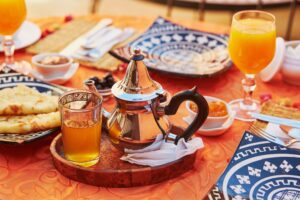
The Breads: The Foundation of Every Moroccan Breakfast
No Moroccan breakfast exists without bread, and Morocco’s bread tradition is one of the richest in the world. The breads served at breakfast cover a spectrum from thick round loaves to paper-thin griddle crepes, each with its own technique, texture, and appropriate accompaniment.
Khobz — The Everyday Round Loaf
Khobz (pronounced khobz or hobz depending on region) is Morocco’s essential bread — a round, flat loaf made from semolina or a semolina-flour blend, with a distinctive slightly dense crumb and a firm, golden crust. It is baked in a communal wood-fired oven (a farran) found in every medina neighbourhood, to which families traditionally bring their shaped loaves in the morning to be baked. The farran is not just a bakery — it is a social infrastructure, and the sight of children carrying round trays of unbaked dough on their heads to the neighbourhood oven is one of the defining images of Moroccan medina mornings. Khobz is torn rather than sliced and used to scoop everything on the breakfast table — olive oil, amlou, honey, jam, and soft cheese.
Msemen — The Layered Griddle Flatbread
Msemen is arguably Morocco’s most beloved breakfast bread — a square, multi-layered flatbread made by rolling, folding, and refolding a semolina dough with generous amounts of butter and fine semolina to create thin, distinct layers that separate as the bread is torn apart. Cooked on a dry griddle, it develops a slight crisp on the outside while remaining soft and slightly chewy within — the layers pulling apart in the fingers, absorbing olive oil, honey, or amlou with each bite. A freshly made msemen, still warm from the griddle, torn in half and dipped in amlou, is one of the great simple pleasures of Moroccan food. Our full guide to bread in Morocco covers msemen and its variations in depth.
Meloui — The Round Layered Crepe
Meloui is the round cousin of msemen, made from the same layered dough but rolled into a spiral before cooking, producing a circular, coiled flatbread with a more pronounced chew and a slightly sweeter character than the square msemen. The two are often served together on the same breakfast tray. In some regions, particularly in the Fes and northern Morocco areas, meloui is the dominant breakfast bread.
Beghrir — The Honeycomb Crepe
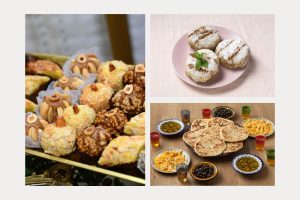
Beghrir — sometimes called “thousand holes crepe” — is one of Morocco’s most distinctive breakfast foods and arguably one of the most beautiful things you can eat at a morning table. Made from a thin, yeast-leavened semolina batter poured onto a griddle and cooked on one side only, beghrir develops a distinctive honeycomb surface as hundreds of tiny bubbles form and burst on the upper face during cooking, leaving a porous, lace-like texture that is extraordinary at absorbing butter and honey. The correct way to eat beghrir is to pour warm honey and melted butter directly onto the honeycomb surface and allow it to sink through — each bite is simultaneously light and rich, simultaneously crispy around the edges and yielding at the centre. Beghrir is typically a weekend or celebration morning food rather than an everyday one, though city cafés serve it daily.
Harcha — The Semolina Griddle Cake
Harcha is a thick semolina griddle cake with a sandy, slightly gritty texture — entirely different from the layered flatbreads and crepes above. Made from fine semolina, butter, milk, and a little sugar, it is cooked on a dry griddle until golden on both sides, producing a dense, crumbly interior with a warmly toasted exterior. Harcha is paired most naturally with fresh cheese (kefir-like jben or fromage de chèvre), honey, or argan oil. It is particularly common in rural households and in the breakfast offerings of traditional cafés outside the major tourist cities.
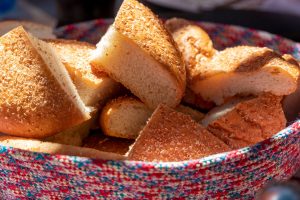
The Accompaniments: What Goes on the Breakfast Tray
The breads are inseparable from what accompanies them — and the range of accompaniments on a traditional Moroccan breakfast tray is one of the things that sets it apart from most other breakfast traditions in the world.
Argan Oil and Amlou — Morocco’s Greatest Breakfast Condiment
Amlou is the single most extraordinary thing on a Moroccan breakfast table, and the thing most foreign visitors have never encountered before. It is a thick paste made from roasted argan kernels ground with honey and a little almond oil — darker, richer, and more complex than peanut butter, with a deep nuttiness from the argan, a floral sweetness from the honey, and a faint bitterness that is entirely addictive. Spread thickly on warm msemen or torn khobz, amlou is one of the defining flavors of southern Moroccan food. It is produced primarily in the Souss region around Agadir and Essaouira, where the argan tree grows. Alongside amlou, straight argan oil is often served separately — drizzled over bread or used as a dipping oil. Our argan oil guide covers the production and use of argan in full.
Olive Oil
Morocco is one of the world’s significant olive oil producers, and good Moroccan olive oil — peppery, grassy, genuinely fruity — is a breakfast staple throughout the country. A small plate of olive oil for dipping bread, sometimes with a few green or black olives alongside, appears on virtually every traditional breakfast table. Moroccan breakfast olive oil is almost always eaten at room temperature with bread — not cooked with anything else at this meal.
Honey
Morocco produces exceptional regional honeys — euphorbia honey from the Tifelt plateau near Rabat (intensely floral and golden), thyme honey from the Atlas Mountains (herbal and complex), and sidr honey (from the jujube tree, dark and almost caramel-like). A good riad or traditional café will serve local honey rather than generic commercial varieties. With beghrir specifically, the combination of warm honey poured over the honeycomb surface and allowed to saturate through is one of the genuinely unmissable eating experiences in Moroccan food.
Jben — Fresh Cheese
Jben is Morocco’s traditional fresh cheese — a simple, slightly salty, very fresh white cheese with a consistency somewhere between ricotta and feta, produced from goat or sheep’s milk in rural areas. It is ubiquitous at breakfast tables in Berber households and increasingly in urban cafés, and it pairs beautifully with honey (the salt-sweet contrast is superb), with olive oil, or simply with warm bread. In cities, jben is sometimes substituted with kiri (a processed cream cheese common in North Africa) at less traditional establishments — the real thing is significantly better.
Olive Tapenade and Preserved Olives
A small bowl of seasoned olives — often marinated with preserved lemon, cumin, chilli, and herbs — appears on most traditional Moroccan breakfast tables, alongside or sometimes blended into a rough olive tapenade. This is one of the more immediately distinctive elements of Moroccan breakfast for visitors accustomed to sweeter European morning traditions. The combination of olives with sweet tea and honeyed bread is a flavour balance that takes a little getting used to and then becomes entirely natural.
Khlii — Preserved Meat (Special Occasion)
Khlii (also spelled khlij or khlea) is a traditional Moroccan preserved meat — strips of seasoned beef or lamb dried and then confit-cooked in rendered fat and argan oil — that appears at special breakfast occasions, celebrations, and in traditional family homes particularly in Fes and the northern regions. It is intensely flavoured, almost gamey, and extraordinarily satisfying with warm bread. Khlii is not typically found in tourist cafés but is the breakfast equivalent of a local specialty worth seeking out if invited into a Moroccan home.
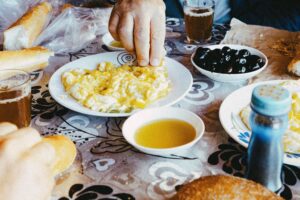
The Drinks: What Moroccans Drink at Breakfast
Atay — Moroccan Mint Tea
Atay is the cornerstone of Moroccan daily life at every hour — but at breakfast specifically, the sweet, bright, slightly bitter combination of Chinese gunpowder green tea, fresh spearmint, and an extraordinary quantity of sugar, served in small decorated glasses from a high-poured pot, is inseparable from the food experience. The high pour from the teapot (sometimes 30–40cm above the glass) is not theatrics — it creates the fine foam on the surface of the glass that Moroccans consider a mark of quality preparation. At breakfast, tea is drunk in three rounds at minimum, each slightly different as the pot steeps. Our dedicated Moroccan mint tea guide covers the tradition, the technique, and the cultural significance of tea in Morocco.
Café au Lait and Nus-Nus
Morocco’s café culture is French-influenced, and the morning coffee at a traditional café is almost always café au lait — a strong espresso-style brew combined with warm steamed milk, served in a glass or a café-au-lait bowl. Nus-nus (literally “half-half” in Darija) is the slightly more coffee-forward version — half espresso, half warm milk — and is the drink of choice for Moroccans who want a stronger morning coffee without going to a full espresso. Both are served with sugar on the side. Instant coffee exists but is considered a last resort, and you are unlikely to encounter it in a café of any quality.
Harira Soup (Ramadan Breakfast and Special Occasions)
While not a standard daily breakfast drink, harira — Morocco’s spiced tomato, lentil, and chickpea soup — is the food that breaks the Ramadan fast at sunset (which is technically the Moroccan breakfast, the ftour, in its most culturally loaded moment) and also appears as a warming breakfast option in winter and in some traditional households. If you are in Morocco during Ramadan, the harira served immediately at Iftar, with chebakia (honey-soaked sesame pastry) alongside, is one of the most important eating experiences in Moroccan food culture. Our full Moroccan food guide covers harira and the complete cuisine.
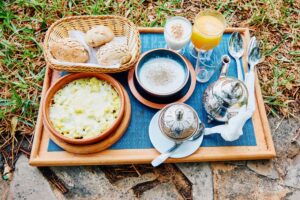
The Moroccan Breakfast Experience: Local vs Tourist
It is worth being honest about the difference between the breakfast most visitors experience in Morocco and the breakfast most Moroccans actually eat every morning. The hotel and riad breakfast — particularly in tourist-oriented establishments in Marrakech — often includes excellent local elements (msemen, beghrir, amlou, local honey) alongside Western additions (croissants, orange juice, eggs to order) that are not part of the native tradition. This is not dishonest — it reflects what many international travellers expect — but it is not the authentic Moroccan breakfast experience.
The authentic version is found in the medina neighbourhood café: a small wooden table, a round tray bearing msemen or harcha, a bowl of olive oil and a smaller bowl of amlou, a few olives, and a glass of heavily sweetened mint tea with a café au lait alongside — the whole spread costing 15–30 MAD ($1.50–3). This is what the man who bakes the khobz at the farran eats at 7am. It is what the carpet merchant has before he opens his shop. It is what the grandmother serves to her family in the courtyard. And it is available to any visitor who steps off the riad terrace and walks three minutes into the medina alleys instead.
Where to Find the Best Moroccan Breakfast
Marrakech
The best authentic breakfast cafés in Marrakech are found in the residential quarters of the medina — around Bab Doukkala, the Mouassine neighbourhood, and the streets near Rahba Kedima market. Look for a small café with local men drinking coffee at 7am — this is the best quality indicator. Jemaa el-Fnaa’s own surrounding streets have breakfast cafés that serve adequately but price upward for location. For a beautiful riad-style breakfast experience with genuine traditional foods, the better small riads in Marrakech put genuine effort into the breakfast tray — our best riads in Marrakech guide notes which properties serve particularly good breakfasts.
Fes
Fes has the deepest traditional food culture in Morocco, and its medina cafés serve some of the finest everyday breakfasts in the country. The area around Bab Bou Jeloud (the Blue Gate) has a dense concentration of traditional cafés serving msemen, meloui, and very strong café au lait to early-morning medina foot traffic. The Fes breakfast is notably generous — multiple bread types, regional honey, real jben, and olives from the local souk are standard in even modest neighbourhood establishments.
Essaouira
Essaouira’s relaxed, ocean-city café culture produces some of Morocco’s most enjoyable breakfast experiences — the combination of the Atlantic morning light, the coffee culture inherited from the town’s artistic and international community, and the local bakeries producing extraordinary khobz and beghrir makes for a particularly pleasurable morning. The cafés along Avenue de l’Istiklal and in the medina’s smaller squares are the best places to look.
In a Moroccan Home
The very best Moroccan breakfast is not available in any restaurant or café. It is the breakfast eaten in a Moroccan home — where the msemen is made fresh by hand from a recipe passed through the family for generations, where the amlou was prepared by the women of the household from argan kernels they roasted themselves, where the honey comes from a relative’s hives in the mountains, and where the tea is poured with the unhurried care of someone who understands that the morning is a ritual worth performing properly. If you are invited to breakfast in a Moroccan home — through a guide, through a riad host, through any genuine connection — accept without hesitation. It will be the best breakfast you eat in Morocco.
Moroccan Breakfast During Ramadan
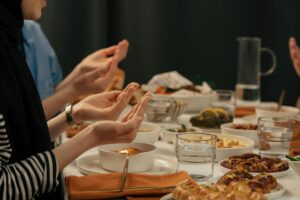
During Ramadan, the daily rhythm of eating in Morocco shifts entirely. The pre-dawn meal — suhoor — taken before the Fajr prayer marks the beginning of the fast and often includes many of the same elements as a regular breakfast (bread, olive oil, cheese, tea), though lighter and taken in the dark before dawn. The much more significant event is Iftar — the breaking of the fast at sunset — which is the true “breakfast” of Ramadan and the meal that defines the month. The Iftar table centres on harira soup, chebakia (sesame honey pastries), dates, shebakia, beghrir with honey, and a glass of milk, followed by the full spread of msemen and accompaniments as the evening unfolds. If your Morocco trip overlaps with Ramadan, experiencing a communal Iftar — whether at a café table, in a medina restaurant, or invited by a Moroccan family — is one of the most extraordinary food experiences the country offers. Our Ramadan in Morocco guide covers this fully.
How to Order Moroccan Breakfast Like a Local
🗣️ Useful Phrases for Ordering Breakfast in Morocco
- Atay b’na’na: Mint tea (atay with mint)
- Nus-nus: Half coffee, half warm milk
- Café au lait (kaf o leh): Coffee with warm milk
- Msemen / Beghrir / Harcha: The specific bread type you want — just say the name
- Amlou: The argan-almond-honey paste — if it is not on the table, ask for it
- Bssaha: Bon appétit — said before eating; the response is “Allah y’aafik” (may God give you health)
- Shhal hado? How much is this? — for settling the bill
Come and Experience Morocco’s Mornings
A breakfast on a medina rooftop with msemen, amlou, and a glass of mint tea as the Atlas Mountains catch the first light — this is how we start every day in Morocco. We would love to show you the same.
We reply within 24 hours · No obligation
Frequently Asked Questions: Moroccan Breakfast
What is a typical Moroccan breakfast?
A traditional Moroccan breakfast centres on one or more breads — typically msemen (layered flatbread), khobz (round semolina loaf), or beghrir (honeycomb crepe) — accompanied by olive oil, argan oil or amlou (argan-almond-honey paste), local honey, fresh cheese (jben), olives, and a glass of heavily sweetened mint tea or café au lait. It is a communal, tray-based meal eaten at a shared table at a relaxed pace.
What is amlou and why is it special?
Amlou is a thick paste made from roasted argan kernels ground with honey and almond oil — Morocco’s most distinctive breakfast condiment and one of the finest things you will eat in the country. It is darker and more complex than peanut butter, with a deep nuttiness from the argan and a floral sweetness from the honey. It is produced primarily in the Souss region of southern Morocco, where the argan tree grows, and is best eaten warm and freshly spread on msemen or torn khobz.
What is msemen?
Msemen is a square, multi-layered Moroccan flatbread made by repeatedly folding a buttered semolina dough to create thin, distinct layers, then cooking on a dry griddle until slightly crisp on the outside and soft within. It is torn rather than cut and dipped into or spread with olive oil, amlou, honey, or fresh cheese. Fresh, warm msemen is one of the great simple pleasures of Moroccan food.
What is beghrir and how is it different from msemen?
Beghrir is a completely different bread to msemen — a thin, yeast-leavened semolina crepe cooked on one side only, which develops a distinctive honeycomb surface of hundreds of tiny holes that absorb butter and honey beautifully. Where msemen is dense, layered, and chewy, beghrir is light, lacy, and porous. Both appear on the traditional Moroccan breakfast table, often together.
How much does breakfast cost at a local café in Morocco?
A full local breakfast at a traditional Moroccan café — msemen or harcha, olive oil, honey or amlou, a few olives, mint tea and café au lait — costs between 15 and 35 MAD ($1.50–3.50). This is one of the great bargains in international food travel. Tourist-oriented riad breakfasts cost more (80–150 MAD per person) but are typically more elaborate in range.
Is the Moroccan breakfast the same across the whole country?
The core elements — bread in some form, olive oil, honey or amlou, mint tea — appear throughout Morocco, but regional variations are real and worth seeking out. Amlou is most common in the south (Souss, Agadir, Essaouira region) where argan trees grow. Khlii (preserved meat) is most associated with Fes. Beghrir appears more frequently in Fes and northern cities as a daily food rather than a special-occasion one. The Atlas Berber breakfast may include mountain butter and freshly churned smen (aged butter). Each region brings its own identity to the same basic structure.