Ait Ben Haddou Travel Guide, Ait Ben Haddou is the single most photographed building complex in Morocco, and for good reason. Rising from the valley floor on the ancient caravan route between the Sahara and Marrakech, this fortified earthen city — a ksar, in the local term — is one of the finest surviving examples of pre-Saharan Moroccan architecture anywhere in the world. Its tower walls, built from rammed earth and straw in a technique unchanged for centuries, glow a deep ochre red at sunrise and sunset, and the entire structure has appeared in more than 20 major film and television productions, from Lawrence of Arabia to Gladiator to Game of Thrones.
But Ait Ben Haddou is more than a filming backdrop. It is a genuinely lived architectural marvel — a UNESCO World Heritage Site, a window into how Berber and Sahrawi trading communities built for defense, climate, and community across centuries, and one of the most rewarding stops on Morocco’s southern circuit. This guide covers everything: how to get there, what to expect, the history behind the walls, the best time to visit, and how to avoid simply rushing through with the tour bus crowd.
⚡ Ait Ben Haddou — Essential Facts for 2026
- Distance from Marrakech: ~190 km / 3–3.5 hours by car via the Tizi n’Tichka pass
- Distance from Ouarzazate: ~30 km / 30–40 minutes — the closest major town
- UNESCO World Heritage status: Inscribed in 1987
- Entrance fee: Approximately 20–30 MAD ($2–3) for the ksar interior
- Best time of day: Early morning (8–9am) or late afternoon (5–7pm) for light and fewer crowds
- Time needed: 1.5–2 hours minimum; half a day for a relaxed, photography-focused visit
- Residents today: A handful of families still live within the ksar; most residents moved to the modern village across the river
- Famous film locations: Lawrence of Arabia, Gladiator, The Mummy, Kingdom of Heaven, Game of Thrones, Prince of Persia
- Best base for visiting: Ouarzazate (overnight) or as a stop on the Marrakech–Merzouga desert route
- Combine with: Ouarzazate film studios, Telouet Kasbah, Dades Valley
What Is Ait Ben Haddou?
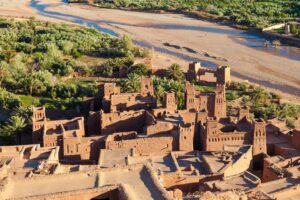
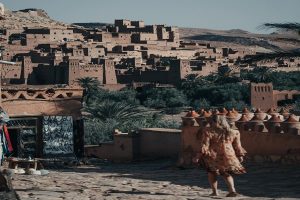
Ait Ben Haddou is a ksar — a fortified pre-Saharan settlement, traditionally built to protect a community and its trade goods along the historic caravan routes that connected sub-Saharan Africa with Marrakech and the Mediterranean. The complex consists of dozens of kasbahs (individual fortified family residences) clustered together within outer defensive walls, built almost entirely from rammed earth (pisé), straw, and wood in a construction technique known locally as tabout. The result is a structure that appears to grow directly out of the surrounding hillside, its high towers and crenellated walls a deep red-ochre that intensifies dramatically at sunrise and sunset.
The ksar sits on the western bank of the Ounila River, with the small modern village of Ait Ben Haddou on the opposite bank, where most of the original residents now live in more contemporary housing. A handful of families continue to live within the historic ksar itself, alongside small shops selling local crafts, paintings, and souvenirs to visitors. The entire site is listed as a UNESCO World Heritage Site, recognized for representing an outstanding example of the pre-Saharan earthen architectural tradition.
The History of Ait Ben Haddou
Ait Ben Haddou’s origins trace back at least to the 11th century, though the structures visible today are mostly the result of rebuilding and expansion through the 17th to 19th centuries, as earthen architecture requires continuous maintenance and rarely survives many centuries unmodified. The ksar’s location was strategically chosen: positioned on the trans-Saharan caravan route that carried gold, salt, ivory, and enslaved people between Timbuktu and Marrakech for over a thousand years, Ait Ben Haddou served as a fortified staging post and trading community for merchants making the arduous crossing of the Atlas Mountains and the Sahara.
The structure’s design reflects this defensive purpose directly: thick earthen walls that regulate temperature naturally (cool in summer, retaining warmth in winter), narrow defensible entrances, a central agadir (communal granary and refuge at the hilltop) where the community’s grain reserves and valuables were protected during raids, and dense, mazelike internal streets designed to slow and confuse any attacking force. By the mid-20th century, modern construction materials, the decline of caravan trade, and the practical challenges of maintaining earthen buildings led most residents to relocate across the river — but the ksar itself survived largely intact, in part because of its growing recognition as an architectural treasure. Its UNESCO inscription in 1987 formalized international recognition and brought resources for ongoing restoration.
Ait Ben Haddou as a Film Location
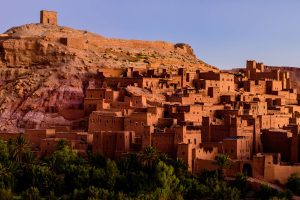
Ait Ben Haddou’s dramatic silhouette and the surrounding Ouarzazate region’s reliable sunshine and varied desert landscapes made this corner of Morocco one of the film industry’s preferred shooting locations from the 1960s onward, earning Ouarzazate the nickname “Ouallywood.” Ait Ben Haddou itself has appeared as a backdrop or filming location in more than 20 major productions, including Lawrence of Arabia (1962), Jesus of Nazareth (1977), The Mummy (1999), Gladiator (2000), Kingdom of Heaven (2005), Prince of Persia: The Sands of Time (2010), and most famously for a generation of younger visitors, Game of Thrones, where the ksar served as the city of Yunkai.
Walking through the site today, it is genuinely striking how recognizable certain angles and alleyways are from these productions — the main staircase climbing toward the agadir, the narrow internal passages, the view back across the river toward the modern village. For travellers specifically interested in the film connections, our dedicated Game of Thrones filming locations in Morocco guide covers Ait Ben Haddou alongside the other Moroccan locations used in the series.
How to Get to Ait Ben Haddou
From Marrakech (Most Common Route)
Ait Ben Haddou sits approximately 190 km from Marrakech, a drive of 3 to 3.5 hours via the N9 road over the spectacular Tizi n’Tichka pass — at 2,260 metres, the highest paved mountain pass road in North Africa. The drive itself is one of the highlights of any visit: switchback roads through the High Atlas, Berber villages clinging to terraced hillsides, walnut groves, and increasingly dramatic views as the road descends toward the pre-Saharan landscape on the southern side of the mountains. Most visitors combine Ait Ben Haddou with a stop in Ouarzazate, 30 km further along the same route, making this leg of a Marrakech–Merzouga desert tour the natural way to experience the site.
From Ouarzazate
Ouarzazate is the closest substantial town, 30 km / 30–40 minutes from Ait Ben Haddou. Grand taxis run between Ouarzazate and Ait Ben Haddou regularly, and several Ouarzazate-based tour operators offer half-day excursions to the site, often combined with a visit to the Atlas Film Studios. For travellers basing themselves in Ouarzazate for a night, an early morning visit to Ait Ben Haddou before the day-trip crowds arrive is one of the best ways to experience the site with relative quiet.
As Part of a Desert Tour
The overwhelming majority of visitors see Ait Ben Haddou as a stop on a multi-day Marrakech–Merzouga Sahara desert tour, typically on the first day of a 3-day circuit. This is genuinely the best way to experience the site for most travellers — it requires no additional logistics, it places the visit within the broader context of the Tizi n’Tichka crossing and the journey toward the desert, and a knowledgeable guide will know exactly when to arrive for the best light and how to navigate the ksar efficiently. Our desert tour from Marrakech and Morocco road trip guide cover this route in full.
Self-Drive
The N9 road to Ait Ben Haddou via the Tizi n’Tichka is fully paved and accessible in any standard rental car — no 4×4 required. The pass itself demands confident mountain driving (narrow sections, switchbacks, occasional slower trucks) but is entirely manageable in daylight and good weather. See our renting a car in Morocco guide for the full picture on self-drive logistics, insurance, and mountain driving conditions.
Visiting Ait Ben Haddou: What to Expect
Crossing the River
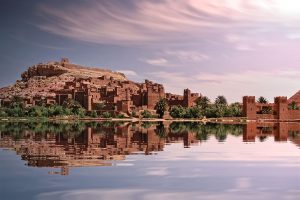
Approaching the ksar from the parking area on the modern village side, visitors cross the Ounila River — a shallow seasonal river that can usually be crossed via stepping stones or a low concrete causeway, though after heavy rain it occasionally requires a short detour or a small fee for a makeshift crossing assisted by locals. This first view across the water, with the full silhouette of the ksar rising on the far bank, is one of the most photographed compositions in Morocco and worth pausing for before crossing.
Inside the Ksar
Once inside, narrow alleys wind upward through the kasbah cluster, past small shops selling paintings (some made with local pigments including saffron and henna), carpets, and crafts, and past several of the still-inhabited family homes. The main route leads to the hilltop agadir — the communal fortified granary at the summit — from which the views over the Ounila Valley, the surrounding palm groves, and the distant Atlas foothills are genuinely spectacular and represent the best reward for the climb. The walk to the top takes 20–30 minutes at a relaxed pace and involves some uneven stone steps; sturdy footwear is recommended.
Entrance Fees and Practicalities
A small entrance fee (approximately 20–30 MAD / $2–3) applies for access to certain sections of the ksar, typically collected informally near the entrance. Local guides are often available at the entrance offering to lead visitors through the site for a negotiable fee — useful for historical context, though the site is straightforward enough to navigate independently if you prefer, particularly with a guide already accompanying you from a broader tour. There is no significant shade within the ksar itself, so sun protection matters, particularly for midday visits.
Best Time to Visit Ait Ben Haddou
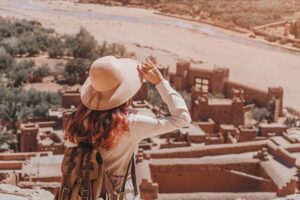
Light is everything at Ait Ben Haddou — the deep red-ochre of the rammed-earth walls transforms dramatically depending on the angle and quality of sunlight, and this should be the primary factor in timing your visit.
- Early morning (8–9:30am): The best combination of quality light and minimal crowds — most tour buses arrive from 10am onward. The morning sun catches the eastern face of the ksar directly, producing the richest color.
- Sunset (final hour before dusk): Spectacular light on the ksar’s western-facing walls, though this coincides with many tour groups also choosing this time, so expect more company than in early morning.
- Midday (11am–3pm): The least flattering light (flat, harsh overhead sun) and the busiest period with day-trip groups from Marrakech arriving in coordinated waves. Avoid if your schedule allows flexibility.
- Best months: March–May and October–November offer the most comfortable temperatures for the climb to the agadir. Summer (June–August) brings intense heat with little shade — visit only in early morning if travelling during this period.
For travellers with flexibility, an overnight stay in Ouarzazate or at one of the guesthouses near the ksar itself allows for both an early morning and a sunset visit — genuinely the best way to see the site at its most photogenic and least crowded, in both directions.
Where to Stay Near Ait Ben Haddou
Most visitors pass through Ait Ben Haddou as a stop rather than an overnight destination, continuing to Ouarzazate or further toward the Dades Valley. For travellers who want the early-morning and sunset light without the day-trip crowds, two options stand out:
- Guesthouses in the modern village: Several small family-run guesthouses sit directly across the river from the ksar, offering rooftop terraces with direct views of the site at sunrise and sunset — the single best way to experience the lighting without rushing
- Ouarzazate: Morocco’s “Hollywood of Africa” has a far wider range of accommodation, from budget guesthouses to international hotel chains, and makes an excellent base for both Ait Ben Haddou and the Atlas Film Studios, 30–40 minutes away
What Else to See Nearby
Ouarzazate and the Atlas Film Studios
Just 30 km from Ait Ben Haddou, Ouarzazate is home to the Atlas Corporation Studios — among the largest film studios in the world by land area — where many of the productions filmed in the region were shot. Guided tours of the studio backlots, with surviving sets from various productions, make a natural complement to a morning at Ait Ben Haddou.
Telouet Kasbah
A worthwhile detour for travellers with extra time: the ruined Glaoui family kasbah at Telouet, reached via a partially paved mountain road from the Tizi n’Tichka route, offers extraordinary surviving interior decoration — carved cedar ceilings and intricate plasterwork — within a crumbling, atmospheric shell that receives a fraction of Ait Ben Haddou’s visitor numbers.
The Dades Valley and Todra Gorge
Continuing east from Ait Ben Haddou and Ouarzazate, the Dades Valley and its dramatic Monkey Fingers rock formations, followed by the slot canyon of Todra Gorge, are the natural next stops on the classic southern circuit toward the Sahara desert at Merzouga. Our Morocco road trip guide details the full route, and the kasbahs of Morocco guide covers the broader architectural tradition that Ait Ben Haddou represents.
Visit Ait Ben Haddou the Right Way
We are a Berber family who has guided travellers through Ait Ben Haddou for fifteen years — we know exactly when to arrive, where the light is best, and how to make this stop one of the highlights of your trip rather than a rushed photo opportunity.
Plan My Southern Morocco Route →
We reply within 24 hours · No obligation
Frequently Asked Questions: Ait Ben Haddou
Is Ait Ben Haddou worth visiting?
Yes — it is widely considered one of the most important and most beautiful examples of pre-Saharan earthen architecture in the world, a UNESCO World Heritage Site, and one of the most photogenic locations in Morocco. Most travellers on the classic Marrakech–Sahara route consider it one of the highlights of the journey.
How long does it take to visit Ait Ben Haddou?
A focused visit takes 1.5–2 hours, including the river crossing, the walk through the ksar, and the climb to the agadir at the summit. Photographers and travellers who want to fully absorb the site should allow half a day, ideally split between an early morning and sunset visit if staying overnight nearby.
How far is Ait Ben Haddou from Marrakech?
Approximately 190 km, a drive of 3 to 3.5 hours via the N9 road over the Tizi n’Tichka pass. It is most commonly visited as the first stop on a multi-day Sahara desert tour rather than as a separate day trip, given the distance and the spectacular mountain drive involved.
Do people still live in Ait Ben Haddou?
Yes, a small number of families continue to live within the historic ksar, though most original residents relocated to the more modern village on the opposite riverbank in the mid-20th century as earthen construction became harder to maintain and modern materials became available.
Was Game of Thrones filmed at Ait Ben Haddou?
Yes — Ait Ben Haddou served as the city of Yunkai in the series. The wider Ouarzazate region was used extensively throughout the show’s production. Our Game of Thrones filming locations guide covers every Moroccan location used.
What should I wear to visit Ait Ben Haddou?
Comfortable, sturdy footwear is important given the uneven stone steps leading to the agadir. Sun protection (hat, sunscreen, water) matters as there is minimal shade within the ksar. Standard modest dress appropriate for Morocco’s medinas and historical sites applies. See our full Morocco packing list for complete guidance.